Collagen fleece-bound fibrin sealant is not associated with an increased risk of thromboembolic events or major bleeding after its use for haemostasis in surgery: a prospective multicentre surveillance study.
Mathias Birth, Joan Figueras, Stéphane Bernardini, Tine Troen, Klaus Günther, Darius Mirza, Frank Viborg Mortensen
{"title":"Collagen fleece-bound fibrin sealant is not associated with an increased risk of thromboembolic events or major bleeding after its use for haemostasis in surgery: a prospective multicentre surveillance study.","authors":"Mathias Birth, Joan Figueras, Stéphane Bernardini, Tine Troen, Klaus Günther, Darius Mirza, Frank Viborg Mortensen","doi":"10.1186/1754-9493-3-13","DOIUrl":null,"url":null,"abstract":"<p><strong>Background: </strong>Topical haemostatic agents are used to help achieve haemostasis during surgery when standard surgical techniques are insufficient. The objective of this study was to confirm the safety profile of an equine collagen patch coated with human fibrinogen and human thrombin with particular focus on the occurrence of thromboembolic events (TEEs), major bleeding and immunological events.</p><p><strong>Methods: </strong>This was a non-interventional, multicentre, prospective, surveillance study in which a collagen fleece-bound fibrin sealant was prescribed in accordance with its marketing authorisation. The decision to use the sealant was based solely on current surgical practice. All patients that received the sealant and provided informed consent were included. TEEs (any coagula-based occlusion in a vessel or the heart identified by symptomatic clinical signs and/or verified by paraclinical examination), major bleeding (any bleeding that required intervention), and immunological events (hypersensitivity including anaphylaxis) that occurred during surgery, post-operative hospital stay or 6 months of follow-up were reported as adverse events. The primary endpoint was the proportion of patients experiencing a confirmed TEE.</p><p><strong>Results: </strong>A total of 3098 patients were recruited at 227 centres in 12 European countries. The most frequent types of surgery were hepatic (33%), gastrointestinal (16%) and urological (14%) and the main indication for surgery was for primary (35%) or secondary (20%) malignancy. Forty-six patients (1.5%, 95% CI 1.1-2.0%) had at least one TEE during the study. The most commonly reported TEEs were pulmonary embolism or post-procedural pulmonary embolism (n = 18) and deep vein thrombosis (n = 9). There were 64 major bleedings in 62 patients and 9 immunological events in 8 patients.</p><p><strong>Conclusion: </strong>Collagen fleece-bound fibrin sealant does not appear to be associated with an increased risk of TEEs, major bleeding or immunological events in patients undergoing surgery.</p><p><strong>Trial registration: </strong>Clinicaltrials.gov number: NCT00285623.</p>","PeriodicalId":46782,"journal":{"name":"Patient Safety in Surgery","volume":"3 1","pages":"13"},"PeriodicalIF":2.1000,"publicationDate":"2009-06-22","publicationTypes":"Journal Article","fieldsOfStudy":null,"isOpenAccess":false,"openAccessPdf":"https://sci-hub-pdf.com/10.1186/1754-9493-3-13","citationCount":"21","resultStr":null,"platform":"Semanticscholar","paperid":null,"PeriodicalName":"Patient Safety in Surgery","FirstCategoryId":"1085","ListUrlMain":"https://doi.org/10.1186/1754-9493-3-13","RegionNum":0,"RegionCategory":null,"ArticlePicture":[],"TitleCN":null,"AbstractTextCN":null,"PMCID":null,"EPubDate":"","PubModel":"","JCR":"Q1","JCRName":"SURGERY","Score":null,"Total":0}
引用次数: 21
Abstract
Background: Topical haemostatic agents are used to help achieve haemostasis during surgery when standard surgical techniques are insufficient. The objective of this study was to confirm the safety profile of an equine collagen patch coated with human fibrinogen and human thrombin with particular focus on the occurrence of thromboembolic events (TEEs), major bleeding and immunological events.
Methods: This was a non-interventional, multicentre, prospective, surveillance study in which a collagen fleece-bound fibrin sealant was prescribed in accordance with its marketing authorisation. The decision to use the sealant was based solely on current surgical practice. All patients that received the sealant and provided informed consent were included. TEEs (any coagula-based occlusion in a vessel or the heart identified by symptomatic clinical signs and/or verified by paraclinical examination), major bleeding (any bleeding that required intervention), and immunological events (hypersensitivity including anaphylaxis) that occurred during surgery, post-operative hospital stay or 6 months of follow-up were reported as adverse events. The primary endpoint was the proportion of patients experiencing a confirmed TEE.
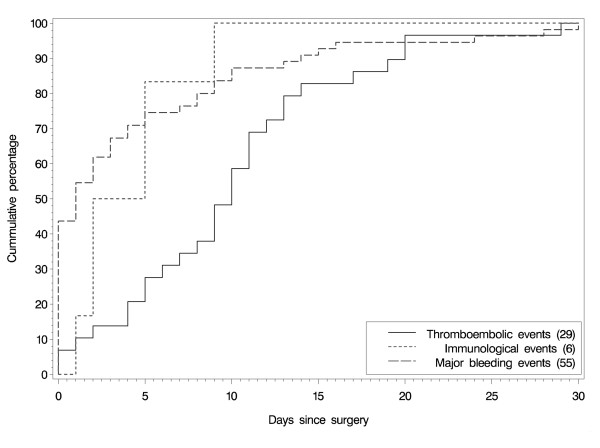
Results: A total of 3098 patients were recruited at 227 centres in 12 European countries. The most frequent types of surgery were hepatic (33%), gastrointestinal (16%) and urological (14%) and the main indication for surgery was for primary (35%) or secondary (20%) malignancy. Forty-six patients (1.5%, 95% CI 1.1-2.0%) had at least one TEE during the study. The most commonly reported TEEs were pulmonary embolism or post-procedural pulmonary embolism (n = 18) and deep vein thrombosis (n = 9). There were 64 major bleedings in 62 patients and 9 immunological events in 8 patients.
Conclusion: Collagen fleece-bound fibrin sealant does not appear to be associated with an increased risk of TEEs, major bleeding or immunological events in patients undergoing surgery.



 京公网安备 11010802042870号
京ICP备2023020795号-1
京公网安备 11010802042870号
京ICP备2023020795号-1

 分享
分享
 求助内容:
求助内容: 应助结果提醒方式:
 扫码关注我们
