{"title":"Densities and Viscosities of (Choline Chloride + Urea) Deep Eutectic Solvent and Its Aqueous Mixtures in the Temperature Range 293.15 K to 363.15 K","authors":"Anita Yadav, Siddharth Pandey*","doi":"10.1021/je5001796","DOIUrl":null,"url":null,"abstract":"<p >Deep eutectic solvents (DESs) have been regarded as one of the most promising environmentally benign and cost-effective alternatives to conventional ionic liquids and volatile organic solvents. Aqueous mixtures of DESs have the potential to afford modified properties for specific applications. Densities and dynamic viscosities of a common and popular DES composed of choline chloride and urea in 1:2 molar ratio, named reline, and its aqueous mixtures in the temperature range 293.15 K to 363.15 K are reported. A decrease in density with increasing temperature is found to follow a quadratic expression. Excess molar volumes of the aqueous mixtures of reline are found to be negative at all temperatures and compositions. The absolute excess molar volume is found to decrease, in general, as the temperature is increased from 293.15 K to 323.15 K. For temperatures above 323.15 K, the excess molar volume does not change much with further increase in temperature to 363.15 K. The temperature dependence of dynamic viscosity of aqueous mixtures of reline in the temperature range 293.15 K to 363.15 K at all compositions is found to be better described by a Vogel–Fulcher–Tamman (VFT) model as opposed to an Arrhenius expression. Excess logarithmic viscosities for aqueous mixtures of reline are found to be negative at most temperatures and compositions; however, they become positive at 353.15 K and 363.15 K. The excess logarithmic viscosities of aqueous reline mixtures are in stark contrast to that reported for aqueous mixtures of DES glyceline, composed of choline chloride and glycerol in the same mole ratio, where the excess logarithmic viscosities are positive. Facile interstitial accommodation of water within H-bonded reline network as opposed to formation of extensive H-bonding is proposed to be the reason for this experimental observation. The important role of the H-bond donor as a constituent of DES is amply highlighted as it controls the interactions present in a DES and its aqueous mixtures.</p>","PeriodicalId":42,"journal":{"name":"Journal of Chemical & Engineering Data","volume":"59 7","pages":"2221–2229"},"PeriodicalIF":2.1000,"publicationDate":"2014-06-13","publicationTypes":"Journal Article","fieldsOfStudy":null,"isOpenAccess":false,"openAccessPdf":"https://sci-hub-pdf.com/10.1021/je5001796","citationCount":"313","resultStr":null,"platform":"Semanticscholar","paperid":null,"PeriodicalName":"Journal of Chemical & Engineering Data","FirstCategoryId":"1","ListUrlMain":"https://pubs.acs.org/doi/10.1021/je5001796","RegionNum":3,"RegionCategory":"工程技术","ArticlePicture":[],"TitleCN":null,"AbstractTextCN":null,"PMCID":null,"EPubDate":"","PubModel":"","JCR":"Q3","JCRName":"CHEMISTRY, MULTIDISCIPLINARY","Score":null,"Total":0}
引用次数: 313
Abstract
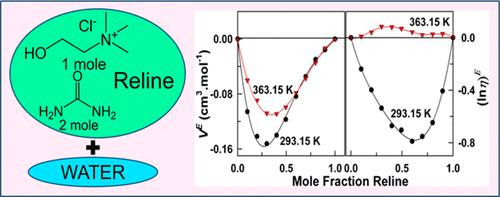
Deep eutectic solvents (DESs) have been regarded as one of the most promising environmentally benign and cost-effective alternatives to conventional ionic liquids and volatile organic solvents. Aqueous mixtures of DESs have the potential to afford modified properties for specific applications. Densities and dynamic viscosities of a common and popular DES composed of choline chloride and urea in 1:2 molar ratio, named reline, and its aqueous mixtures in the temperature range 293.15 K to 363.15 K are reported. A decrease in density with increasing temperature is found to follow a quadratic expression. Excess molar volumes of the aqueous mixtures of reline are found to be negative at all temperatures and compositions. The absolute excess molar volume is found to decrease, in general, as the temperature is increased from 293.15 K to 323.15 K. For temperatures above 323.15 K, the excess molar volume does not change much with further increase in temperature to 363.15 K. The temperature dependence of dynamic viscosity of aqueous mixtures of reline in the temperature range 293.15 K to 363.15 K at all compositions is found to be better described by a Vogel–Fulcher–Tamman (VFT) model as opposed to an Arrhenius expression. Excess logarithmic viscosities for aqueous mixtures of reline are found to be negative at most temperatures and compositions; however, they become positive at 353.15 K and 363.15 K. The excess logarithmic viscosities of aqueous reline mixtures are in stark contrast to that reported for aqueous mixtures of DES glyceline, composed of choline chloride and glycerol in the same mole ratio, where the excess logarithmic viscosities are positive. Facile interstitial accommodation of water within H-bonded reline network as opposed to formation of extensive H-bonding is proposed to be the reason for this experimental observation. The important role of the H-bond donor as a constituent of DES is amply highlighted as it controls the interactions present in a DES and its aqueous mixtures.
期刊介绍:
The Journal of Chemical & Engineering Data is a monthly journal devoted to the publication of data obtained from both experiment and computation, which are viewed as complementary. It is the only American Chemical Society journal primarily concerned with articles containing data on the phase behavior and the physical, thermodynamic, and transport properties of well-defined materials, including complex mixtures of known compositions. While environmental and biological samples are of interest, their compositions must be known and reproducible. As a result, adsorption on natural product materials does not generally fit within the scope of Journal of Chemical & Engineering Data.




 京公网安备 11010802042870号
京ICP备2023020795号-1
京公网安备 11010802042870号
京ICP备2023020795号-1

 分享
分享
 求助内容:
求助内容: 应助结果提醒方式:
 扫码关注我们
