Ye-Sung Kim, Soo-Young Choi, Hyun-Jeong Kwag, Jae-Moon Kim
{"title":"Classification and Serial Evolution of PLEDs.","authors":"Ye-Sung Kim, Soo-Young Choi, Hyun-Jeong Kwag, Jae-Moon Kim","doi":"10.3988/jcn.2006.2.3.179","DOIUrl":null,"url":null,"abstract":"<p><strong>Background and purpose: </strong>Periodic lateralized epileptiform discharges (PLEDs) are defined as spikes or sharp waves occurring at an approximately regular interval. PLEDs are subdivided into PLEDs proper and PLEDs plus in Reiher's classification, but since this does not sufficiently reflect the pleomorphism of PLEDs, we propose a new subclassification scheme of PLEDs, and discuss the relationship between them and clinical prognoses.</p><p><strong>Methods: </strong>Thirty-seven patients who had at least two available EEGs were included in this study. Each patient had structural brain lesions identified in brain CT/MRI: 237 EEGs from 37 patients were reviewed and the patterns of PLEDs were classified by electroencephalographic characteristics based on Reiher's classification. PLEDs proper of class 3 were subclassified into four categories: (1) simple, (2) benign, (3) vigorous, and (4) suppressed.</p><p><strong>Results: </strong>Most of the PLEDs that started with the vigorous or suppressed pattern of class 3 evolved into the simple or benign pattern of class 3 and subsequently changed into class 1 or class 2, finally intermingling with the neighboring background waves. PLEDs that started with the benign or simple pattern of class 3 rapidly changed into class 1 or 2. Patients showing the benign or simple pattern of class 3 exhibited a better clinical prognosis.</p><p><strong>Conclusions: </strong>PLEDs have five distinctive classes, and over time they evolve from malignant PLEDs plus to benign PLEDs proper before finally disappearing. It appears that those of class 3 have more diverse patterns, with the vigorous and suppressed patterns being the more malignant forms of PLEDs in this class.</p>","PeriodicalId":15432,"journal":{"name":"Journal of Clinical Neurology","volume":"2 3","pages":"179-85"},"PeriodicalIF":3.1000,"publicationDate":"2006-09-01","publicationTypes":"Journal Article","fieldsOfStudy":null,"isOpenAccess":false,"openAccessPdf":"https://sci-hub-pdf.com/10.3988/jcn.2006.2.3.179","citationCount":"6","resultStr":null,"platform":"Semanticscholar","paperid":null,"PeriodicalName":"Journal of Clinical Neurology","FirstCategoryId":"3","ListUrlMain":"https://doi.org/10.3988/jcn.2006.2.3.179","RegionNum":3,"RegionCategory":"医学","ArticlePicture":[],"TitleCN":null,"AbstractTextCN":null,"PMCID":null,"EPubDate":"2006/9/20 0:00:00","PubModel":"Epub","JCR":"Q2","JCRName":"CLINICAL NEUROLOGY","Score":null,"Total":0}
引用次数: 6
Abstract
Background and purpose: Periodic lateralized epileptiform discharges (PLEDs) are defined as spikes or sharp waves occurring at an approximately regular interval. PLEDs are subdivided into PLEDs proper and PLEDs plus in Reiher's classification, but since this does not sufficiently reflect the pleomorphism of PLEDs, we propose a new subclassification scheme of PLEDs, and discuss the relationship between them and clinical prognoses.
Methods: Thirty-seven patients who had at least two available EEGs were included in this study. Each patient had structural brain lesions identified in brain CT/MRI: 237 EEGs from 37 patients were reviewed and the patterns of PLEDs were classified by electroencephalographic characteristics based on Reiher's classification. PLEDs proper of class 3 were subclassified into four categories: (1) simple, (2) benign, (3) vigorous, and (4) suppressed.
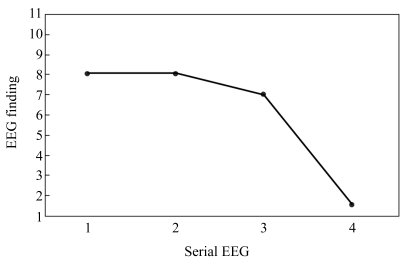
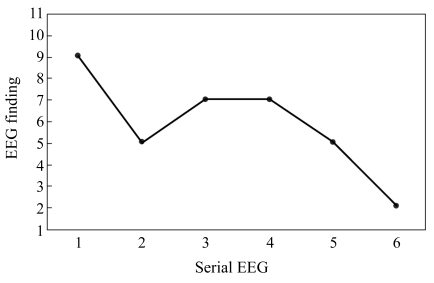
Results: Most of the PLEDs that started with the vigorous or suppressed pattern of class 3 evolved into the simple or benign pattern of class 3 and subsequently changed into class 1 or class 2, finally intermingling with the neighboring background waves. PLEDs that started with the benign or simple pattern of class 3 rapidly changed into class 1 or 2. Patients showing the benign or simple pattern of class 3 exhibited a better clinical prognosis.
Conclusions: PLEDs have five distinctive classes, and over time they evolve from malignant PLEDs plus to benign PLEDs proper before finally disappearing. It appears that those of class 3 have more diverse patterns, with the vigorous and suppressed patterns being the more malignant forms of PLEDs in this class.
期刊介绍:
The JCN aims to publish the cutting-edge research from around the world. The JCN covers clinical and translational research for physicians and researchers in the field of neurology. Encompassing the entire neurological diseases, our main focus is on the common disorders including stroke, epilepsy, Parkinson''s disease, dementia, multiple sclerosis, headache, and peripheral neuropathy. Any authors affiliated with an accredited biomedical institution may submit manuscripts of original articles, review articles, and letters to the editor. The JCN will allow clinical neurologists to enrich their knowledge of patient management, education, and clinical or experimental research, and hence their professionalism.




 京公网安备 11010802042870号
京ICP备2023020795号-1
京公网安备 11010802042870号
京ICP备2023020795号-1

 分享
分享
 求助内容:
求助内容: 应助结果提醒方式:
 扫码关注我们
