Mojca Jensterle, Marija Pfeifer, Matjaz Sever, Tomaz Kocjan
{"title":"Dihydrotachysterol intoxication treated with pamidronate: a case report.","authors":"Mojca Jensterle, Marija Pfeifer, Matjaz Sever, Tomaz Kocjan","doi":"10.1186/1757-1626-3-78","DOIUrl":null,"url":null,"abstract":"<p><strong>Introduction: </strong>Hypoparathyroidism is a chronic condition which requires a lifelong substitution with vitamin D analogues and careful monitoring. This is especially true for older patients and older compounds as dihydrotachysterol with longer half-life that might lead to long-lasting hypercalcemic episodes.</p><p><strong>Case presentation: </strong>A 74-year old male patient with postsurgical hypoparathyroidism who has been successfully supplemented with dihydrotachysterol (1.7 ml/day) for over 50 years presented with neuropsychiatric disturbances, constipation, renal insufficiency and polyuria. Laboratory investigation demonstrated serum calcium 3.7 mmol/L, serum creatinine 180 micromol/L, urine calcium excretion 1.1 mmol/mmol of the creatinine, normal 25 OH vitamin D3 and low parathormone and 1,25 di OH vitamin D3. Careful history revealed that he has been erroneously taking 2.5 ml of dihydrotachysterol per day for at least 6 to 8 weeks that caused vitamin D intoxication and symptomatic hypercalcemia. He was treated with intravenous saline infusion, prednisolone and 60 mg of intravenous sodium pamidronate. On the fourth day after admission serum calcium dropped rapidly within the reference range. The treatment for hypoparathyroidism had to be reinstituted 10 days after dihydrotachysterol had been discontinued when the patient was switched to shorter acting calcitriol.</p><p><strong>Conclusions: </strong>Here we reported that the immediate use of pamidronate in addition to classic treatment of dihydrotachysterol intoxication with intravenous saline, diuretics and glucocorticoids is an effective treatment choice that leads to rapid resolution of hypercalcemia.</p>","PeriodicalId":87572,"journal":{"name":"Cases journal","volume":"3 ","pages":"78"},"PeriodicalIF":0.0000,"publicationDate":"2010-03-26","publicationTypes":"Journal Article","fieldsOfStudy":null,"isOpenAccess":false,"openAccessPdf":"https://sci-hub-pdf.com/10.1186/1757-1626-3-78","citationCount":"13","resultStr":null,"platform":"Semanticscholar","paperid":null,"PeriodicalName":"Cases journal","FirstCategoryId":"1085","ListUrlMain":"https://doi.org/10.1186/1757-1626-3-78","RegionNum":0,"RegionCategory":null,"ArticlePicture":[],"TitleCN":null,"AbstractTextCN":null,"PMCID":null,"EPubDate":"","PubModel":"","JCR":"","JCRName":"","Score":null,"Total":0}
引用次数: 13
Abstract
Introduction: Hypoparathyroidism is a chronic condition which requires a lifelong substitution with vitamin D analogues and careful monitoring. This is especially true for older patients and older compounds as dihydrotachysterol with longer half-life that might lead to long-lasting hypercalcemic episodes.
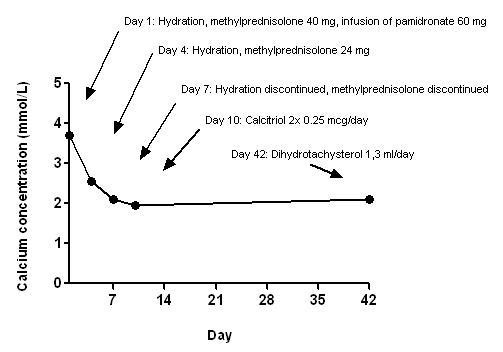
Case presentation: A 74-year old male patient with postsurgical hypoparathyroidism who has been successfully supplemented with dihydrotachysterol (1.7 ml/day) for over 50 years presented with neuropsychiatric disturbances, constipation, renal insufficiency and polyuria. Laboratory investigation demonstrated serum calcium 3.7 mmol/L, serum creatinine 180 micromol/L, urine calcium excretion 1.1 mmol/mmol of the creatinine, normal 25 OH vitamin D3 and low parathormone and 1,25 di OH vitamin D3. Careful history revealed that he has been erroneously taking 2.5 ml of dihydrotachysterol per day for at least 6 to 8 weeks that caused vitamin D intoxication and symptomatic hypercalcemia. He was treated with intravenous saline infusion, prednisolone and 60 mg of intravenous sodium pamidronate. On the fourth day after admission serum calcium dropped rapidly within the reference range. The treatment for hypoparathyroidism had to be reinstituted 10 days after dihydrotachysterol had been discontinued when the patient was switched to shorter acting calcitriol.
Conclusions: Here we reported that the immediate use of pamidronate in addition to classic treatment of dihydrotachysterol intoxication with intravenous saline, diuretics and glucocorticoids is an effective treatment choice that leads to rapid resolution of hypercalcemia.



 京公网安备 11010802042870号
京ICP备2023020795号-1
京公网安备 11010802042870号
京ICP备2023020795号-1

 分享
分享

 求助内容:
求助内容: 应助结果提醒方式:
 扫码关注我们
