Yuri Tulchinsky, Mark A. Iron, Mark Botoshansky, Mark Gandelman
{"title":"Nitrenium ions as ligands for transition metals","authors":"Yuri Tulchinsky, Mark A. Iron, Mark Botoshansky, Mark Gandelman","doi":"10.1038/nchem.1068","DOIUrl":null,"url":null,"abstract":"Unlike N-heterocyclic carbenes (NHCs), which are now used ubiquitously in metal-based chemistry, the nitrogen-derived analogue (in which a carbon is replaced with the isoelectronic nitrogen cation, a nitrenium ion) has remained elusive as a ligand for metals. This is especially intriguing, because several other main-group analogues of NHCs have been prepared, and have been shown to coordinate with transition-metal complexes. Here, we describe the preparation of several N-heterocyclic nitrenium ions that are isoelectronic and isostructural to NHCs, and study their ligand properties. The formation of relatively strong nitrenium–metal bonds is unambiguously confirmed, in solution by selective 15N-labelling experiments, and in the solid state by X-ray crystallography. Experimental and computational studies of the electronic properties of this novel type of ligand suggest that they are poor σ-donors and good π-acceptors. Nitrenium salts have been known for more than 100 years. Despite being isoelectronic and isostructural to the ubiquitous N-heterocyclic carbene ligands and other main-group analogues, their coordination to metals has remained elusive. Here, the first examples of nitrenium ions as ligands for transition metals are described, along with investigations of their electronic properties.","PeriodicalId":18909,"journal":{"name":"Nature chemistry","volume":"3 7","pages":"525-531"},"PeriodicalIF":20.2000,"publicationDate":"2011-06-19","publicationTypes":"Journal Article","fieldsOfStudy":null,"isOpenAccess":false,"openAccessPdf":"https://sci-hub-pdf.com/10.1038/nchem.1068","citationCount":"71","resultStr":null,"platform":"Semanticscholar","paperid":null,"PeriodicalName":"Nature chemistry","FirstCategoryId":"92","ListUrlMain":"https://www.nature.com/articles/nchem.1068","RegionNum":1,"RegionCategory":"化学","ArticlePicture":[],"TitleCN":null,"AbstractTextCN":null,"PMCID":null,"EPubDate":"","PubModel":"","JCR":"Q1","JCRName":"CHEMISTRY, MULTIDISCIPLINARY","Score":null,"Total":0}
引用次数: 71
Abstract
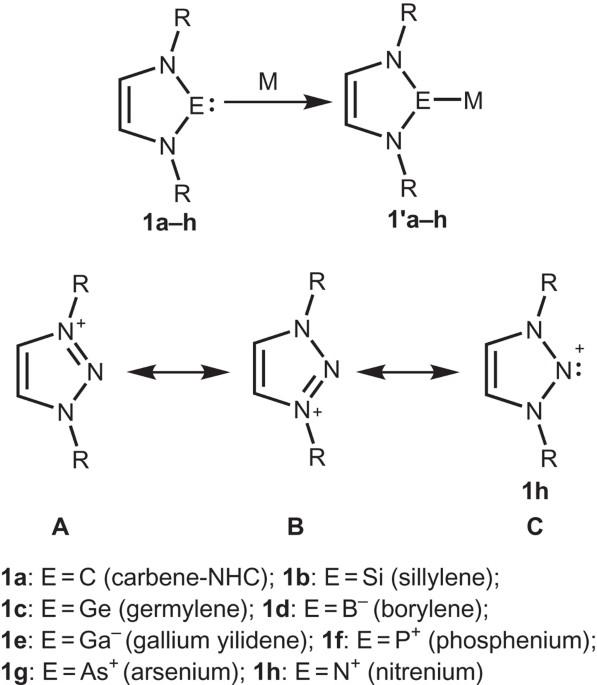
Unlike N-heterocyclic carbenes (NHCs), which are now used ubiquitously in metal-based chemistry, the nitrogen-derived analogue (in which a carbon is replaced with the isoelectronic nitrogen cation, a nitrenium ion) has remained elusive as a ligand for metals. This is especially intriguing, because several other main-group analogues of NHCs have been prepared, and have been shown to coordinate with transition-metal complexes. Here, we describe the preparation of several N-heterocyclic nitrenium ions that are isoelectronic and isostructural to NHCs, and study their ligand properties. The formation of relatively strong nitrenium–metal bonds is unambiguously confirmed, in solution by selective 15N-labelling experiments, and in the solid state by X-ray crystallography. Experimental and computational studies of the electronic properties of this novel type of ligand suggest that they are poor σ-donors and good π-acceptors. Nitrenium salts have been known for more than 100 years. Despite being isoelectronic and isostructural to the ubiquitous N-heterocyclic carbene ligands and other main-group analogues, their coordination to metals has remained elusive. Here, the first examples of nitrenium ions as ligands for transition metals are described, along with investigations of their electronic properties.
期刊介绍:
Nature Chemistry is a monthly journal that publishes groundbreaking and significant research in all areas of chemistry. It covers traditional subjects such as analytical, inorganic, organic, and physical chemistry, as well as a wide range of other topics including catalysis, computational and theoretical chemistry, and environmental chemistry.
The journal also features interdisciplinary research at the interface of chemistry with biology, materials science, nanotechnology, and physics. Manuscripts detailing such multidisciplinary work are encouraged, as long as the central theme pertains to chemistry.
Aside from primary research, Nature Chemistry publishes review articles, news and views, research highlights from other journals, commentaries, book reviews, correspondence, and analysis of the broader chemical landscape. It also addresses crucial issues related to education, funding, policy, intellectual property, and the societal impact of chemistry.
Nature Chemistry is dedicated to ensuring the highest standards of original research through a fair and rigorous review process. It offers authors maximum visibility for their papers, access to a broad readership, exceptional copy editing and production standards, rapid publication, and independence from academic societies and other vested interests.
Overall, Nature Chemistry aims to be the authoritative voice of the global chemical community.



 京公网安备 11010802042870号
京ICP备2023020795号-1
京公网安备 11010802042870号
京ICP备2023020795号-1

 分享
分享
 求助内容:
求助内容: 应助结果提醒方式:
 扫码关注我们
