Ji Hee Yu, Jenie Yoonoo Hwang, Mi-Seon Shin, Chang Hee Jung, Eun Hee Kim, Sang Ah Lee, Eun Hee Koh, Woo Je Lee, Min-Seon Kim, Joong-Yeol Park, Ki-Up Lee
{"title":"The prevalence of peripheral arterial disease in korean patients with type 2 diabetes mellitus attending a university hospital.","authors":"Ji Hee Yu, Jenie Yoonoo Hwang, Mi-Seon Shin, Chang Hee Jung, Eun Hee Kim, Sang Ah Lee, Eun Hee Koh, Woo Je Lee, Min-Seon Kim, Joong-Yeol Park, Ki-Up Lee","doi":"10.4093/dmj.2011.35.5.543","DOIUrl":null,"url":null,"abstract":"<p><strong>Background: </strong>Peripheral arterial disease (PAD) is a common manifestation of systemic atherosclerosis and is associated with significant morbidity and mortality. Diabetes is known to increase the risk of PAD two- to four-fold. The prevalence of PAD in Korean diabetic patients has not been established. In this study, we investigated the prevalence of PAD in Korean patients with type 2 diabetes attending a large university hospital and analyzed the factors associated with PAD.</p><p><strong>Methods: </strong>A total of 2,002 patients with type 2 diabetes who underwent ankle-brachial index (ABI) measurement in an outpatient clinic were enrolled. PAD was defined as an ABI ≤0.9. Clinical characteristics of 64 patients with PAD were compared with those of 192 age- and sex-matched control patients without PAD.</p><p><strong>Results: </strong>Of the 2,002 type 2 diabetic patients, 64 (3.2%) were diagnosed as having PAD. PAD was associated with higher prevalences of retinopathy, nephropathy, neuropathy, cerebrovascular and coronary artery disease. Patients with PAD had higher systolic blood pressure and serum triglyceride level and reported higher pack-years of smoking. Multivariate analysis showed that the presence of micro- and macrovascular complications and high systolic blood pressure are factors independently associated with PAD.</p><p><strong>Conclusion: </strong>The prevalence of PAD in diabetic patients was 3.2%, suggesting that the prevalence in Korean diabetic patients is lower than that of patients in Western countries.</p>","PeriodicalId":11153,"journal":{"name":"Diabetes & Metabolism Journal","volume":"35 5","pages":"543-50"},"PeriodicalIF":8.5000,"publicationDate":"2011-10-01","publicationTypes":"Journal Article","fieldsOfStudy":null,"isOpenAccess":false,"openAccessPdf":"https://ftp.ncbi.nlm.nih.gov/pub/pmc/oa_pdf/b2/d3/dmj-35-543.PMC3221031.pdf","citationCount":"0","resultStr":null,"platform":"Semanticscholar","paperid":null,"PeriodicalName":"Diabetes & Metabolism Journal","FirstCategoryId":"3","ListUrlMain":"https://doi.org/10.4093/dmj.2011.35.5.543","RegionNum":2,"RegionCategory":"医学","ArticlePicture":[],"TitleCN":null,"AbstractTextCN":null,"PMCID":null,"EPubDate":"2011/10/31 0:00:00","PubModel":"Epub","JCR":"Q1","JCRName":"ENDOCRINOLOGY & METABOLISM","Score":null,"Total":0}
引用次数: 0
Abstract
Background: Peripheral arterial disease (PAD) is a common manifestation of systemic atherosclerosis and is associated with significant morbidity and mortality. Diabetes is known to increase the risk of PAD two- to four-fold. The prevalence of PAD in Korean diabetic patients has not been established. In this study, we investigated the prevalence of PAD in Korean patients with type 2 diabetes attending a large university hospital and analyzed the factors associated with PAD.
Methods: A total of 2,002 patients with type 2 diabetes who underwent ankle-brachial index (ABI) measurement in an outpatient clinic were enrolled. PAD was defined as an ABI ≤0.9. Clinical characteristics of 64 patients with PAD were compared with those of 192 age- and sex-matched control patients without PAD.
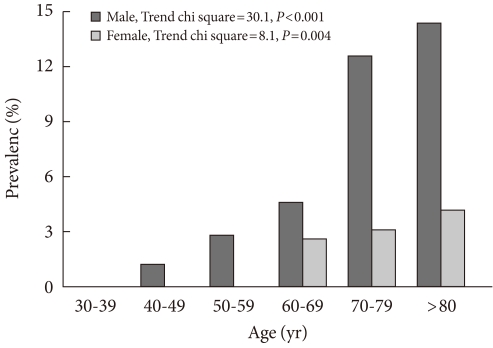
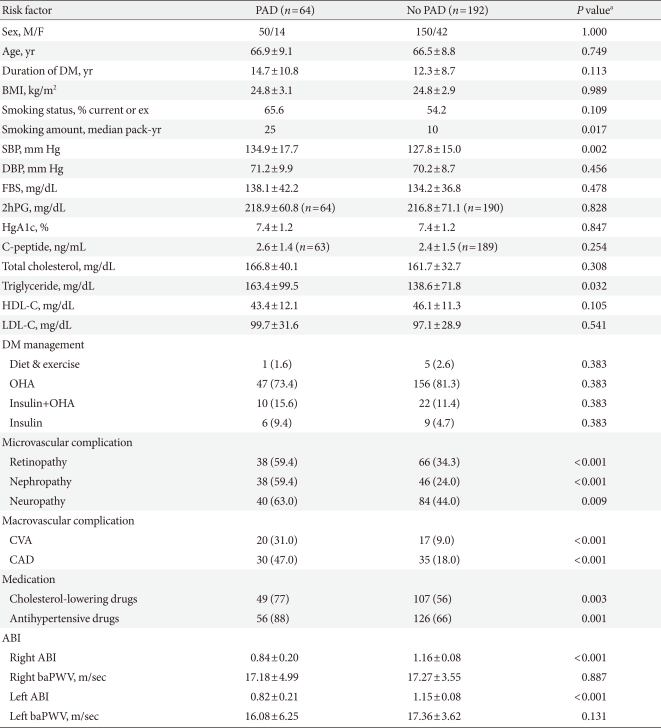
Results: Of the 2,002 type 2 diabetic patients, 64 (3.2%) were diagnosed as having PAD. PAD was associated with higher prevalences of retinopathy, nephropathy, neuropathy, cerebrovascular and coronary artery disease. Patients with PAD had higher systolic blood pressure and serum triglyceride level and reported higher pack-years of smoking. Multivariate analysis showed that the presence of micro- and macrovascular complications and high systolic blood pressure are factors independently associated with PAD.
Conclusion: The prevalence of PAD in diabetic patients was 3.2%, suggesting that the prevalence in Korean diabetic patients is lower than that of patients in Western countries.
背景:外周动脉疾病(PAD)是全身性动脉粥样硬化的常见表现,与严重的发病率和死亡率相关。众所周知,糖尿病会使 PAD 的风险增加两到四倍。韩国糖尿病患者的 PAD 患病率尚未确定。在这项研究中,我们调查了在一家大型大学医院就诊的韩国 2 型糖尿病患者中 PAD 的患病率,并分析了与 PAD 相关的因素:共有 2,002 名 2 型糖尿病患者在门诊接受了踝肱指数(ABI)测量。ABI≤0.9即为PAD。将 64 名 PAD 患者的临床特征与 192 名年龄和性别匹配、无 PAD 的对照组患者的临床特征进行了比较:结果:在 2,002 名 2 型糖尿病患者中,有 64 人(3.2%)被诊断为患有 PAD。PAD 与视网膜病变、肾病、神经病变、脑血管疾病和冠状动脉疾病的发病率较高有关。PAD 患者的收缩压和血清甘油三酯水平较高,吸烟年数也较多。多变量分析表明,微血管和大血管并发症的存在以及高收缩压是与 PAD 独立相关的因素:结论:糖尿病患者的 PAD 患病率为 3.2%,表明韩国糖尿病患者的患病率低于西方国家。
期刊介绍:
The aims of the Diabetes & Metabolism Journal are to contribute to the cure of and education about diabetes mellitus, and the advancement of diabetology through the sharing of scientific information on the latest developments in diabetology among members of the Korean Diabetes Association and other international societies.
The Journal publishes articles on basic and clinical studies, focusing on areas such as metabolism, epidemiology, pathogenesis, complications, and treatments relevant to diabetes mellitus. It also publishes articles covering obesity and cardiovascular disease. Articles on translational research and timely issues including ubiquitous care or new technology in the management of diabetes and metabolic disorders are welcome. In addition, genome research, meta-analysis, and randomized controlled studies are welcome for publication.
The editorial board invites articles from international research or clinical study groups. Publication is determined by the editors and peer reviewers, who are experts in their specific fields of diabetology.




 京公网安备 11010802042870号
京ICP备2023020795号-1
京公网安备 11010802042870号
京ICP备2023020795号-1

 分享
分享
 求助内容:
求助内容: 应助结果提醒方式:
 扫码关注我们
