Antibacterial activity of Thymus maroccanus and Thymus broussonetii essential oils against nosocomial infection – bacteria and their synergistic potential with antibiotics
Mariam Fadli , Asmaa Saad , Sami Sayadi , Jacqueline Chevalier , Nour-Eddine Mezrioui , Jean-Marie Pagès , Lahcen Hassani
{"title":"Antibacterial activity of Thymus maroccanus and Thymus broussonetii essential oils against nosocomial infection – bacteria and their synergistic potential with antibiotics","authors":"Mariam Fadli , Asmaa Saad , Sami Sayadi , Jacqueline Chevalier , Nour-Eddine Mezrioui , Jean-Marie Pagès , Lahcen Hassani","doi":"10.1016/j.phymed.2011.12.003","DOIUrl":null,"url":null,"abstract":"<div><p><span>The aim of this study was to evaluate the antibacterial effect of the association between conventional antibiotics and essential oils (EOs) of endemic Moroccan thyme species, </span><span><em>Thymus</em><em> maroccanus</em></span> and <em>T. broussonetii</em><span><span>, on antibiotic-resistant bacteria involved in nosocomial infections. Synergistic interactions between antibiotics (ciprofloxacin, gentamicin, </span>pristinamycin, and cefixime) and EOs, and between </span><em>T. maroccanus</em> and <em>T. Broussonetii</em><span> EOs were determined by the checkerboard test. Serial dilutions of two antimicrobial agents were mixed together so that each row (and column) contained a fixed amount of the first agent and increasing amounts of the second one.</span></p><p>The results indicate that the oils had a high inhibitory activity against tested bacteria, except for <span><em>Pseudomonas aeruginosa</em></span>. In parallel with the increase of cellular killing, the release of 260<!--> <span>nm-absorbing materials from bacterial cells<span>, treated with EOs, increased in response to oil concentration. Out of 80 combinations tested between EOs and antibiotics, 71% showed total synergism, 20% had partial synergistic interaction and 9% showed no effect. Combination with carvacrol, the major constituent of </span></span><em>T. maroccanus</em> and <em>T. broussonetii</em><span>, showed also an interesting synergistic effect in combination with ciprofloxacin. The effect on Gram-positive bacteria was more important than on Gram-negative bacteria.</span></p><p>These findings are very promising since the use of these combinations for nosocomial infections treatment is likely to reduce the minimum effective dose of the antibiotics, thus minimizing their possible toxic side effects and treatment cost. However, further investigations are needed to assess the potential for therapeutic application.</p></div>","PeriodicalId":20212,"journal":{"name":"Phytomedicine","volume":"19 5","pages":"Pages 464-471"},"PeriodicalIF":8.3000,"publicationDate":"2012-03-15","publicationTypes":"Journal Article","fieldsOfStudy":null,"isOpenAccess":false,"openAccessPdf":"https://sci-hub-pdf.com/10.1016/j.phymed.2011.12.003","citationCount":"182","resultStr":null,"platform":"Semanticscholar","paperid":null,"PeriodicalName":"Phytomedicine","FirstCategoryId":"3","ListUrlMain":"https://www.sciencedirect.com/science/article/pii/S0944711311005812","RegionNum":1,"RegionCategory":"医学","ArticlePicture":[],"TitleCN":null,"AbstractTextCN":null,"PMCID":null,"EPubDate":"","PubModel":"","JCR":"Q1","JCRName":"CHEMISTRY, MEDICINAL","Score":null,"Total":0}
引用次数: 182
Abstract
The aim of this study was to evaluate the antibacterial effect of the association between conventional antibiotics and essential oils (EOs) of endemic Moroccan thyme species, Thymus maroccanus and T. broussonetii, on antibiotic-resistant bacteria involved in nosocomial infections. Synergistic interactions between antibiotics (ciprofloxacin, gentamicin, pristinamycin, and cefixime) and EOs, and between T. maroccanus and T. Broussonetii EOs were determined by the checkerboard test. Serial dilutions of two antimicrobial agents were mixed together so that each row (and column) contained a fixed amount of the first agent and increasing amounts of the second one.
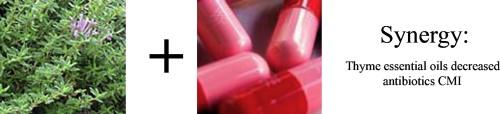
The results indicate that the oils had a high inhibitory activity against tested bacteria, except for Pseudomonas aeruginosa. In parallel with the increase of cellular killing, the release of 260 nm-absorbing materials from bacterial cells, treated with EOs, increased in response to oil concentration. Out of 80 combinations tested between EOs and antibiotics, 71% showed total synergism, 20% had partial synergistic interaction and 9% showed no effect. Combination with carvacrol, the major constituent of T. maroccanus and T. broussonetii, showed also an interesting synergistic effect in combination with ciprofloxacin. The effect on Gram-positive bacteria was more important than on Gram-negative bacteria.
These findings are very promising since the use of these combinations for nosocomial infections treatment is likely to reduce the minimum effective dose of the antibiotics, thus minimizing their possible toxic side effects and treatment cost. However, further investigations are needed to assess the potential for therapeutic application.
期刊介绍:
Phytomedicine is a therapy-oriented journal that publishes innovative studies on the efficacy, safety, quality, and mechanisms of action of specified plant extracts, phytopharmaceuticals, and their isolated constituents. This includes clinical, pharmacological, pharmacokinetic, and toxicological studies of herbal medicinal products, preparations, and purified compounds with defined and consistent quality, ensuring reproducible pharmacological activity. Founded in 1994, Phytomedicine aims to focus and stimulate research in this field and establish internationally accepted scientific standards for pharmacological studies, proof of clinical efficacy, and safety of phytomedicines.




 京公网安备 11010802042870号
京ICP备2023020795号-1
京公网安备 11010802042870号
京ICP备2023020795号-1

 分享
分享
 求助内容:
求助内容: 应助结果提醒方式:
 扫码关注我们
