A C Laska, T Kahan, A Hellblom, V Murray, M von Arbin
{"title":"A randomized controlled trial on very early speech and language therapy in acute stroke patients with aphasia.","authors":"A C Laska, T Kahan, A Hellblom, V Murray, M von Arbin","doi":"10.1159/000329835","DOIUrl":null,"url":null,"abstract":"<p><strong>Background: </strong>Aphasia affects one third of acute stroke patients. There is a considerable spontaneous recovery in aphasia, but impaired communication ability remains a great problem. Communication difficulties are an impediment to rehabilitation. Early treatment of the language deficits leading to increased communication ability would improve rehabilitation. The aim of this study is to elucidate the efficacy of very early speech and language therapy (SLT) in acute stroke patients with aphasia.</p><p><strong>Methods: </strong>A prospective, open, randomized, controlled trial was carried out with blinded endpoint evaluation of SLT, starting within 2 days of stroke onset and lasting for 21 days. 123 consecutive patients with acute, first-ever ischemic stroke and aphasia were randomized. The SLT treatment was Language Enrichment Therapy, and the aphasia tests used were the Norsk grunntest for afasi (NGA) and the Amsterdam-Nijmegen everyday language test (ANELT), both performed by speech pathologists, blinded for randomization.</p><p><strong>Results: </strong>The primary outcome, as measured by ANELT at day 21, was 1.3 in the actively treated patient group and 1.2 among controls. NGA led to similar results in both groups. Patients with a higher level of education (>12 years) improved more on ANELT by day 21 than those with <12 years of education (3.4 vs. 1.0, respectively). In 34 patients in the treatment group and 19 in the control group improvement was ≥1 on ANELT (p < 0.05). There was no difference in the degree of aphasia at baseline except for fluency, which was higher in the group responding to treatment.</p><p><strong>Conclusions: </strong>Very early intensive SLT with the Language Enrichment Therapy program over 21 days had no effect on the degree of aphasia in unselected acute aphasic stroke patients. In aphasic patients with more fluency, SLT resulted in a significant improvement as compared to controls. A higher educational level of >12 years was beneficial.</p>","PeriodicalId":45709,"journal":{"name":"Cerebrovascular Diseases Extra","volume":"1 1","pages":"66-74"},"PeriodicalIF":2.1000,"publicationDate":"2011-01-01","publicationTypes":"Journal Article","fieldsOfStudy":null,"isOpenAccess":false,"openAccessPdf":"https://ftp.ncbi.nlm.nih.gov/pub/pmc/oa_pdf/bb/5a/cee-0001-0066.PMC3343759.pdf","citationCount":"0","resultStr":null,"platform":"Semanticscholar","paperid":null,"PeriodicalName":"Cerebrovascular Diseases Extra","FirstCategoryId":"1085","ListUrlMain":"https://doi.org/10.1159/000329835","RegionNum":0,"RegionCategory":null,"ArticlePicture":[],"TitleCN":null,"AbstractTextCN":null,"PMCID":null,"EPubDate":"2011/7/12 0:00:00","PubModel":"Epub","JCR":"Q3","JCRName":"PERIPHERAL VASCULAR DISEASE","Score":null,"Total":0}
引用次数: 0
Abstract
Background: Aphasia affects one third of acute stroke patients. There is a considerable spontaneous recovery in aphasia, but impaired communication ability remains a great problem. Communication difficulties are an impediment to rehabilitation. Early treatment of the language deficits leading to increased communication ability would improve rehabilitation. The aim of this study is to elucidate the efficacy of very early speech and language therapy (SLT) in acute stroke patients with aphasia.
Methods: A prospective, open, randomized, controlled trial was carried out with blinded endpoint evaluation of SLT, starting within 2 days of stroke onset and lasting for 21 days. 123 consecutive patients with acute, first-ever ischemic stroke and aphasia were randomized. The SLT treatment was Language Enrichment Therapy, and the aphasia tests used were the Norsk grunntest for afasi (NGA) and the Amsterdam-Nijmegen everyday language test (ANELT), both performed by speech pathologists, blinded for randomization.
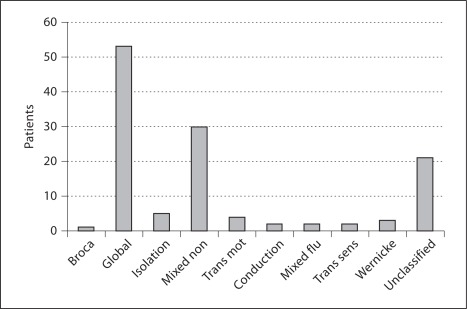
Results: The primary outcome, as measured by ANELT at day 21, was 1.3 in the actively treated patient group and 1.2 among controls. NGA led to similar results in both groups. Patients with a higher level of education (>12 years) improved more on ANELT by day 21 than those with <12 years of education (3.4 vs. 1.0, respectively). In 34 patients in the treatment group and 19 in the control group improvement was ≥1 on ANELT (p < 0.05). There was no difference in the degree of aphasia at baseline except for fluency, which was higher in the group responding to treatment.
Conclusions: Very early intensive SLT with the Language Enrichment Therapy program over 21 days had no effect on the degree of aphasia in unselected acute aphasic stroke patients. In aphasic patients with more fluency, SLT resulted in a significant improvement as compared to controls. A higher educational level of >12 years was beneficial.
期刊介绍:
This open access and online-only journal publishes original articles covering the entire spectrum of stroke and cerebrovascular research, drawing from a variety of specialties such as neurology, internal medicine, surgery, radiology, epidemiology, cardiology, hematology, psychology and rehabilitation. Offering an international forum, it meets the growing need for sophisticated, up-to-date scientific information on clinical data, diagnostic testing, and therapeutic issues. The journal publishes original contributions, reviews of selected topics as well as clinical investigative studies. All aspects related to clinical advances are considered, while purely experimental work appears only if directly relevant to clinical issues. Cerebrovascular Diseases Extra provides additional contents based on reviewed and accepted submissions to the main journal Cerebrovascular Diseases.





 京公网安备 11010802042870号
京ICP备2023020795号-1
京公网安备 11010802042870号
京ICP备2023020795号-1

 分享
分享
 求助内容:
求助内容: 应助结果提醒方式:
 扫码关注我们
