Reza Fazel-Rezai, Brendan Z Allison, Christoph Guger, Eric W Sellers, Sonja C Kleih, Andrea Kübler
{"title":"P300 brain computer interface: current challenges and emerging trends.","authors":"Reza Fazel-Rezai, Brendan Z Allison, Christoph Guger, Eric W Sellers, Sonja C Kleih, Andrea Kübler","doi":"10.3389/fneng.2012.00014","DOIUrl":null,"url":null,"abstract":"<p><p>A brain-computer interface (BCI) enables communication without movement based on brain signals measured with electroencephalography (EEG). BCIs usually rely on one of three types of signals: the P300 and other components of the event-related potential (ERP), steady state visual evoked potential (SSVEP), or event related desynchronization (ERD). Although P300 BCIs were introduced over twenty years ago, the past few years have seen a strong increase in P300 BCI research. This closed-loop BCI approach relies on the P300 and other components of the ERP, based on an oddball paradigm presented to the subject. In this paper, we overview the current status of P300 BCI technology, and then discuss new directions: paradigms for eliciting P300s; signal processing methods; applications; and hybrid BCIs. We conclude that P300 BCIs are quite promising, as several emerging directions have not yet been fully explored and could lead to improvements in bit rate, reliability, usability, and flexibility.</p>","PeriodicalId":73093,"journal":{"name":"Frontiers in neuroengineering","volume":"5 ","pages":"14"},"PeriodicalIF":0.0000,"publicationDate":"2012-07-17","publicationTypes":"Journal Article","fieldsOfStudy":null,"isOpenAccess":false,"openAccessPdf":"https://sci-hub-pdf.com/10.3389/fneng.2012.00014","citationCount":"320","resultStr":null,"platform":"Semanticscholar","paperid":null,"PeriodicalName":"Frontiers in neuroengineering","FirstCategoryId":"1085","ListUrlMain":"https://doi.org/10.3389/fneng.2012.00014","RegionNum":0,"RegionCategory":null,"ArticlePicture":[],"TitleCN":null,"AbstractTextCN":null,"PMCID":null,"EPubDate":"2012/1/1 0:00:00","PubModel":"eCollection","JCR":"","JCRName":"","Score":null,"Total":0}
引用次数: 320
Abstract
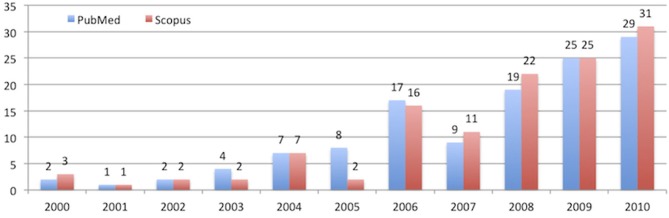
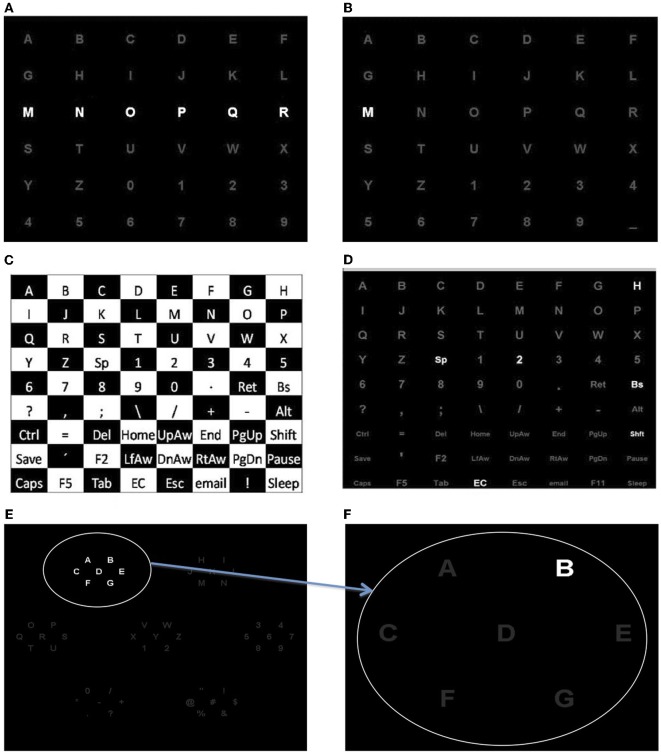
A brain-computer interface (BCI) enables communication without movement based on brain signals measured with electroencephalography (EEG). BCIs usually rely on one of three types of signals: the P300 and other components of the event-related potential (ERP), steady state visual evoked potential (SSVEP), or event related desynchronization (ERD). Although P300 BCIs were introduced over twenty years ago, the past few years have seen a strong increase in P300 BCI research. This closed-loop BCI approach relies on the P300 and other components of the ERP, based on an oddball paradigm presented to the subject. In this paper, we overview the current status of P300 BCI technology, and then discuss new directions: paradigms for eliciting P300s; signal processing methods; applications; and hybrid BCIs. We conclude that P300 BCIs are quite promising, as several emerging directions have not yet been fully explored and could lead to improvements in bit rate, reliability, usability, and flexibility.




 京公网安备 11010802042870号
京ICP备2023020795号-1
京公网安备 11010802042870号
京ICP备2023020795号-1

 分享
分享

 求助内容:
求助内容: 应助结果提醒方式:
 扫码关注我们
