On the search for potential anti-Trypanosoma cruzi drugs: Synthesis and biological evaluation of 2-hydroxy-3-methylamino and 1,2,3-triazolic naphthoquinoidal compounds obtained by click chemistry reactions
Eufrânio N. da Silva Júnior , Isadora M.M. de Melo , Emilay B.T. Diogo , Verenice A. Costa , José D. de Souza Filho , Wagner O. Valença , Celso A. Camara , Ronaldo N. de Oliveira , Alexandre S. de Araujo , Flávio S. Emery , Marcelo R. dos Santos , Carlos A. de Simone , Rubem F.S. Menna-Barreto , Solange L. de Castro
{"title":"On the search for potential anti-Trypanosoma cruzi drugs: Synthesis and biological evaluation of 2-hydroxy-3-methylamino and 1,2,3-triazolic naphthoquinoidal compounds obtained by click chemistry reactions","authors":"Eufrânio N. da Silva Júnior , Isadora M.M. de Melo , Emilay B.T. Diogo , Verenice A. Costa , José D. de Souza Filho , Wagner O. Valença , Celso A. Camara , Ronaldo N. de Oliveira , Alexandre S. de Araujo , Flávio S. Emery , Marcelo R. dos Santos , Carlos A. de Simone , Rubem F.S. Menna-Barreto , Solange L. de Castro","doi":"10.1016/j.ejmech.2012.03.039","DOIUrl":null,"url":null,"abstract":"<div><p><span>Five 2-hydroxy-3-substituted-aminomethyl naphthoquinones, nine 1,2,3-triazolic </span><em>para</em>-naphthoquinones, five <em>nor</em>-β-lapachone-based 1,2,3-triazoles, and several other naphthoquinonoid compounds were synthesized and evaluated against the infective bloodstream form of <span><em>Trypanosoma cruzi</em></span><span>, the etiological agent of Chagas disease<span>, continuing our screening program for new trypanocidal compounds. Among all the substances, </span></span><strong>16</strong>–<strong>18</strong>, <strong>23</strong>, <strong>25</strong>–<strong>29</strong> and <strong>30</strong>–<strong>33</strong><span> were herein described for the first time and fifteen substances were identified as more potent than the standard drug benznidazole, with IC</span><sub>50</sub>/24<!--> <!-->h values in the range of 10.9–101.5<!--> <!-->μM. Compounds <strong>14</strong> and <strong>19</strong><span> with Selectivity Index of 18.9 and 6.1 are important structures for further studies.</span></p></div>","PeriodicalId":314,"journal":{"name":"European Journal of Medicinal Chemistry","volume":"52 ","pages":"Pages 304-312"},"PeriodicalIF":5.9000,"publicationDate":"2012-06-01","publicationTypes":"Journal Article","fieldsOfStudy":null,"isOpenAccess":false,"openAccessPdf":"https://sci-hub-pdf.com/10.1016/j.ejmech.2012.03.039","citationCount":"58","resultStr":null,"platform":"Semanticscholar","paperid":null,"PeriodicalName":"European Journal of Medicinal Chemistry","FirstCategoryId":"3","ListUrlMain":"https://www.sciencedirect.com/science/article/pii/S0223523412002012","RegionNum":2,"RegionCategory":"医学","ArticlePicture":[],"TitleCN":null,"AbstractTextCN":null,"PMCID":null,"EPubDate":"","PubModel":"","JCR":"Q1","JCRName":"CHEMISTRY, MEDICINAL","Score":null,"Total":0}
引用次数: 58
Abstract
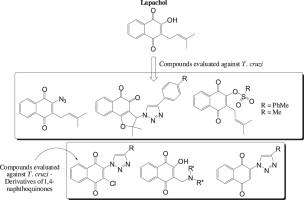
Five 2-hydroxy-3-substituted-aminomethyl naphthoquinones, nine 1,2,3-triazolic para-naphthoquinones, five nor-β-lapachone-based 1,2,3-triazoles, and several other naphthoquinonoid compounds were synthesized and evaluated against the infective bloodstream form of Trypanosoma cruzi, the etiological agent of Chagas disease, continuing our screening program for new trypanocidal compounds. Among all the substances, 16–18, 23, 25–29 and 30–33 were herein described for the first time and fifteen substances were identified as more potent than the standard drug benznidazole, with IC50/24 h values in the range of 10.9–101.5 μM. Compounds 14 and 19 with Selectivity Index of 18.9 and 6.1 are important structures for further studies.
期刊介绍:
The European Journal of Medicinal Chemistry is a global journal that publishes studies on all aspects of medicinal chemistry. It provides a medium for publication of original papers and also welcomes critical review papers.
A typical paper would report on the organic synthesis, characterization and pharmacological evaluation of compounds. Other topics of interest are drug design, QSAR, molecular modeling, drug-receptor interactions, molecular aspects of drug metabolism, prodrug synthesis and drug targeting. The journal expects manuscripts to present the rational for a study, provide insight into the design of compounds or understanding of mechanism, or clarify the targets.



 京公网安备 11010802042870号
京ICP备2023020795号-1
京公网安备 11010802042870号
京ICP备2023020795号-1

 分享
分享
 求助内容:
求助内容: 应助结果提醒方式:
 扫码关注我们
