Matthias Zunhammer, Hanna Eberle, Peter Eichhammer, Volker Busch
{"title":"Somatic symptoms evoked by exam stress in university students: the role of alexithymia, neuroticism, anxiety and depression.","authors":"Matthias Zunhammer, Hanna Eberle, Peter Eichhammer, Volker Busch","doi":"10.1371/journal.pone.0084911","DOIUrl":null,"url":null,"abstract":"<p><strong>Objective: </strong>The etiology of somatization is incompletely understood, but could be elucidated by models of psychosocial stress. Academic exam stress has effectively been applied as a naturalistic stress model, however its effect on somatization symptoms according to ICD-10 and DSM-IV criteria has not been reported so far. Baseline associations between somatization and personality traits, such as alexithymia, have been studied exhaustively. Nevertheless, it is largely unknown if personality traits have an explanatory value for stress induced somatization.</p><p><strong>Methods: </strong>This longitudinal, quasi-experimental study assessed the effects of university exams on somatization - and the reversal of effects after an exam-free period. Repeated-observations were obtained within 150 students, measuring symptom intensity before, during and after an exam period, according to the Screening for Somatoform Symptoms 7-day (SOMS-7d). Additionally, self-reports on health status were used to differentiate between medically explained and medically unexplained symptoms. Alexithymia, neuroticism, trait-anxiety and baseline depression were surveyed using the Toronto-Alexithymia Scale (TAS-20), the Big-Five Personality Interview (NEO-FFI), the State Trait Anxiety Inventory (STAI) and Beck's Depression Inventory (BDI-II). These traits were competitively tested for their ability to explain somatization increases under exam stress.</p><p><strong>Results: </strong>Somatization significantly increased across a wide range of symptoms under exam stress, while health reports pointed towards a reduction in acute infections and injuries. Neuroticism, alexithymia, trait anxiety and depression explained variance in somatization at baseline, but only neuroticism was associated with symptom increases under exam stress.</p><p><strong>Conclusion: </strong>Exam stress is an effective psychosocial stress model inducing somatization. A comprehensive quantitative description of bodily symptoms under exam stress is supplied. The results do not support the stress-alexithymia hypothesis, but favor neuroticism as a personality trait of importance for somatization.</p>","PeriodicalId":2,"journal":{"name":"ACS Applied Bio Materials","volume":" ","pages":"e84911"},"PeriodicalIF":4.7000,"publicationDate":"2013-12-18","publicationTypes":"Journal Article","fieldsOfStudy":null,"isOpenAccess":false,"openAccessPdf":"https://sci-hub-pdf.com/10.1371/journal.pone.0084911","citationCount":"77","resultStr":null,"platform":"Semanticscholar","paperid":null,"PeriodicalName":"ACS Applied Bio Materials","FirstCategoryId":"103","ListUrlMain":"https://doi.org/10.1371/journal.pone.0084911","RegionNum":0,"RegionCategory":null,"ArticlePicture":[],"TitleCN":null,"AbstractTextCN":null,"PMCID":null,"EPubDate":"2013/1/1 0:00:00","PubModel":"eCollection","JCR":"Q2","JCRName":"MATERIALS SCIENCE, BIOMATERIALS","Score":null,"Total":0}
引用次数: 77
Abstract
Objective: The etiology of somatization is incompletely understood, but could be elucidated by models of psychosocial stress. Academic exam stress has effectively been applied as a naturalistic stress model, however its effect on somatization symptoms according to ICD-10 and DSM-IV criteria has not been reported so far. Baseline associations between somatization and personality traits, such as alexithymia, have been studied exhaustively. Nevertheless, it is largely unknown if personality traits have an explanatory value for stress induced somatization.
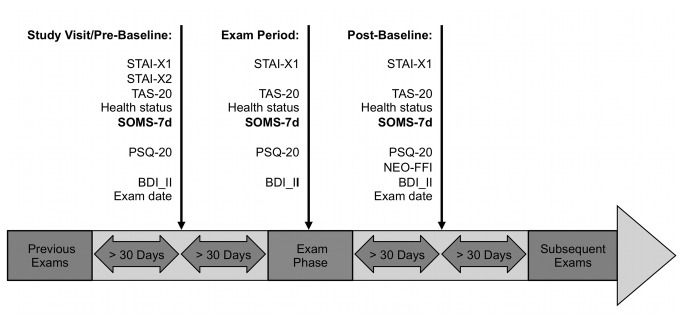
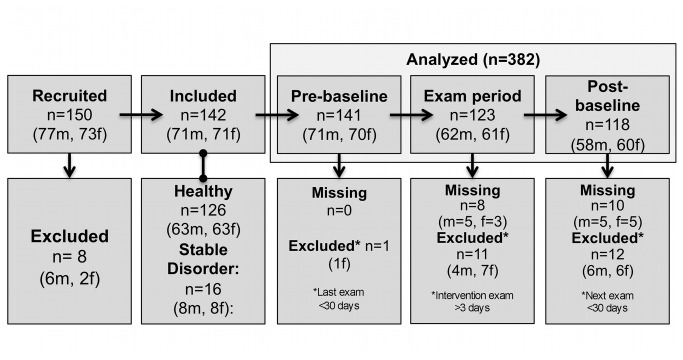
Methods: This longitudinal, quasi-experimental study assessed the effects of university exams on somatization - and the reversal of effects after an exam-free period. Repeated-observations were obtained within 150 students, measuring symptom intensity before, during and after an exam period, according to the Screening for Somatoform Symptoms 7-day (SOMS-7d). Additionally, self-reports on health status were used to differentiate between medically explained and medically unexplained symptoms. Alexithymia, neuroticism, trait-anxiety and baseline depression were surveyed using the Toronto-Alexithymia Scale (TAS-20), the Big-Five Personality Interview (NEO-FFI), the State Trait Anxiety Inventory (STAI) and Beck's Depression Inventory (BDI-II). These traits were competitively tested for their ability to explain somatization increases under exam stress.
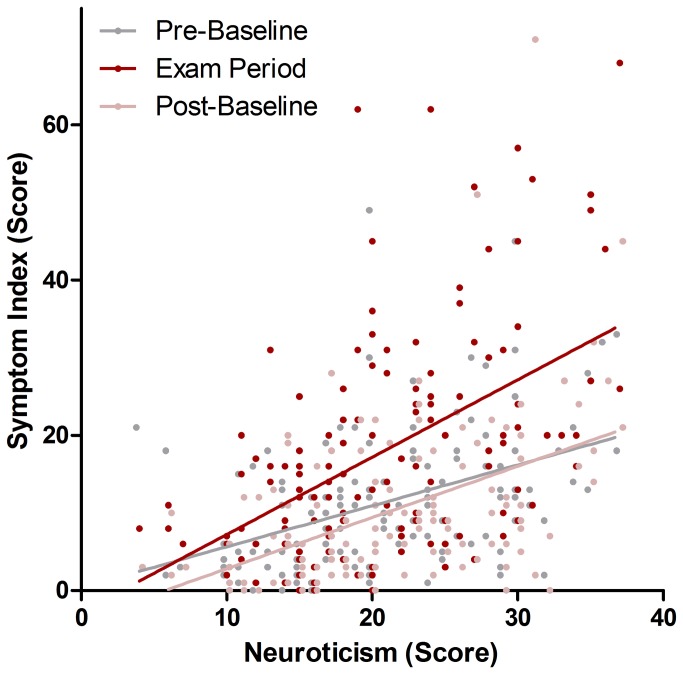
Results: Somatization significantly increased across a wide range of symptoms under exam stress, while health reports pointed towards a reduction in acute infections and injuries. Neuroticism, alexithymia, trait anxiety and depression explained variance in somatization at baseline, but only neuroticism was associated with symptom increases under exam stress.
Conclusion: Exam stress is an effective psychosocial stress model inducing somatization. A comprehensive quantitative description of bodily symptoms under exam stress is supplied. The results do not support the stress-alexithymia hypothesis, but favor neuroticism as a personality trait of importance for somatization.
期刊介绍:
ACS Applied Bio Materials is an interdisciplinary journal publishing original research covering all aspects of biomaterials and biointerfaces including and beyond the traditional biosensing, biomedical and therapeutic applications.
The journal is devoted to reports of new and original experimental and theoretical research of an applied nature that integrates knowledge in the areas of materials, engineering, physics, bioscience, and chemistry into important bio applications. The journal is specifically interested in work that addresses the relationship between structure and function and assesses the stability and degradation of materials under relevant environmental and biological conditions.




 京公网安备 11010802042870号
京ICP备2023020795号-1
京公网安备 11010802042870号
京ICP备2023020795号-1

 分享
分享
 求助内容:
求助内容: 应助结果提醒方式:
 扫码关注我们
