First-Principles Calculations of the Effects of Edge Functionalization and Size on the Band Gap of Be3N2 Nanoribbons: Implications for Nanoelectronic Devices
Aditya Dey, Bhumi A. Baraiya, Souren Adhikary, Prafulla K. Jha*
{"title":"First-Principles Calculations of the Effects of Edge Functionalization and Size on the Band Gap of Be3N2 Nanoribbons: Implications for Nanoelectronic Devices","authors":"Aditya Dey, Bhumi A. Baraiya, Souren Adhikary, Prafulla K. Jha*","doi":"10.1021/acsanm.0c02809","DOIUrl":null,"url":null,"abstract":"<p >First-principles calculations are carried out to address the structural stability and width-dependent electronic properties of the hydrogen (H)-, fluorine (F)-, and chlorine (Cl)-passivated armchair and zigzag nanoribbons (NRs) of beryllium nitride (Be<sub>3</sub>N<sub>2</sub>). The negative value of cohesive and edge formation energies implies the thermodynamic stability of NRs. With regard to the electronic properties, all NRs are direct band gap semiconductors and the band gap (ranging from 2.0 to 3.78 eV) strongly depends on the edge functionalization. The band gap inversely varies with the ribbon width for H-passivated NRs. Interestingly, band gap is almost width-independent for the F- and Cl-passivated NRs. The edge asymmetric effect (σ and π* orbitals) causes the lower band gap in F- and Cl-passivated NRs. The significant orbital contribution of atoms is analyzed from the projected density of states and partial charge density plots of the valence band maximum and conduction band minimum. The work function (WF) of NRs is quite sensitive to edge functionalization and confirms the tunable emission behavior of the electrons. The adjustable band gap and the WF of NRs approve their efficient applications in nanoelectronics such as field-emission and optoelectronic devices.</p>","PeriodicalId":6,"journal":{"name":"ACS Applied Nano Materials","volume":"4 1","pages":"493–502"},"PeriodicalIF":5.5000,"publicationDate":"2020-12-23","publicationTypes":"Journal Article","fieldsOfStudy":null,"isOpenAccess":false,"openAccessPdf":"https://sci-hub-pdf.com/10.1021/acsanm.0c02809","citationCount":"8","resultStr":null,"platform":"Semanticscholar","paperid":null,"PeriodicalName":"ACS Applied Nano Materials","FirstCategoryId":"88","ListUrlMain":"https://pubs.acs.org/doi/10.1021/acsanm.0c02809","RegionNum":2,"RegionCategory":"材料科学","ArticlePicture":[],"TitleCN":null,"AbstractTextCN":null,"PMCID":null,"EPubDate":"","PubModel":"","JCR":"Q2","JCRName":"MATERIALS SCIENCE, MULTIDISCIPLINARY","Score":null,"Total":0}
引用次数: 8
Abstract
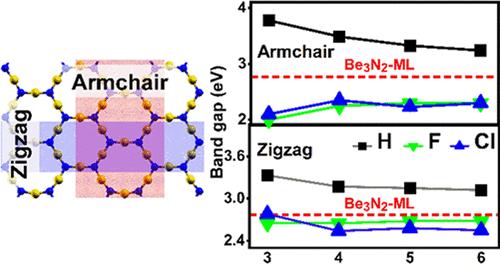
First-principles calculations are carried out to address the structural stability and width-dependent electronic properties of the hydrogen (H)-, fluorine (F)-, and chlorine (Cl)-passivated armchair and zigzag nanoribbons (NRs) of beryllium nitride (Be3N2). The negative value of cohesive and edge formation energies implies the thermodynamic stability of NRs. With regard to the electronic properties, all NRs are direct band gap semiconductors and the band gap (ranging from 2.0 to 3.78 eV) strongly depends on the edge functionalization. The band gap inversely varies with the ribbon width for H-passivated NRs. Interestingly, band gap is almost width-independent for the F- and Cl-passivated NRs. The edge asymmetric effect (σ and π* orbitals) causes the lower band gap in F- and Cl-passivated NRs. The significant orbital contribution of atoms is analyzed from the projected density of states and partial charge density plots of the valence band maximum and conduction band minimum. The work function (WF) of NRs is quite sensitive to edge functionalization and confirms the tunable emission behavior of the electrons. The adjustable band gap and the WF of NRs approve their efficient applications in nanoelectronics such as field-emission and optoelectronic devices.
期刊介绍:
ACS Applied Nano Materials is an interdisciplinary journal publishing original research covering all aspects of engineering, chemistry, physics and biology relevant to applications of nanomaterials. The journal is devoted to reports of new and original experimental and theoretical research of an applied nature that integrate knowledge in the areas of materials, engineering, physics, bioscience, and chemistry into important applications of nanomaterials.



 京公网安备 11010802042870号
京ICP备2023020795号-1
京公网安备 11010802042870号
京ICP备2023020795号-1

 分享
分享
 求助内容:
求助内容: 应助结果提醒方式:
 扫码关注我们
