Bahare Kiumarsi;Frank. L. Lewis;Mohammad-Bagher Naghibi-Sistani;Ali Karimpour
{"title":"Optimal Tracking Control of Unknown Discrete-Time Linear Systems Using Input-Output Measured Data","authors":"Bahare Kiumarsi;Frank. L. Lewis;Mohammad-Bagher Naghibi-Sistani;Ali Karimpour","doi":"10.1109/TCYB.2014.2384016","DOIUrl":null,"url":null,"abstract":"In this paper, an output-feedback solution to the infinite-horizon linear quadratic tracking (LQT) problem for unknown discrete-time systems is proposed. An augmented system composed of the system dynamics and the reference trajectory dynamics is constructed. The state of the augmented system is constructed from a limited number of measurements of the past input, output, and reference trajectory in the history of the augmented system. A novel Bellman equation is developed that evaluates the value function related to a fixed policy by using only the input, output, and reference trajectory data from the augmented system. By using approximate dynamic programming, a class of reinforcement learning methods, the LQT problem is solved online without requiring knowledge of the augmented system dynamics only by measuring the input, output, and reference trajectory from the augmented system. We develop both policy iteration (PI) and value iteration (VI) algorithms that converge to an optimal controller that require only measuring the input, output, and reference trajectory data. The convergence of the proposed PI and VI algorithms is shown. A simulation example is used to verify the effectiveness of the proposed control scheme.","PeriodicalId":13112,"journal":{"name":"IEEE Transactions on Cybernetics","volume":"45 12","pages":"2770-2779"},"PeriodicalIF":10.5000,"publicationDate":"2015-01-06","publicationTypes":"Journal Article","fieldsOfStudy":null,"isOpenAccess":false,"openAccessPdf":"https://sci-hub-pdf.com/10.1109/TCYB.2014.2384016","citationCount":"163","resultStr":null,"platform":"Semanticscholar","paperid":null,"PeriodicalName":"IEEE Transactions on Cybernetics","FirstCategoryId":"94","ListUrlMain":"https://ieeexplore.ieee.org/document/7001601/","RegionNum":1,"RegionCategory":"计算机科学","ArticlePicture":[],"TitleCN":null,"AbstractTextCN":null,"PMCID":null,"EPubDate":"","PubModel":"","JCR":"Q1","JCRName":"AUTOMATION & CONTROL SYSTEMS","Score":null,"Total":0}
引用次数: 163
Abstract
In this paper, an output-feedback solution to the infinite-horizon linear quadratic tracking (LQT) problem for unknown discrete-time systems is proposed. An augmented system composed of the system dynamics and the reference trajectory dynamics is constructed. The state of the augmented system is constructed from a limited number of measurements of the past input, output, and reference trajectory in the history of the augmented system. A novel Bellman equation is developed that evaluates the value function related to a fixed policy by using only the input, output, and reference trajectory data from the augmented system. By using approximate dynamic programming, a class of reinforcement learning methods, the LQT problem is solved online without requiring knowledge of the augmented system dynamics only by measuring the input, output, and reference trajectory from the augmented system. We develop both policy iteration (PI) and value iteration (VI) algorithms that converge to an optimal controller that require only measuring the input, output, and reference trajectory data. The convergence of the proposed PI and VI algorithms is shown. A simulation example is used to verify the effectiveness of the proposed control scheme.
期刊介绍:
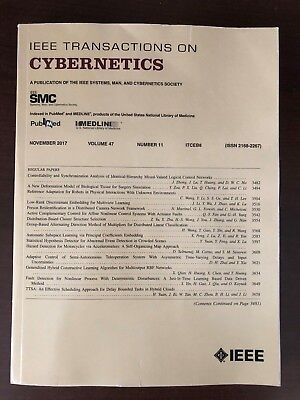
The scope of the IEEE Transactions on Cybernetics includes computational approaches to the field of cybernetics. Specifically, the transactions welcomes papers on communication and control across machines or machine, human, and organizations. The scope includes such areas as computational intelligence, computer vision, neural networks, genetic algorithms, machine learning, fuzzy systems, cognitive systems, decision making, and robotics, to the extent that they contribute to the theme of cybernetics or demonstrate an application of cybernetics principles.



 京公网安备 11010802042870号
京ICP备2023020795号-1
京公网安备 11010802042870号
京ICP备2023020795号-1

 分享
分享
 求助内容:
求助内容: 应助结果提醒方式:
 扫码关注我们
