{"title":"Combined influence of basal media and fibroblast growth factor on the expansion and differentiation capabilities of adipose-derived stem cells","authors":"Mark Ahearne , Joanne Lysaght , Amy P Lynch","doi":"10.1186/2045-9769-3-13","DOIUrl":null,"url":null,"abstract":"<div><h3>Background</h3><p>Interest in adipose-derived stem cells (ASCs) has increased in recent years due to their multi-linage differentiation capabilities. While much work has been done to optimize the differentiation media, few studies have focused on examining the influence of different expansion media on cell behavior. In this study, three basal media (low glucose Dulbecco’s modified Eagle’s medium (DMEM), high glucose DMEM and DMEM-F12) supplemented with or without fibroblast growth factor 2 (FGF) were examined to assess their suitability for expanding ASCs.</p></div><div><h3>Findings</h3><p>Flow cytometry, colony-forming unit assays (CFU-Fs) and differentiation assays were utilized to study cell behavior. High glucose media CFU-Fs produced fewest colonies while the addition of FGF increased colony size. By passage 2, the majority of cells were positive for CD44, 45, 73, 90 and 105 and negative for CD14, 31 and 45, indicating a mesenchymal phenotype. A sub-population of CD34 positive cells was present among passage 2 cells; however, by passage 4 the cells were negative for CD34. FGF has a negative effective on passage 4 ASC adipogenesis and high glucose media plus FGF-enhanced osteogenic capacity of passage 4 ASCs. FGF supplemented basal media were most suitable for chondrogenesis. High glucose media plus FGF appeared to be the most beneficial for priming ASCs to induce a keratocyte phenotype.</p></div><div><h3>Conclusions</h3><p>These findings demonstrate the reciprocal effect FGF and basal media have on ASCs. This research has implications for those interested regenerating bone, cartilage, cornea or adipose tissues.</p></div>","PeriodicalId":9811,"journal":{"name":"Cell Regeneration","volume":"3 1","pages":"Article 3:13"},"PeriodicalIF":4.7000,"publicationDate":"2014-01-01","publicationTypes":"Journal Article","fieldsOfStudy":null,"isOpenAccess":false,"openAccessPdf":"https://sci-hub-pdf.com/10.1186/2045-9769-3-13","citationCount":"1","resultStr":null,"platform":"Semanticscholar","paperid":null,"PeriodicalName":"Cell Regeneration","FirstCategoryId":"1085","ListUrlMain":"https://www.sciencedirect.com/science/article/pii/S2045976917300287","RegionNum":0,"RegionCategory":null,"ArticlePicture":[],"TitleCN":null,"AbstractTextCN":null,"PMCID":null,"EPubDate":"","PubModel":"","JCR":"Q2","JCRName":"CELL & TISSUE ENGINEERING","Score":null,"Total":0}
引用次数: 1
Abstract
Background
Interest in adipose-derived stem cells (ASCs) has increased in recent years due to their multi-linage differentiation capabilities. While much work has been done to optimize the differentiation media, few studies have focused on examining the influence of different expansion media on cell behavior. In this study, three basal media (low glucose Dulbecco’s modified Eagle’s medium (DMEM), high glucose DMEM and DMEM-F12) supplemented with or without fibroblast growth factor 2 (FGF) were examined to assess their suitability for expanding ASCs.
Findings
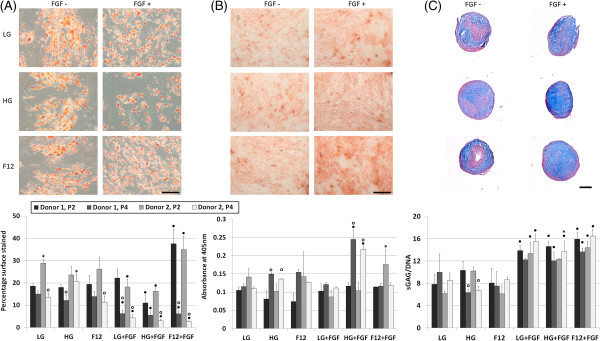
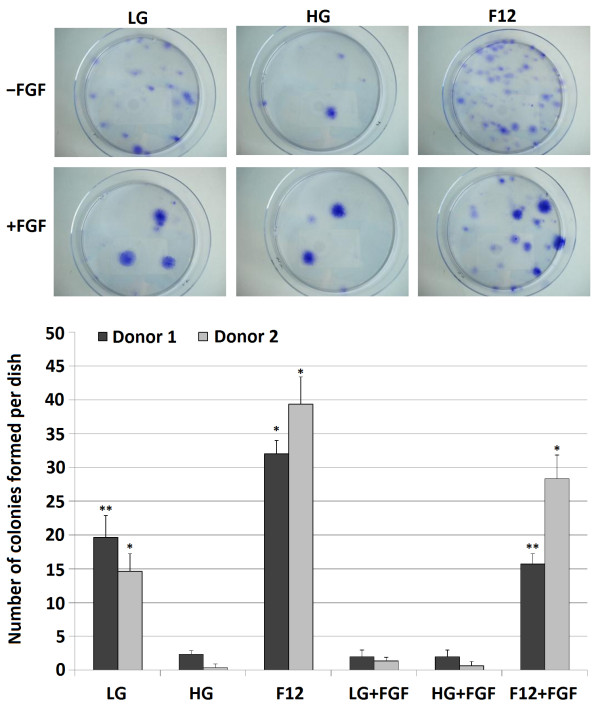
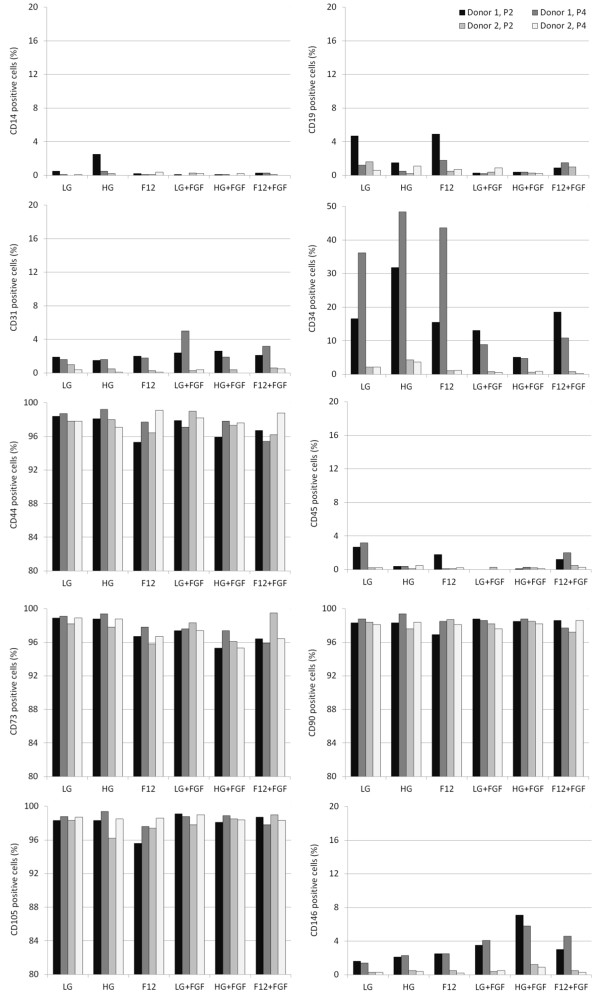
Flow cytometry, colony-forming unit assays (CFU-Fs) and differentiation assays were utilized to study cell behavior. High glucose media CFU-Fs produced fewest colonies while the addition of FGF increased colony size. By passage 2, the majority of cells were positive for CD44, 45, 73, 90 and 105 and negative for CD14, 31 and 45, indicating a mesenchymal phenotype. A sub-population of CD34 positive cells was present among passage 2 cells; however, by passage 4 the cells were negative for CD34. FGF has a negative effective on passage 4 ASC adipogenesis and high glucose media plus FGF-enhanced osteogenic capacity of passage 4 ASCs. FGF supplemented basal media were most suitable for chondrogenesis. High glucose media plus FGF appeared to be the most beneficial for priming ASCs to induce a keratocyte phenotype.
Conclusions
These findings demonstrate the reciprocal effect FGF and basal media have on ASCs. This research has implications for those interested regenerating bone, cartilage, cornea or adipose tissues.
Cell RegenerationBiochemistry, Genetics and Molecular Biology-Cell Biology
CiteScore
5.80
自引率
0.00%
发文量
42
审稿时长
35 days
期刊介绍:
Cell Regeneration aims to provide a worldwide platform for researches on stem cells and regenerative biology to develop basic science and to foster its clinical translation in medicine. Cell Regeneration welcomes reports on novel discoveries, theories, methods, technologies, and products in the field of stem cells and regenerative research, the journal is interested, but not limited to the following topics:
◎ Embryonic stem cells
◎ Induced pluripotent stem cells
◎ Tissue-specific stem cells
◎ Tissue or organ regeneration
◎ Methodology
◎ Biomaterials and regeneration
◎ Clinical translation or application in medicine



 京公网安备 11010802042870号
京ICP备2023020795号-1
京公网安备 11010802042870号
京ICP备2023020795号-1

 分享
分享
 求助内容:
求助内容: 应助结果提醒方式:
 扫码关注我们
