{"title":"ASK1 restores the antiviral activity of APOBEC3G by disrupting HIV-1 Vif-mediated counteraction.","authors":"Kei Miyakawa, Satoko Matsunaga, Kazuhiko Kanou, Atsushi Matsuzawa, Ryo Morishita, Ayumi Kudoh, Keisuke Shindo, Masaru Yokoyama, Hironori Sato, Hirokazu Kimura, Tomohiko Tamura, Naoki Yamamoto, Hidenori Ichijo, Akifumi Takaori-Kondo, Akihide Ryo","doi":"10.1038/ncomms7945","DOIUrl":null,"url":null,"abstract":"<p><p>APOBEC3G (A3G) is an innate antiviral restriction factor that strongly inhibits the replication of human immunodeficiency virus type 1 (HIV-1). An HIV-1 accessory protein, Vif, hijacks the host ubiquitin-proteasome system to execute A3G degradation. Identification of the host pathways that obstruct the action of Vif could provide a new strategy for blocking viral replication. We demonstrate here that the host protein ASK1 (apoptosis signal-regulating kinase 1) interferes with the counteraction by Vif and revitalizes A3G-mediated viral restriction. ASK1 binds the BC-box of Vif, thereby disrupting the assembly of the Vif-ubiquitin ligase complex. Consequently, ASK1 stabilizes A3G and promotes its incorporation into viral particles, ultimately reducing viral infectivity. Furthermore, treatment with the antiretroviral drug AZT (zidovudine) induces ASK1 expression and restores the antiviral activity of A3G in HIV-1-infected cells. This study thus demonstrates a distinct function of ASK1 in restoring the host antiviral system that can be enhanced by AZT treatment. </p>","PeriodicalId":19066,"journal":{"name":"Nature Communications","volume":" ","pages":"6945"},"PeriodicalIF":15.7000,"publicationDate":"2015-04-22","publicationTypes":"Journal Article","fieldsOfStudy":null,"isOpenAccess":false,"openAccessPdf":"https://sci-hub-pdf.com/10.1038/ncomms7945","citationCount":"31","resultStr":null,"platform":"Semanticscholar","paperid":null,"PeriodicalName":"Nature Communications","FirstCategoryId":"103","ListUrlMain":"https://doi.org/10.1038/ncomms7945","RegionNum":1,"RegionCategory":"综合性期刊","ArticlePicture":[],"TitleCN":null,"AbstractTextCN":null,"PMCID":null,"EPubDate":"","PubModel":"","JCR":"Q1","JCRName":"MULTIDISCIPLINARY SCIENCES","Score":null,"Total":0}
引用次数: 31
Abstract
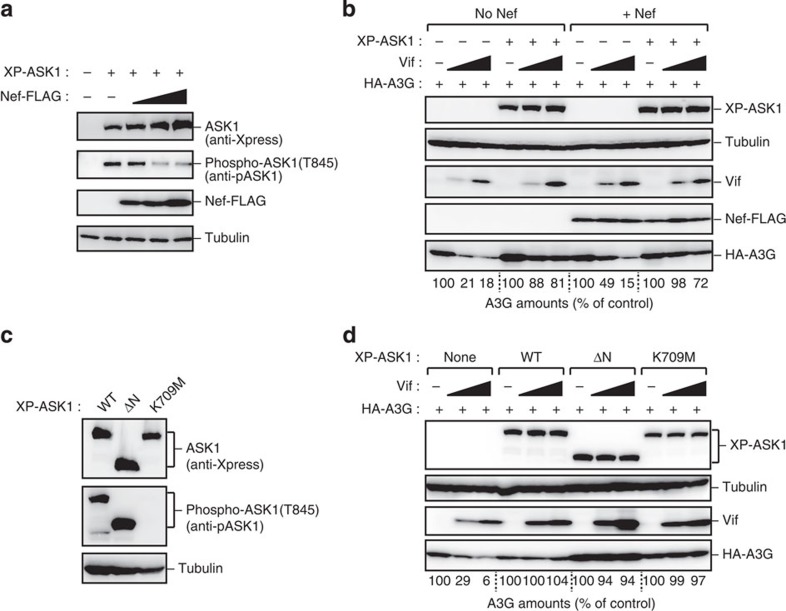
APOBEC3G (A3G) is an innate antiviral restriction factor that strongly inhibits the replication of human immunodeficiency virus type 1 (HIV-1). An HIV-1 accessory protein, Vif, hijacks the host ubiquitin-proteasome system to execute A3G degradation. Identification of the host pathways that obstruct the action of Vif could provide a new strategy for blocking viral replication. We demonstrate here that the host protein ASK1 (apoptosis signal-regulating kinase 1) interferes with the counteraction by Vif and revitalizes A3G-mediated viral restriction. ASK1 binds the BC-box of Vif, thereby disrupting the assembly of the Vif-ubiquitin ligase complex. Consequently, ASK1 stabilizes A3G and promotes its incorporation into viral particles, ultimately reducing viral infectivity. Furthermore, treatment with the antiretroviral drug AZT (zidovudine) induces ASK1 expression and restores the antiviral activity of A3G in HIV-1-infected cells. This study thus demonstrates a distinct function of ASK1 in restoring the host antiviral system that can be enhanced by AZT treatment.
期刊介绍:
Nature Communications, an open-access journal, publishes high-quality research spanning all areas of the natural sciences. Papers featured in the journal showcase significant advances relevant to specialists in each respective field. With a 2-year impact factor of 16.6 (2022) and a median time of 8 days from submission to the first editorial decision, Nature Communications is committed to rapid dissemination of research findings. As a multidisciplinary journal, it welcomes contributions from biological, health, physical, chemical, Earth, social, mathematical, applied, and engineering sciences, aiming to highlight important breakthroughs within each domain.





 京公网安备 11010802042870号
京ICP备2023020795号-1
京公网安备 11010802042870号
京ICP备2023020795号-1

 分享
分享
 求助内容:
求助内容: 应助结果提醒方式:
 扫码关注我们
