Hans-Christoph Diener, Peter Kropp, Thomas Dresler, Stefan Evers, Stefanie Förderreuther, Charly Gaul, Dagny Holle-Lee, Arne May, Uwe Niederberger, Sabrina Moll, Christoph Schankin, Christian Lampl
{"title":"Management of medication overuse (MO) and medication overuse headache (MOH) S1 guideline.","authors":"Hans-Christoph Diener, Peter Kropp, Thomas Dresler, Stefan Evers, Stefanie Förderreuther, Charly Gaul, Dagny Holle-Lee, Arne May, Uwe Niederberger, Sabrina Moll, Christoph Schankin, Christian Lampl","doi":"10.1186/s42466-022-00200-0","DOIUrl":null,"url":null,"abstract":"<p><strong>Introduction: </strong>Chronic headache due to the overuse of medication for the treatment of migraine attacks has a prevalence of 0.5-2.0%. This guideline provides guidance for the management of medication overuse (MO) and medication overuse headache (MOH).</p><p><strong>Recommendations: </strong>Treatment of headache due to overuse of analgesics or specific migraine medications involves several stages. Patients with medication overuse (MO) or medication overuse headache (MOH) should be educated about the relationship between frequent use of symptomatic headache medication and the transition from episodic to chronic migraine (chronification), with the aim of reducing and limiting the use of acute medication. In a second step, migraine prophylaxis should be initiated in patients with migraine and overuse of analgesics or specific migraine drugs. Topiramate, onabotulinumtoxinA and the monoclonal antibodies against CGRP or the CGRP-receptor are effective in patients with chronic migraine and medication overuse. In patients with tension-type headache, prophylaxis is performed with amitriptyline. Drug prophylaxis should be supplemented by non-drug interventions. For patients in whom education and prophylactic medication are not effective, pausing acute medication is recommended. This treatment can be performed in an outpatient, day hospital or inpatient setting. Patients with headache due to overuse of opioids should undergo inpatient withdrawal. The success rate of the stepped treatment approach is 50-70% after 6 to 12 months. A high relapse rate is observed in patients with opioid overuse. Tricyclic antidepressants, neuroleptics (antiemetics) and the administration of steroids are recommended for the treatment of withdrawal symptoms or headaches during the medication pause. Consistent patient education and further close monitoring reduce the risk of relapse.</p>","PeriodicalId":19169,"journal":{"name":"Neurological Research and Practice","volume":" ","pages":"37"},"PeriodicalIF":0.0000,"publicationDate":"2022-08-29","publicationTypes":"Journal Article","fieldsOfStudy":null,"isOpenAccess":false,"openAccessPdf":"https://www.ncbi.nlm.nih.gov/pmc/articles/PMC9422154/pdf/","citationCount":"9","resultStr":null,"platform":"Semanticscholar","paperid":null,"PeriodicalName":"Neurological Research and Practice","FirstCategoryId":"1085","ListUrlMain":"https://doi.org/10.1186/s42466-022-00200-0","RegionNum":0,"RegionCategory":null,"ArticlePicture":[],"TitleCN":null,"AbstractTextCN":null,"PMCID":null,"EPubDate":"","PubModel":"","JCR":"","JCRName":"","Score":null,"Total":0}
引用次数: 9
Abstract
Introduction: Chronic headache due to the overuse of medication for the treatment of migraine attacks has a prevalence of 0.5-2.0%. This guideline provides guidance for the management of medication overuse (MO) and medication overuse headache (MOH).
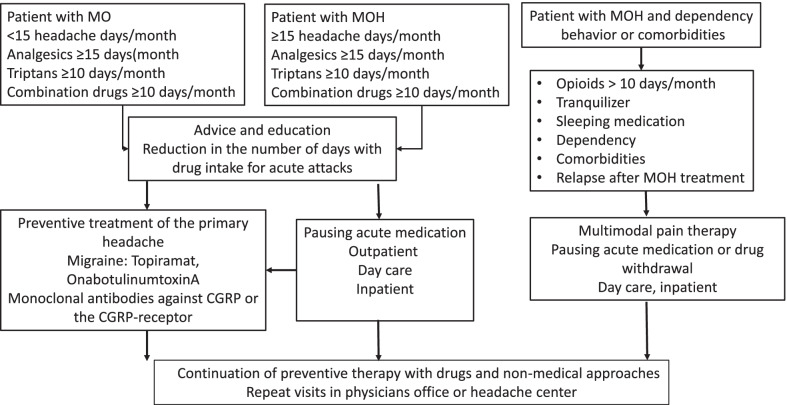
Recommendations: Treatment of headache due to overuse of analgesics or specific migraine medications involves several stages. Patients with medication overuse (MO) or medication overuse headache (MOH) should be educated about the relationship between frequent use of symptomatic headache medication and the transition from episodic to chronic migraine (chronification), with the aim of reducing and limiting the use of acute medication. In a second step, migraine prophylaxis should be initiated in patients with migraine and overuse of analgesics or specific migraine drugs. Topiramate, onabotulinumtoxinA and the monoclonal antibodies against CGRP or the CGRP-receptor are effective in patients with chronic migraine and medication overuse. In patients with tension-type headache, prophylaxis is performed with amitriptyline. Drug prophylaxis should be supplemented by non-drug interventions. For patients in whom education and prophylactic medication are not effective, pausing acute medication is recommended. This treatment can be performed in an outpatient, day hospital or inpatient setting. Patients with headache due to overuse of opioids should undergo inpatient withdrawal. The success rate of the stepped treatment approach is 50-70% after 6 to 12 months. A high relapse rate is observed in patients with opioid overuse. Tricyclic antidepressants, neuroleptics (antiemetics) and the administration of steroids are recommended for the treatment of withdrawal symptoms or headaches during the medication pause. Consistent patient education and further close monitoring reduce the risk of relapse.



 京公网安备 11010802042870号
京ICP备2023020795号-1
京公网安备 11010802042870号
京ICP备2023020795号-1

 分享
分享

 求助内容:
求助内容: 应助结果提醒方式:
 扫码关注我们
