Bacterial Contamination Level of Indoor Air and Surface of Equipment in the Operation Room in Dil-Chora Referral Hospital, Dire Dawa, Eastern Ethiopia.
{"title":"Bacterial Contamination Level of Indoor Air and Surface of Equipment in the Operation Room in Dil-Chora Referral Hospital, Dire Dawa, Eastern Ethiopia.","authors":"Robel Mekonnen Yimer, Mesfin Kebede Alemu","doi":"10.2147/IDR.S380774","DOIUrl":null,"url":null,"abstract":"<p><strong>Purpose: </strong>This study investigated the bacterial contamination level of the indoor air and surface of the operation room, surgical, and gynecology wards of Dilchora Referral hospitals between January and August 2020.</p><p><strong>Methods: </strong>A laboratory based cross-sectional study was carried out on the OR and wards of Dilchora referral hospital in Eastern Ethiopia. A passive air sampling method was used to collect 128 indoor air samples; the bacterial load was enumerated and the result was expressed as colony forming units (CFU/m<sup>3</sup>). Additional qualitative analysis was carried out to identify particular bacterial species that were isolated from the indoor air and swabs taken from the surface of the equipment using conventional techniques. All laboratory data were entered and analyzed using MS Excel 2007 and SPSS version 20.</p><p><strong>Results: </strong>The mean bacterial counts of 94.63 CFU/dm/hr in major OR during active time as well as 509.75 and 509.38 CFU/dm/hr in male and female clothing rooms during the afternoon were unacceptable (>450 CFU/dm<sup>2</sup>). Similarly, 43.75% of the bacterial counts found in the afternoon samples fell short of Fisher's criterion. The difference between the bacterial counts recorded in the morning and afternoon was significant (<i>p</i>=0.000). A total of 54 (42.2%) indoor air samples and 28 (93.3%) cotton swabs were positive for bacterial growth, with S. aureus (51.04%) and Bacillus sp (55%) being the dominant bacteria isolated from indoor air and the surface of equipment, respectively.</p><p><strong>Conclusion: </strong>The bacterial load of investigated wards is considerably \"high\" to \"very high\", which implies a significant risk of hospital acquired infections. Therefore, devising effective control strategies targeted on surface cleansing and sterilizing of the air environment and practicing periodic microbial surveillance of the hospital environment is a paramant.</p>","PeriodicalId":2,"journal":{"name":"ACS Applied Bio Materials","volume":" ","pages":"5085-5097"},"PeriodicalIF":4.7000,"publicationDate":"2022-08-31","publicationTypes":"Journal Article","fieldsOfStudy":null,"isOpenAccess":false,"openAccessPdf":"https://ftp.ncbi.nlm.nih.gov/pub/pmc/oa_pdf/81/e3/idr-15-5085.PMC9442909.pdf","citationCount":"0","resultStr":null,"platform":"Semanticscholar","paperid":null,"PeriodicalName":"ACS Applied Bio Materials","FirstCategoryId":"3","ListUrlMain":"https://doi.org/10.2147/IDR.S380774","RegionNum":0,"RegionCategory":null,"ArticlePicture":[],"TitleCN":null,"AbstractTextCN":null,"PMCID":null,"EPubDate":"2022/1/1 0:00:00","PubModel":"eCollection","JCR":"Q2","JCRName":"MATERIALS SCIENCE, BIOMATERIALS","Score":null,"Total":0}
引用次数: 0
Abstract
Purpose: This study investigated the bacterial contamination level of the indoor air and surface of the operation room, surgical, and gynecology wards of Dilchora Referral hospitals between January and August 2020.
Methods: A laboratory based cross-sectional study was carried out on the OR and wards of Dilchora referral hospital in Eastern Ethiopia. A passive air sampling method was used to collect 128 indoor air samples; the bacterial load was enumerated and the result was expressed as colony forming units (CFU/m3). Additional qualitative analysis was carried out to identify particular bacterial species that were isolated from the indoor air and swabs taken from the surface of the equipment using conventional techniques. All laboratory data were entered and analyzed using MS Excel 2007 and SPSS version 20.
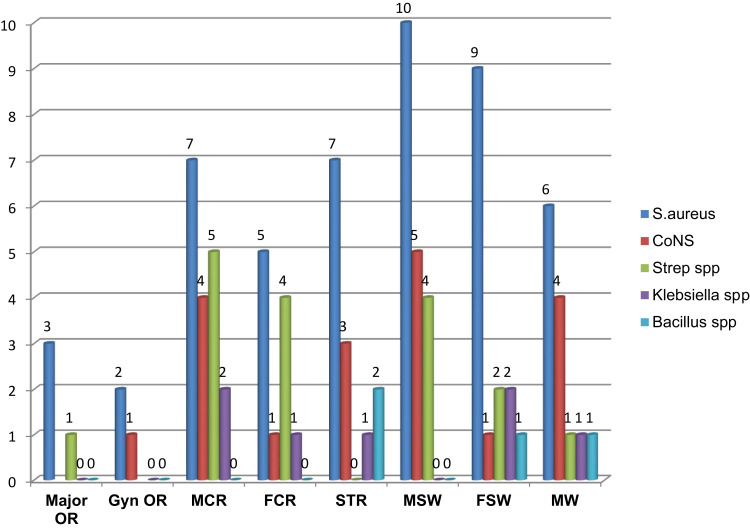
Results: The mean bacterial counts of 94.63 CFU/dm/hr in major OR during active time as well as 509.75 and 509.38 CFU/dm/hr in male and female clothing rooms during the afternoon were unacceptable (>450 CFU/dm2). Similarly, 43.75% of the bacterial counts found in the afternoon samples fell short of Fisher's criterion. The difference between the bacterial counts recorded in the morning and afternoon was significant (p=0.000). A total of 54 (42.2%) indoor air samples and 28 (93.3%) cotton swabs were positive for bacterial growth, with S. aureus (51.04%) and Bacillus sp (55%) being the dominant bacteria isolated from indoor air and the surface of equipment, respectively.
Conclusion: The bacterial load of investigated wards is considerably "high" to "very high", which implies a significant risk of hospital acquired infections. Therefore, devising effective control strategies targeted on surface cleansing and sterilizing of the air environment and practicing periodic microbial surveillance of the hospital environment is a paramant.
期刊介绍:
ACS Applied Bio Materials is an interdisciplinary journal publishing original research covering all aspects of biomaterials and biointerfaces including and beyond the traditional biosensing, biomedical and therapeutic applications.
The journal is devoted to reports of new and original experimental and theoretical research of an applied nature that integrates knowledge in the areas of materials, engineering, physics, bioscience, and chemistry into important bio applications. The journal is specifically interested in work that addresses the relationship between structure and function and assesses the stability and degradation of materials under relevant environmental and biological conditions.





 京公网安备 11010802042870号
京ICP备2023020795号-1
京公网安备 11010802042870号
京ICP备2023020795号-1

 分享
分享
 求助内容:
求助内容: 应助结果提醒方式:
 扫码关注我们
