Modified Taohong Siwu decoction improves cardiac function after myocardial ischaemia and reperfusion in rats by promoting endogenous stem cell mobilization and regulating metabolites.
Wan-Ting Meng, Zhong-Xin Xiao, Han Li, Ya-Chao Wang, Yue Zhao, Yan Zhu, Hai-Dong Guo
{"title":"Modified Taohong Siwu decoction improves cardiac function after myocardial ischaemia and reperfusion in rats by promoting endogenous stem cell mobilization and regulating metabolites.","authors":"Wan-Ting Meng, Zhong-Xin Xiao, Han Li, Ya-Chao Wang, Yue Zhao, Yan Zhu, Hai-Dong Guo","doi":"10.1080/13880209.2022.2116054","DOIUrl":null,"url":null,"abstract":"<p><strong>Context: </strong>Taohong Siwu decoction (THSWD) has been shown to promote heart repair in myocardial infarction.</p><p><strong>Objective: </strong>To determine the effects of modified THSWD (THSWD plus four ingredients) on myocardial ischaemia and reperfusion (I/R) injury.</p><p><strong>Materials and methods: </strong>Sixty Sprague-Dawley rats were randomly divided into the I/R group and three different modified THSWD dose groups (gavage administration, 1.215, 2.43, and 4.86 g, respectively). 2,3,5-Triphenyltetrazolium chloride and Evans blue staining were used to detect the infarct area at 24 h after treatment. The serum biochemical indexes and cell apoptosis were examined to determine myocardial injury. The number of endogenous stem cells, expression of stromal dell derived factor-1 (SDF-1) and stem cell factor (SCF), and cardiac function were measured at 4 weeks. The serum was collected for metabolomic analysis.</p><p><strong>Results: </strong>The high-dose modified THSWD group presented a reduced infarction area (decreased by 21.3%), decreased levels of lactate dehydrogenase and creatinine kinase, attenuated cell apoptosis, and enhanced superoxide dismutase activity in early stage I/R compared with other groups. The serum SCF and SDF-1 levels were higher in the high-dose group than in the I/R group. At 4 weeks, the infarct size and collagen content were the lowest, and the ejection fraction and fractional shortening values were the highest in the high-dose group. Moreover, high-dose modified THSWD affected the metabolism of phosphonate and phosphonate, taurine, and hypotaurine.</p><p><strong>Conclusions: </strong>Endogenous stem cell mobilization and metabolic regulation were related to the cardioprotection of modified THSWD. We provided a new strategy and direction for the treatment of cardiovascular diseases with traditional Chinese medicine.</p>","PeriodicalId":19942,"journal":{"name":"Pharmaceutical Biology","volume":" ","pages":"1721-1731"},"PeriodicalIF":4.8000,"publicationDate":"2022-12-01","publicationTypes":"Journal Article","fieldsOfStudy":null,"isOpenAccess":false,"openAccessPdf":"https://ftp.ncbi.nlm.nih.gov/pub/pmc/oa_pdf/c1/21/IPHB_60_2116054.PMC9467615.pdf","citationCount":"2","resultStr":null,"platform":"Semanticscholar","paperid":null,"PeriodicalName":"Pharmaceutical Biology","FirstCategoryId":"3","ListUrlMain":"https://doi.org/10.1080/13880209.2022.2116054","RegionNum":3,"RegionCategory":"医学","ArticlePicture":[],"TitleCN":null,"AbstractTextCN":null,"PMCID":null,"EPubDate":"","PubModel":"","JCR":"Q1","JCRName":"MEDICAL LABORATORY TECHNOLOGY","Score":null,"Total":0}
引用次数: 2
Abstract
Context: Taohong Siwu decoction (THSWD) has been shown to promote heart repair in myocardial infarction.
Objective: To determine the effects of modified THSWD (THSWD plus four ingredients) on myocardial ischaemia and reperfusion (I/R) injury.
Materials and methods: Sixty Sprague-Dawley rats were randomly divided into the I/R group and three different modified THSWD dose groups (gavage administration, 1.215, 2.43, and 4.86 g, respectively). 2,3,5-Triphenyltetrazolium chloride and Evans blue staining were used to detect the infarct area at 24 h after treatment. The serum biochemical indexes and cell apoptosis were examined to determine myocardial injury. The number of endogenous stem cells, expression of stromal dell derived factor-1 (SDF-1) and stem cell factor (SCF), and cardiac function were measured at 4 weeks. The serum was collected for metabolomic analysis.
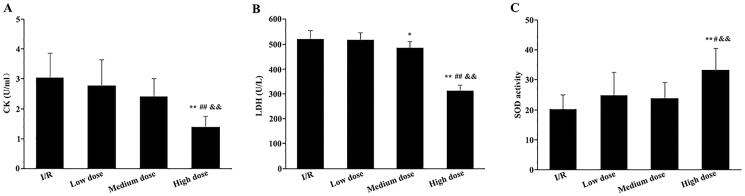
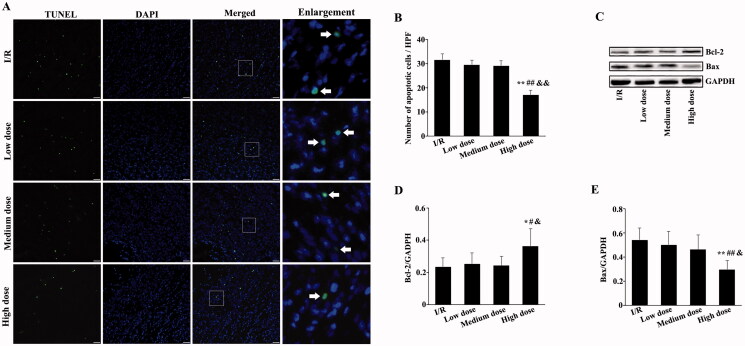
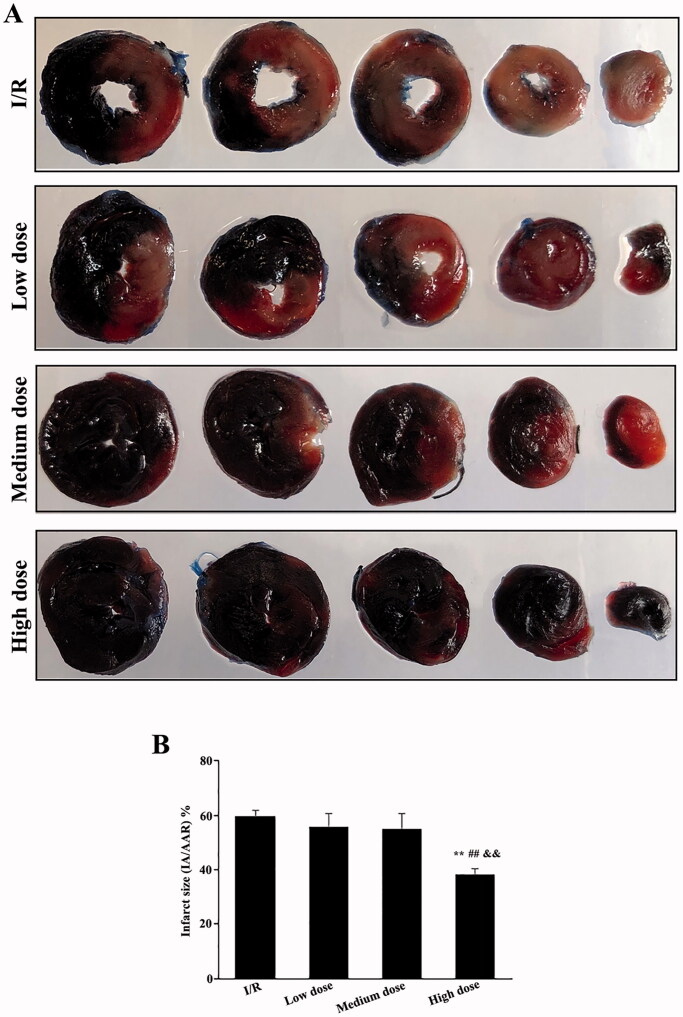
Results: The high-dose modified THSWD group presented a reduced infarction area (decreased by 21.3%), decreased levels of lactate dehydrogenase and creatinine kinase, attenuated cell apoptosis, and enhanced superoxide dismutase activity in early stage I/R compared with other groups. The serum SCF and SDF-1 levels were higher in the high-dose group than in the I/R group. At 4 weeks, the infarct size and collagen content were the lowest, and the ejection fraction and fractional shortening values were the highest in the high-dose group. Moreover, high-dose modified THSWD affected the metabolism of phosphonate and phosphonate, taurine, and hypotaurine.
Conclusions: Endogenous stem cell mobilization and metabolic regulation were related to the cardioprotection of modified THSWD. We provided a new strategy and direction for the treatment of cardiovascular diseases with traditional Chinese medicine.
期刊介绍:
Pharmaceutical Biology will publish manuscripts describing the discovery, methods for discovery, description, analysis characterization, and production/isolation (including sources and surveys) of biologically-active chemicals or other substances, drugs, pharmaceutical products, or preparations utilized in systems of traditional medicine.
Topics may generally encompass any facet of natural product research related to pharmaceutical biology. Papers dealing with agents or topics related to natural product drugs are also appropriate (e.g., semi-synthetic derivatives). Manuscripts will be published as reviews, perspectives, regular research articles, and short communications. The primary criteria for acceptance and publication are scientific rigor and potential to advance the field.



 京公网安备 11010802042870号
京ICP备2023020795号-1
京公网安备 11010802042870号
京ICP备2023020795号-1

 分享
分享
 求助内容:
求助内容: 应助结果提醒方式:
 扫码关注我们
