Christiane van As, Marijke Koedam, Anke McLuskey, Piet Kramer, Najiba Lahlou, Bram C J van der Eerden, Jenny A Visser
{"title":"Loss of Anti-Müllerian Hormone Signaling in Mice Affects Trabecular Bone Mass in a Sex- and Age-Dependent Manner.","authors":"Christiane van As, Marijke Koedam, Anke McLuskey, Piet Kramer, Najiba Lahlou, Bram C J van der Eerden, Jenny A Visser","doi":"10.1210/endocr/bqac157","DOIUrl":null,"url":null,"abstract":"<p><p>Ovariectomy-induced osteoporosis in mice results from an abrupt loss of ovarian sex steroids. Anti-Müllerian hormone knockout (AMHKO) mice show a gradual but accelerated ovarian aging, and therefore may better resemble osteoporosis following natural menopause. To study the impact of AMH signaling deficiency on bone, we compared trabecular and cortical bone parameters in 2-, 4-, 10-, and 16-month-old male and female wild-type (WT), AMHKO, and AMH type II receptor knockout (MRKI) mice using micro computed tomography (microCT). Goldner's staining was performed to confirm the observed bone phenotype. Both male and female AMHKO and MRKI mice showed age-dependent loss of trabecular bone (P < 0.001). However, reproductive-aged female AMHKO and MRKI mice had higher BV/TV compared with WT (P < 0.001), coinciding with increased growing follicle numbers (P < 0.05) and increased estrus inhibin B levels (AMHKO: P < 0.001; MRKI: P < 0.05) but normal inhibin A, estrogen, and progesterone levels. In aged female AMHKO and MRKI mice BV/TV did not differ from WT mice due to greater trabecular bone loss between 10 and 16 months compared with WT mice. At these ages, AMHKO and MRKI mice had reduced growing follicle numbers (P < 0.05) and reduced inhibin B levels (P < 0.001). At age 10 months, female MRKI mice had increased cortical bone parameters compared with WT mice (P < 0.01). Bone parameters of male AMHKO and MRKI mice did not differ from male WT mice. In conclusion, AMH signaling deficiency results in a sex- and age-dependent effect on predominantly trabecular bone. Our results further suggest that reproductive hormones beyond estrogen may contribute to bone homeostasis.</p>","PeriodicalId":11819,"journal":{"name":"Endocrinology","volume":" ","pages":""},"PeriodicalIF":3.3000,"publicationDate":"2022-10-11","publicationTypes":"Journal Article","fieldsOfStudy":null,"isOpenAccess":false,"openAccessPdf":"https://www.ncbi.nlm.nih.gov/pmc/articles/PMC9576916/pdf/","citationCount":"0","resultStr":null,"platform":"Semanticscholar","paperid":null,"PeriodicalName":"Endocrinology","FirstCategoryId":"3","ListUrlMain":"https://doi.org/10.1210/endocr/bqac157","RegionNum":3,"RegionCategory":"医学","ArticlePicture":[],"TitleCN":null,"AbstractTextCN":null,"PMCID":null,"EPubDate":"","PubModel":"","JCR":"Q2","JCRName":"ENDOCRINOLOGY & METABOLISM","Score":null,"Total":0}
引用次数: 0
Abstract
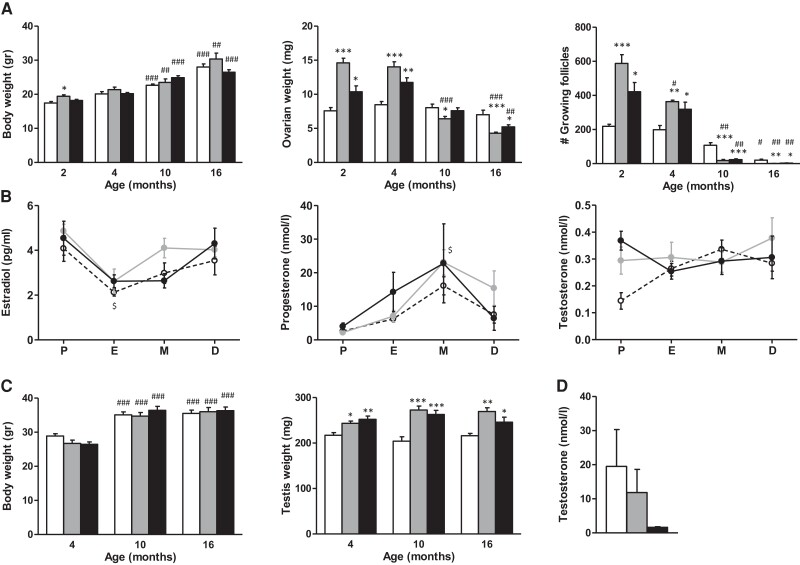
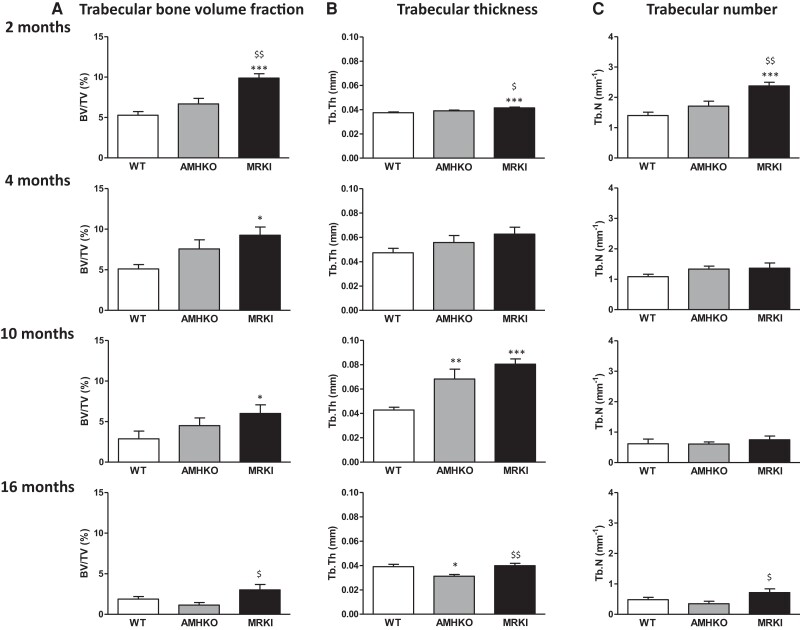
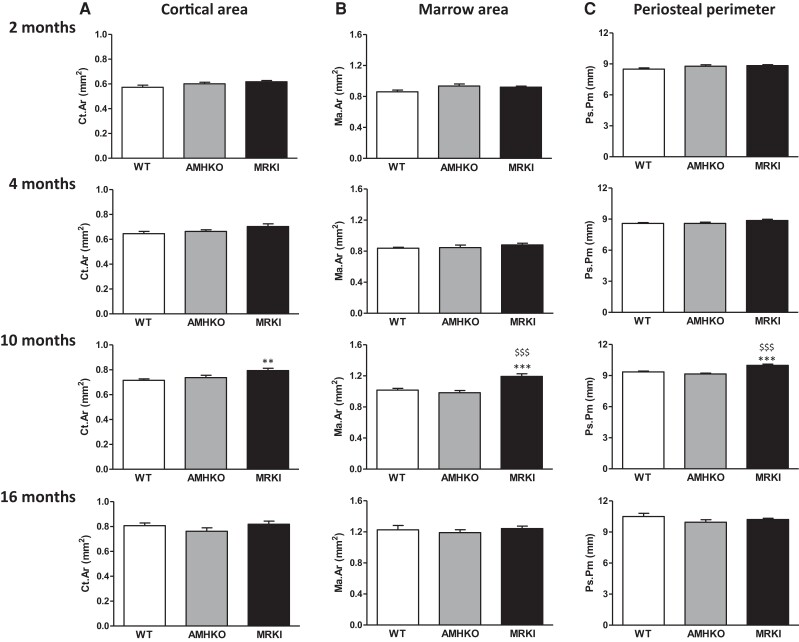
Ovariectomy-induced osteoporosis in mice results from an abrupt loss of ovarian sex steroids. Anti-Müllerian hormone knockout (AMHKO) mice show a gradual but accelerated ovarian aging, and therefore may better resemble osteoporosis following natural menopause. To study the impact of AMH signaling deficiency on bone, we compared trabecular and cortical bone parameters in 2-, 4-, 10-, and 16-month-old male and female wild-type (WT), AMHKO, and AMH type II receptor knockout (MRKI) mice using micro computed tomography (microCT). Goldner's staining was performed to confirm the observed bone phenotype. Both male and female AMHKO and MRKI mice showed age-dependent loss of trabecular bone (P < 0.001). However, reproductive-aged female AMHKO and MRKI mice had higher BV/TV compared with WT (P < 0.001), coinciding with increased growing follicle numbers (P < 0.05) and increased estrus inhibin B levels (AMHKO: P < 0.001; MRKI: P < 0.05) but normal inhibin A, estrogen, and progesterone levels. In aged female AMHKO and MRKI mice BV/TV did not differ from WT mice due to greater trabecular bone loss between 10 and 16 months compared with WT mice. At these ages, AMHKO and MRKI mice had reduced growing follicle numbers (P < 0.05) and reduced inhibin B levels (P < 0.001). At age 10 months, female MRKI mice had increased cortical bone parameters compared with WT mice (P < 0.01). Bone parameters of male AMHKO and MRKI mice did not differ from male WT mice. In conclusion, AMH signaling deficiency results in a sex- and age-dependent effect on predominantly trabecular bone. Our results further suggest that reproductive hormones beyond estrogen may contribute to bone homeostasis.
期刊介绍:
The mission of Endocrinology is to be the authoritative source of emerging hormone science and to disseminate that new knowledge to scientists, clinicians, and the public in a way that will enable "hormone science to health." Endocrinology welcomes the submission of original research investigating endocrine systems and diseases at all levels of biological organization, incorporating molecular mechanistic studies, such as hormone-receptor interactions, in all areas of endocrinology, as well as cross-disciplinary and integrative studies. The editors of Endocrinology encourage the submission of research in emerging areas not traditionally recognized as endocrinology or metabolism in addition to the following traditionally recognized fields: Adrenal; Bone Health and Osteoporosis; Cardiovascular Endocrinology; Diabetes; Endocrine-Disrupting Chemicals; Endocrine Neoplasia and Cancer; Growth; Neuroendocrinology; Nuclear Receptors and Their Ligands; Obesity; Reproductive Endocrinology; Signaling Pathways; and Thyroid.




 京公网安备 11010802042870号
京ICP备2023020795号-1
京公网安备 11010802042870号
京ICP备2023020795号-1

 分享
分享
 求助内容:
求助内容: 应助结果提醒方式:
 扫码关注我们
