Chang Wan Seo, Sung Hyun Kim, Young Woon Lim, Myung Soo Park
{"title":"Re-Identification on Korean <i>Penicillium</i> Sequences in GenBank Collected by Software GenMine.","authors":"Chang Wan Seo, Sung Hyun Kim, Young Woon Lim, Myung Soo Park","doi":"10.1080/12298093.2022.2116816","DOIUrl":null,"url":null,"abstract":"<p><p><i>Penicillium</i> species have been actively studied in various fields, and many new and unrecorded species continue to be reported in Korea. Moreover, unidentified and misidentified Korean <i>Penicillium</i> species still exist in GenBank. Therefore, it is necessary to revise the Korean <i>Penicillium</i> inventory based on accurate identification. We collected Korean <i>Penicillium</i> nucleotide sequence records from GenBank using the newly developed software, GenMine, and re-identified Korean <i>Penicillium</i> based on the maximum likelihood trees. A total of 1681 Korean <i>Penicillium</i> GenBank nucleotide sequence records were collected from GenBank. In these records, 1208 strains with four major genes (Internal Transcribed Spacer rDNA region, β-tubulin, Calmodulin and RNA polymerase II) were selected for <i>Penicillium</i> re-identification. Among 1208 strains, 927 were identified, 82 were identified as other genera, the rest remained undetermined due to low phylogenetic resolution. Identified strains consisted of 206 <i>Penicillium</i> species, including 156 recorded species and 50 new species candidates. However, 37 species recorded in the national list of species in Korea were not found in GenBank. Further studies on the presence or absence of these species are required through literature investigation, additional sampling, and sequencing. Our study can be the basis for updating the Korean <i>Penicillium</i> inventory.</p>","PeriodicalId":18825,"journal":{"name":"Mycobiology","volume":"50 4","pages":"231-237"},"PeriodicalIF":2.0000,"publicationDate":"2022-09-05","publicationTypes":"Journal Article","fieldsOfStudy":null,"isOpenAccess":false,"openAccessPdf":"https://ftp.ncbi.nlm.nih.gov/pub/pmc/oa_pdf/45/1a/TMYB_50_2116816.PMC9467555.pdf","citationCount":"0","resultStr":null,"platform":"Semanticscholar","paperid":null,"PeriodicalName":"Mycobiology","FirstCategoryId":"99","ListUrlMain":"https://doi.org/10.1080/12298093.2022.2116816","RegionNum":4,"RegionCategory":"生物学","ArticlePicture":[],"TitleCN":null,"AbstractTextCN":null,"PMCID":null,"EPubDate":"2022/1/1 0:00:00","PubModel":"eCollection","JCR":"Q2","JCRName":"AGRONOMY","Score":null,"Total":0}
引用次数: 0
Abstract
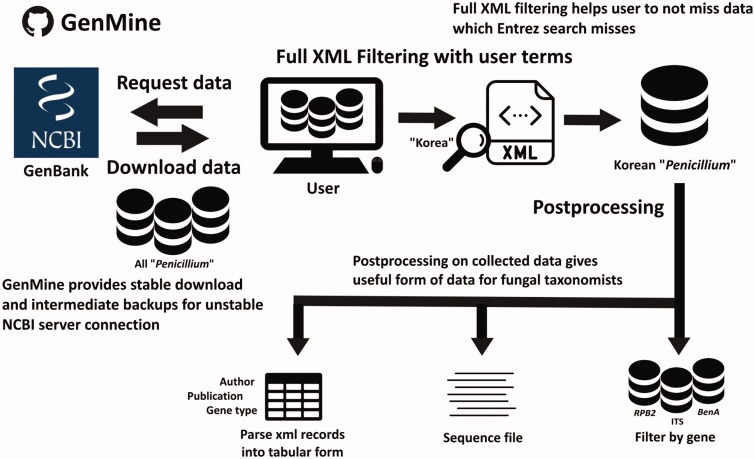
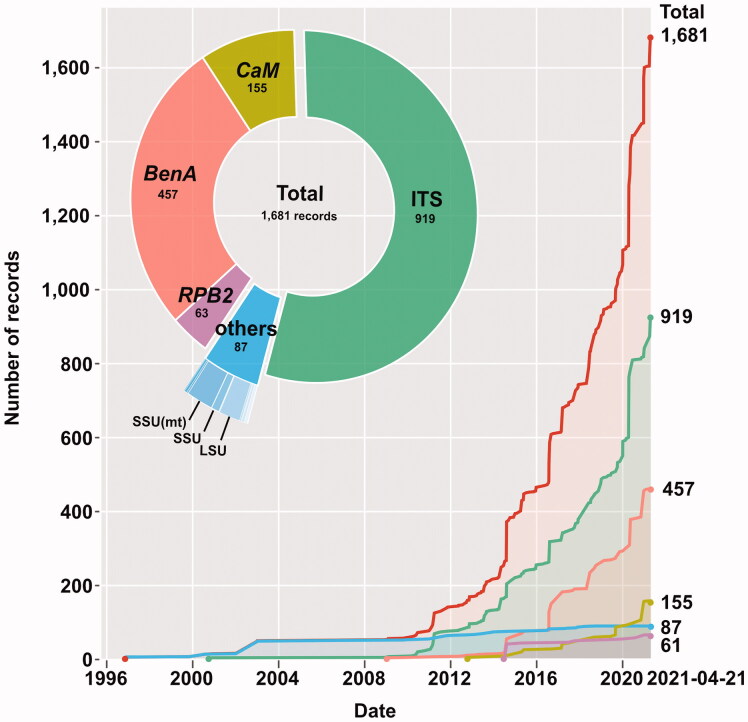
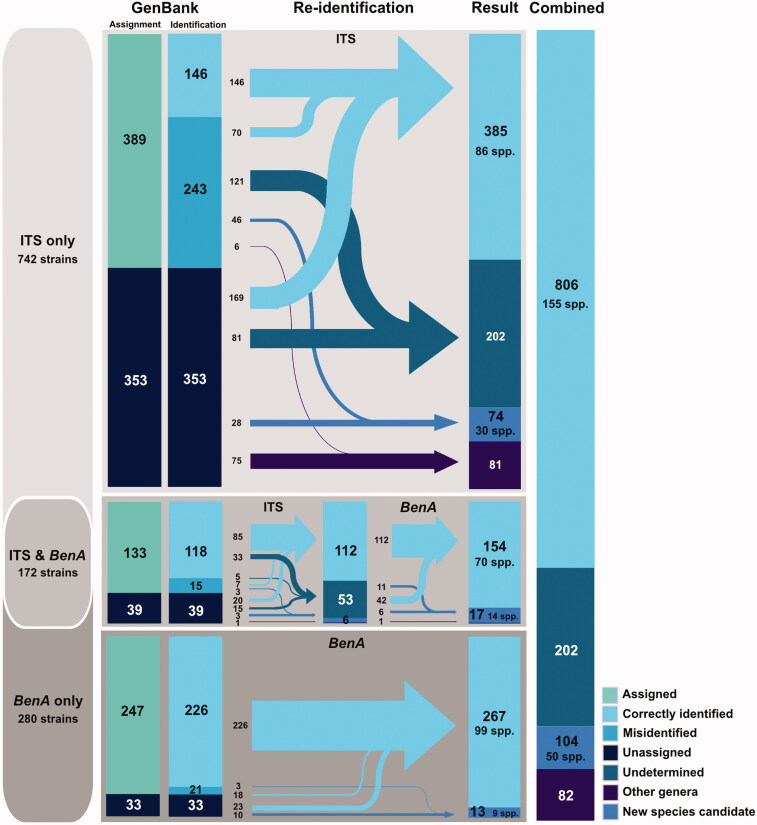
Penicillium species have been actively studied in various fields, and many new and unrecorded species continue to be reported in Korea. Moreover, unidentified and misidentified Korean Penicillium species still exist in GenBank. Therefore, it is necessary to revise the Korean Penicillium inventory based on accurate identification. We collected Korean Penicillium nucleotide sequence records from GenBank using the newly developed software, GenMine, and re-identified Korean Penicillium based on the maximum likelihood trees. A total of 1681 Korean Penicillium GenBank nucleotide sequence records were collected from GenBank. In these records, 1208 strains with four major genes (Internal Transcribed Spacer rDNA region, β-tubulin, Calmodulin and RNA polymerase II) were selected for Penicillium re-identification. Among 1208 strains, 927 were identified, 82 were identified as other genera, the rest remained undetermined due to low phylogenetic resolution. Identified strains consisted of 206 Penicillium species, including 156 recorded species and 50 new species candidates. However, 37 species recorded in the national list of species in Korea were not found in GenBank. Further studies on the presence or absence of these species are required through literature investigation, additional sampling, and sequencing. Our study can be the basis for updating the Korean Penicillium inventory.
期刊介绍:
Mycobiology is an international journal devoted to the publication of fundamental and applied investigations on all aspects of mycology and their traditional allies. It is published quarterly and is the official publication of the Korean Society of Mycology. Mycobiology publishes reports of basic research on fungi and fungus-like organisms, including yeasts, filamentous fungi, lichen fungi, oomycetes, moulds, and mushroom. Topics also include molecular and cellular biology, biochemistry, metabolism, developmental biology, environmental mycology, evolution, ecology, taxonomy and systematics, genetics/genomics, fungal pathogen and disease control, physiology, and industrial biotechnology using fungi.



 京公网安备 11010802042870号
京ICP备2023020795号-1
京公网安备 11010802042870号
京ICP备2023020795号-1

 分享
分享
 求助内容:
求助内容: 应助结果提醒方式:
 扫码关注我们
