Ravi Kant, Lakshya Chandra, Vipin Verma, Priyanshu Nain, Diego Bello, Siddharth Patel, Subash Ala, Rashmi Chandra, Mc Anto Antony
{"title":"Gut microbiota interactions with anti-diabetic medications and pathogenesis of type 2 diabetes mellitus.","authors":"Ravi Kant, Lakshya Chandra, Vipin Verma, Priyanshu Nain, Diego Bello, Siddharth Patel, Subash Ala, Rashmi Chandra, Mc Anto Antony","doi":"10.5662/wjm.v12.i4.246","DOIUrl":null,"url":null,"abstract":"<p><p>Microorganisms including bacteria, viruses, protozoa, and fungi living in the gastrointestinal tract are collectively known as the gut microbiota. Dysbiosis is the imbalance in microbial composition on or inside the body relative to healthy state. Altered Firmicutes to Bacteroidetes ratio and decreased abundance of Akkermansia muciniphila are the predominant gut dysbiosis associated with the pathogenesis of type 2 diabetes mellitus (T2DM) and metabolic syndrome. Pathophysiological mechanisms linking gut dysbiosis, and metabolic diseases and their complications include altered metabolism of short-chain fatty acids and bile acids, interaction with gut hormones, increased gut microbial metabolite trimethylamine-N-oxide, bacterial translocation/Leaky gut syndrome, and endotoxin production such as lipopolysaccharides. The association between the gut microbiota and glycemic agents, however, is much less understood and is the growing focus of research and conversation. Recent studies suggest that the gut microbiota and anti-diabetic medications are interdependent on each other, meaning that while anti-diabetic medications alter the gut microbiota, the gut microbiota also alters the efficacy of anti-diabetic medications. With increasing evidence regarding the significance of gut microbiota, it is imperative to review the role of gut microbiota in the pathogenesis of T2DM. This review also discusses the interaction between gut microbiota and the various medications used in the treatment of T2DM.</p>","PeriodicalId":23729,"journal":{"name":"World journal of methodology","volume":"12 4","pages":"246-257"},"PeriodicalIF":0.0000,"publicationDate":"2022-07-20","publicationTypes":"Journal Article","fieldsOfStudy":null,"isOpenAccess":false,"openAccessPdf":"https://ftp.ncbi.nlm.nih.gov/pub/pmc/oa_pdf/68/88/WJM-12-246.PMC9350729.pdf","citationCount":"0","resultStr":null,"platform":"Semanticscholar","paperid":null,"PeriodicalName":"World journal of methodology","FirstCategoryId":"1085","ListUrlMain":"https://doi.org/10.5662/wjm.v12.i4.246","RegionNum":0,"RegionCategory":null,"ArticlePicture":[],"TitleCN":null,"AbstractTextCN":null,"PMCID":null,"EPubDate":"","PubModel":"","JCR":"","JCRName":"","Score":null,"Total":0}
引用次数: 0
Abstract
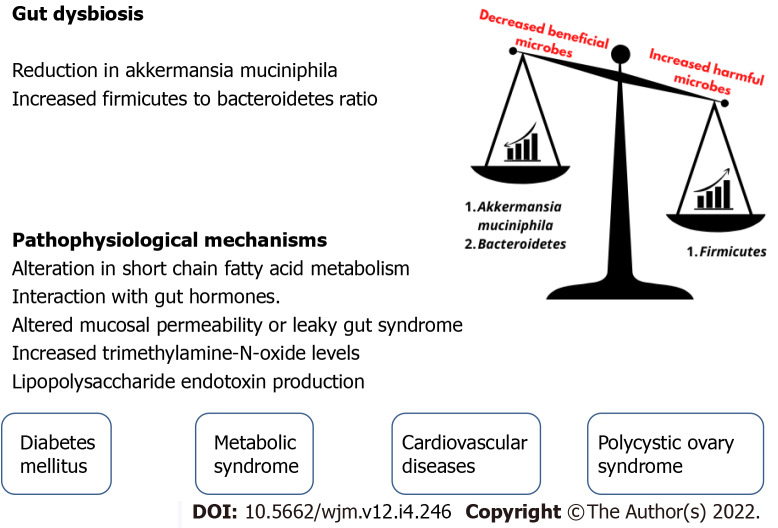
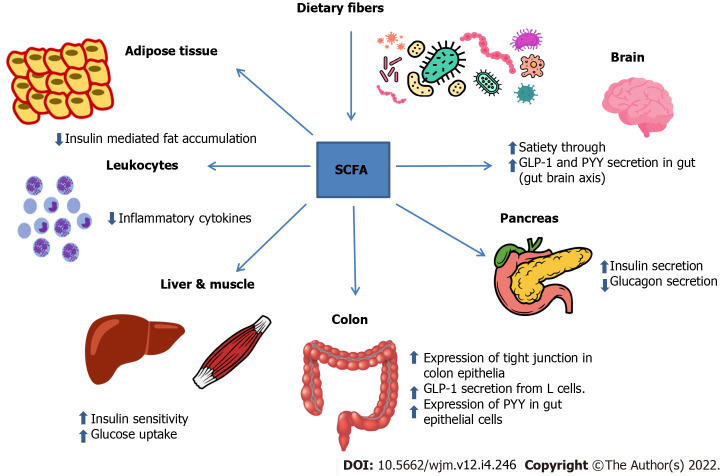
Microorganisms including bacteria, viruses, protozoa, and fungi living in the gastrointestinal tract are collectively known as the gut microbiota. Dysbiosis is the imbalance in microbial composition on or inside the body relative to healthy state. Altered Firmicutes to Bacteroidetes ratio and decreased abundance of Akkermansia muciniphila are the predominant gut dysbiosis associated with the pathogenesis of type 2 diabetes mellitus (T2DM) and metabolic syndrome. Pathophysiological mechanisms linking gut dysbiosis, and metabolic diseases and their complications include altered metabolism of short-chain fatty acids and bile acids, interaction with gut hormones, increased gut microbial metabolite trimethylamine-N-oxide, bacterial translocation/Leaky gut syndrome, and endotoxin production such as lipopolysaccharides. The association between the gut microbiota and glycemic agents, however, is much less understood and is the growing focus of research and conversation. Recent studies suggest that the gut microbiota and anti-diabetic medications are interdependent on each other, meaning that while anti-diabetic medications alter the gut microbiota, the gut microbiota also alters the efficacy of anti-diabetic medications. With increasing evidence regarding the significance of gut microbiota, it is imperative to review the role of gut microbiota in the pathogenesis of T2DM. This review also discusses the interaction between gut microbiota and the various medications used in the treatment of T2DM.



 京公网安备 11010802042870号
京ICP备2023020795号-1
京公网安备 11010802042870号
京ICP备2023020795号-1

 分享
分享

 求助内容:
求助内容: 应助结果提醒方式:
 扫码关注我们
