Sarah Mousavi, Shima Zare, Mahmoud Mirzaei, Awat Feizi
{"title":"Novel Drug Design for Treatment of COVID-19: A Systematic Review of Preclinical Studies.","authors":"Sarah Mousavi, Shima Zare, Mahmoud Mirzaei, Awat Feizi","doi":"10.1155/2022/2044282","DOIUrl":null,"url":null,"abstract":"<p><strong>Background: </strong>Since the beginning of the novel coronavirus (SARS-CoV-2) disease outbreak, there has been an increasing interest in discovering potential therapeutic agents for this disease. In this regard, we conducted a systematic review through an overview of drug development (in silico, in vitro, and in vivo) for treating COVID-19.</p><p><strong>Methods: </strong>A systematic search was carried out in major databases including PubMed, Web of Science, Scopus, EMBASE, and Google Scholar from December 2019 to March 2021. A combination of the following terms was used: coronavirus, COVID-19, SARS-CoV-2, drug design, drug development, In silico, In vitro, and In vivo. A narrative synthesis was performed as a qualitative method for the data synthesis of each outcome measure.</p><p><strong>Results: </strong>A total of 2168 articles were identified through searching databases. Finally, 315 studies (266 in silico, 34 in vitro, and 15 in vivo) were included. In studies with in silico approach, 98 article study repurposed drug and 91 studies evaluated herbal medicine on COVID-19. Among 260 drugs repurposed by the computational method, the best results were observed with saquinavir (<i>n</i> = 9), ritonavir (<i>n</i> = 8), and lopinavir (<i>n</i> = 6). Main protease (<i>n</i> = 154) following spike glycoprotein (<i>n</i> = 62) and other nonstructural protein of virus (<i>n</i> = 45) was among the most studied targets. Doxycycline, chlorpromazine, azithromycin, heparin, bepridil, and glycyrrhizic acid showed both in silico and in vitro inhibitory effects against SARS-CoV-2.</p><p><strong>Conclusion: </strong>The preclinical studies of novel drug design for COVID-19 focused on main protease and spike glycoprotein as targets for antiviral development. From evaluated structures, saquinavir, ritonavir, eucalyptus, Tinospora cordifolia, aloe, green tea, curcumin, pyrazole, and triazole derivatives in in silico studies and doxycycline, chlorpromazine, and heparin from in vitro and human monoclonal antibodies from in vivo studies showed promised results regarding efficacy. It seems that due to the nature of COVID-19 disease, finding some drugs with multitarget antiviral actions and anti-inflammatory potential is valuable and some herbal medicines have this potential.</p>","PeriodicalId":2,"journal":{"name":"ACS Applied Bio Materials","volume":" ","pages":"2044282"},"PeriodicalIF":4.7000,"publicationDate":"2022-09-25","publicationTypes":"Journal Article","fieldsOfStudy":null,"isOpenAccess":false,"openAccessPdf":"https://www.ncbi.nlm.nih.gov/pmc/articles/PMC9527439/pdf/","citationCount":"0","resultStr":null,"platform":"Semanticscholar","paperid":null,"PeriodicalName":"ACS Applied Bio Materials","FirstCategoryId":"3","ListUrlMain":"https://doi.org/10.1155/2022/2044282","RegionNum":0,"RegionCategory":null,"ArticlePicture":[],"TitleCN":null,"AbstractTextCN":null,"PMCID":null,"EPubDate":"2022/1/1 0:00:00","PubModel":"eCollection","JCR":"Q2","JCRName":"MATERIALS SCIENCE, BIOMATERIALS","Score":null,"Total":0}
引用次数: 0
Abstract
Background: Since the beginning of the novel coronavirus (SARS-CoV-2) disease outbreak, there has been an increasing interest in discovering potential therapeutic agents for this disease. In this regard, we conducted a systematic review through an overview of drug development (in silico, in vitro, and in vivo) for treating COVID-19.
Methods: A systematic search was carried out in major databases including PubMed, Web of Science, Scopus, EMBASE, and Google Scholar from December 2019 to March 2021. A combination of the following terms was used: coronavirus, COVID-19, SARS-CoV-2, drug design, drug development, In silico, In vitro, and In vivo. A narrative synthesis was performed as a qualitative method for the data synthesis of each outcome measure.
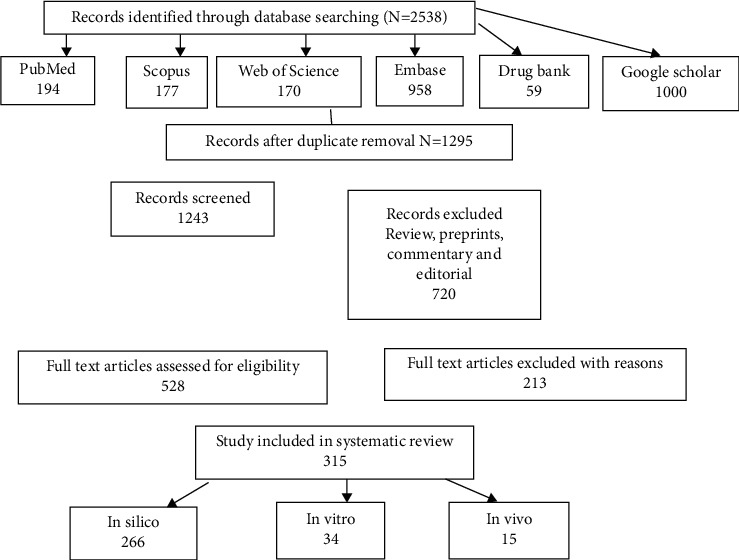
Results: A total of 2168 articles were identified through searching databases. Finally, 315 studies (266 in silico, 34 in vitro, and 15 in vivo) were included. In studies with in silico approach, 98 article study repurposed drug and 91 studies evaluated herbal medicine on COVID-19. Among 260 drugs repurposed by the computational method, the best results were observed with saquinavir (n = 9), ritonavir (n = 8), and lopinavir (n = 6). Main protease (n = 154) following spike glycoprotein (n = 62) and other nonstructural protein of virus (n = 45) was among the most studied targets. Doxycycline, chlorpromazine, azithromycin, heparin, bepridil, and glycyrrhizic acid showed both in silico and in vitro inhibitory effects against SARS-CoV-2.
Conclusion: The preclinical studies of novel drug design for COVID-19 focused on main protease and spike glycoprotein as targets for antiviral development. From evaluated structures, saquinavir, ritonavir, eucalyptus, Tinospora cordifolia, aloe, green tea, curcumin, pyrazole, and triazole derivatives in in silico studies and doxycycline, chlorpromazine, and heparin from in vitro and human monoclonal antibodies from in vivo studies showed promised results regarding efficacy. It seems that due to the nature of COVID-19 disease, finding some drugs with multitarget antiviral actions and anti-inflammatory potential is valuable and some herbal medicines have this potential.
期刊介绍:
ACS Applied Bio Materials is an interdisciplinary journal publishing original research covering all aspects of biomaterials and biointerfaces including and beyond the traditional biosensing, biomedical and therapeutic applications.
The journal is devoted to reports of new and original experimental and theoretical research of an applied nature that integrates knowledge in the areas of materials, engineering, physics, bioscience, and chemistry into important bio applications. The journal is specifically interested in work that addresses the relationship between structure and function and assesses the stability and degradation of materials under relevant environmental and biological conditions.




 京公网安备 11010802042870号
京ICP备2023020795号-1
京公网安备 11010802042870号
京ICP备2023020795号-1

 分享
分享
 求助内容:
求助内容: 应助结果提醒方式:
 扫码关注我们
