Ji Zhou, Weixing Feng, Xiuwei Zhuo, Wenting Lu, Junling Wang, Fang Fang, Xiaohui Wang
{"title":"Cerebral small vessel disease caused by <i>PLOD3</i> mutation: Expanding the phenotypic spectrum of lysyl hydroxylase-3 deficiency.","authors":"Ji Zhou, Weixing Feng, Xiuwei Zhuo, Wenting Lu, Junling Wang, Fang Fang, Xiaohui Wang","doi":"10.1002/ped4.12328","DOIUrl":null,"url":null,"abstract":"<p><strong>Introduction: </strong>Pathogenic variants in <i>PLOD3</i>, encoding lysyl hydroxylase-3 (LH3), can cause a hereditary connective tissue disorder that has rarely been reported. It is a multi-system disease, presenting with craniofacial dysmorphisms, skeletal and eye manifestations, sensorineural hearing loss, and variable skin manifestations. Severe central nervous system involvement has not been reported.</p><p><strong>Case presentation: </strong>A 10-month-old girl was admitted with development delay and clustered epileptic spasms. Hypertelorism, an upturned nose, and low-set ears were noted in physical examination. Cerebral magnetic resonance imaging showed multiple intracranial malacias and bleeding foci, extensive abnormal signals in the white matter, and obvious brain atrophy, which was consistent with cerebral small vessel disease (SVD). Electroencephalography suggested hypsarrhythmia. The vertebrae were flattened. The distal end of the metacarpal bone in the left hand was irregular. She was diagnosed with West syndrome. Whole-exome sequencing revealed a novel homozygous variant of c.1216_1218delCTC (p.L406del) in <i>PLOD3</i>, which was found to be inherited from her heterozygous parents.</p><p><strong>Conclusion: </strong>We report a patient with pathogenic <i>PLOD3</i> mutation who presented with cerebral SVD. This report expands the phenotypic spectrum of LH3 deficiency.</p>","PeriodicalId":1,"journal":{"name":"Accounts of Chemical Research","volume":" ","pages":"219-223"},"PeriodicalIF":17.7000,"publicationDate":"2022-06-04","publicationTypes":"Journal Article","fieldsOfStudy":null,"isOpenAccess":false,"openAccessPdf":"https://ftp.ncbi.nlm.nih.gov/pub/pmc/oa_pdf/61/08/PED4-6-219.PMC9523809.pdf","citationCount":"0","resultStr":null,"platform":"Semanticscholar","paperid":null,"PeriodicalName":"Accounts of Chemical Research","FirstCategoryId":"3","ListUrlMain":"https://doi.org/10.1002/ped4.12328","RegionNum":1,"RegionCategory":"化学","ArticlePicture":[],"TitleCN":null,"AbstractTextCN":null,"PMCID":null,"EPubDate":"2022/9/1 0:00:00","PubModel":"eCollection","JCR":"Q1","JCRName":"CHEMISTRY, MULTIDISCIPLINARY","Score":null,"Total":0}
引用次数: 0
Abstract
Introduction: Pathogenic variants in PLOD3, encoding lysyl hydroxylase-3 (LH3), can cause a hereditary connective tissue disorder that has rarely been reported. It is a multi-system disease, presenting with craniofacial dysmorphisms, skeletal and eye manifestations, sensorineural hearing loss, and variable skin manifestations. Severe central nervous system involvement has not been reported.
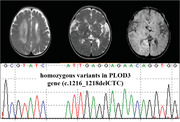
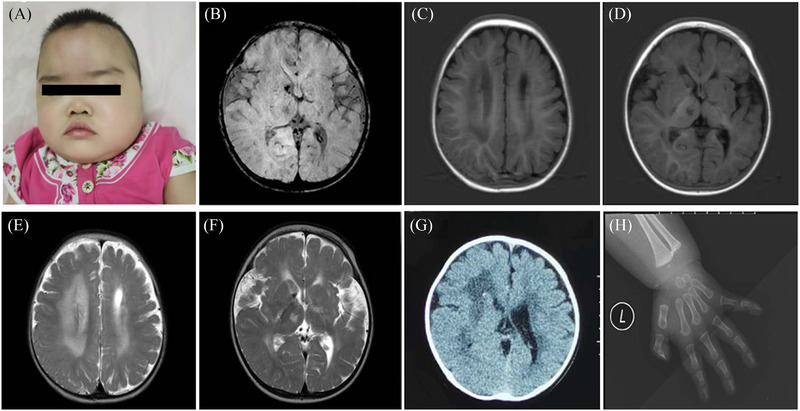
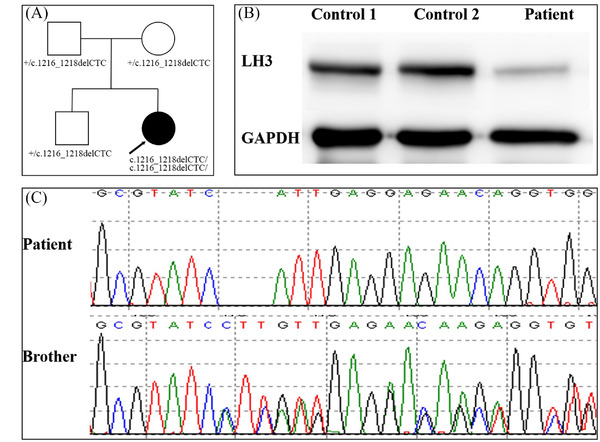
Case presentation: A 10-month-old girl was admitted with development delay and clustered epileptic spasms. Hypertelorism, an upturned nose, and low-set ears were noted in physical examination. Cerebral magnetic resonance imaging showed multiple intracranial malacias and bleeding foci, extensive abnormal signals in the white matter, and obvious brain atrophy, which was consistent with cerebral small vessel disease (SVD). Electroencephalography suggested hypsarrhythmia. The vertebrae were flattened. The distal end of the metacarpal bone in the left hand was irregular. She was diagnosed with West syndrome. Whole-exome sequencing revealed a novel homozygous variant of c.1216_1218delCTC (p.L406del) in PLOD3, which was found to be inherited from her heterozygous parents.
Conclusion: We report a patient with pathogenic PLOD3 mutation who presented with cerebral SVD. This report expands the phenotypic spectrum of LH3 deficiency.
期刊介绍:
Accounts of Chemical Research presents short, concise and critical articles offering easy-to-read overviews of basic research and applications in all areas of chemistry and biochemistry. These short reviews focus on research from the author’s own laboratory and are designed to teach the reader about a research project. In addition, Accounts of Chemical Research publishes commentaries that give an informed opinion on a current research problem. Special Issues online are devoted to a single topic of unusual activity and significance.
Accounts of Chemical Research replaces the traditional article abstract with an article "Conspectus." These entries synopsize the research affording the reader a closer look at the content and significance of an article. Through this provision of a more detailed description of the article contents, the Conspectus enhances the article's discoverability by search engines and the exposure for the research.




 京公网安备 11010802042870号
京ICP备2023020795号-1
京公网安备 11010802042870号
京ICP备2023020795号-1

 分享
分享
 求助内容:
求助内容: 应助结果提醒方式:
 扫码关注我们
