{"title":"Screening for musculoskeletal system malformations and birth injuries in newborns: Results of a screening program in two hospitals in Shenzen, China.","authors":"Zhu Xiong, Zhenhui Zhao, Hansheng Deng, Xin Qiu, Weiqing Li, Xiaodi Chen, Yu Tang, Shuai Han, Jiaxin Zhao, Ting Cai, Xian Liu, Shuaidan Zeng, Shengping Tang","doi":"10.1002/ped4.12334","DOIUrl":null,"url":null,"abstract":"<p><strong>Importance: </strong>There are a variety of musculoskeletal malformations and injuries that can occur in newborns. These can be a significant cause of perinatal death or a reason for miscarriage and can lead to long-term functional issues if not managed appropriately. There is no systematic and well-established screening program for neonatal musculoskeletal malformations and injuries in China now.</p><p><strong>Objective: </strong>To report the incidence and types of congenital musculoskeletal malformations in two hospitals in Shenzhen City, to explore and discuss the details of the screening procedure and improve future prevention and treatment.</p><p><strong>Methods: </strong>From October 2013 to May 2014, 2564 one-day-old newborns were screened by a pediatric orthopedic physical examination, in combination with ultrasonography when required, and the incidence and variety of diseases were recorded statistically.</p><p><strong>Results: </strong>Among 2564 screened newborns, the following musculoskeletal conditions were identified: congenital muscular torticollis (CMT) (seven cases, 0.27%), hip subluxation (four cases, 0.16%), hip dysplasia (47 cases, 1.83%), congenital talipes equinovarus (CTEV) (two cases, 0.08%), congenital talipes calcaneovalgus (15 cases, 0.58%), polydactyly (nine cases, 0.35%), syndactyly (one case, 0.04%), and spinal hemivertebra (one case, 0.04%). Additionally, there were five (0.19%) neonates with birth injuries.</p><p><strong>Interpretation: </strong>It is feasible to carry out neonatal screening and identification of musculoskeletal malformations and birth injuries in China. This is helpful as timely detection and early intervention for many of these conditions can avoid permanent functional impairment in these children.</p>","PeriodicalId":1,"journal":{"name":"Accounts of Chemical Research","volume":" ","pages":"156-162"},"PeriodicalIF":17.7000,"publicationDate":"2022-06-20","publicationTypes":"Journal Article","fieldsOfStudy":null,"isOpenAccess":false,"openAccessPdf":"https://ftp.ncbi.nlm.nih.gov/pub/pmc/oa_pdf/e0/ec/PED4-6-156.PMC9523807.pdf","citationCount":"0","resultStr":null,"platform":"Semanticscholar","paperid":null,"PeriodicalName":"Accounts of Chemical Research","FirstCategoryId":"3","ListUrlMain":"https://doi.org/10.1002/ped4.12334","RegionNum":1,"RegionCategory":"化学","ArticlePicture":[],"TitleCN":null,"AbstractTextCN":null,"PMCID":null,"EPubDate":"2022/9/1 0:00:00","PubModel":"eCollection","JCR":"Q1","JCRName":"CHEMISTRY, MULTIDISCIPLINARY","Score":null,"Total":0}
引用次数: 0
Abstract
Importance: There are a variety of musculoskeletal malformations and injuries that can occur in newborns. These can be a significant cause of perinatal death or a reason for miscarriage and can lead to long-term functional issues if not managed appropriately. There is no systematic and well-established screening program for neonatal musculoskeletal malformations and injuries in China now.
Objective: To report the incidence and types of congenital musculoskeletal malformations in two hospitals in Shenzhen City, to explore and discuss the details of the screening procedure and improve future prevention and treatment.
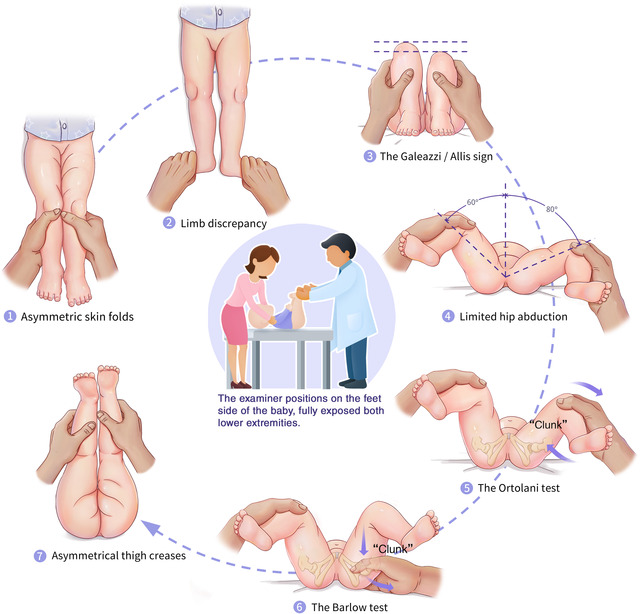
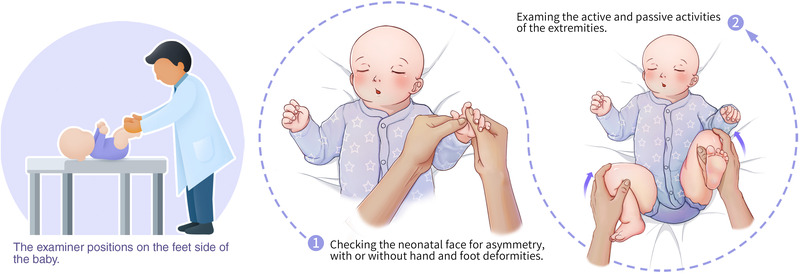
Methods: From October 2013 to May 2014, 2564 one-day-old newborns were screened by a pediatric orthopedic physical examination, in combination with ultrasonography when required, and the incidence and variety of diseases were recorded statistically.
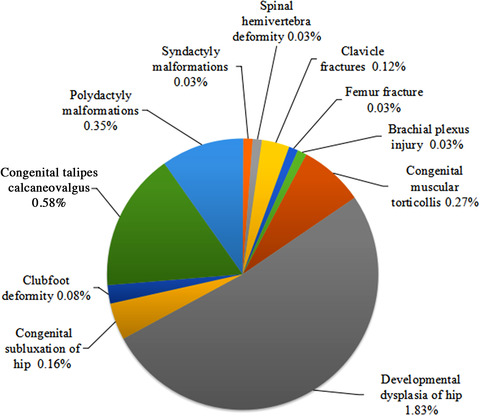
Results: Among 2564 screened newborns, the following musculoskeletal conditions were identified: congenital muscular torticollis (CMT) (seven cases, 0.27%), hip subluxation (four cases, 0.16%), hip dysplasia (47 cases, 1.83%), congenital talipes equinovarus (CTEV) (two cases, 0.08%), congenital talipes calcaneovalgus (15 cases, 0.58%), polydactyly (nine cases, 0.35%), syndactyly (one case, 0.04%), and spinal hemivertebra (one case, 0.04%). Additionally, there were five (0.19%) neonates with birth injuries.
Interpretation: It is feasible to carry out neonatal screening and identification of musculoskeletal malformations and birth injuries in China. This is helpful as timely detection and early intervention for many of these conditions can avoid permanent functional impairment in these children.
期刊介绍:
Accounts of Chemical Research presents short, concise and critical articles offering easy-to-read overviews of basic research and applications in all areas of chemistry and biochemistry. These short reviews focus on research from the author’s own laboratory and are designed to teach the reader about a research project. In addition, Accounts of Chemical Research publishes commentaries that give an informed opinion on a current research problem. Special Issues online are devoted to a single topic of unusual activity and significance.
Accounts of Chemical Research replaces the traditional article abstract with an article "Conspectus." These entries synopsize the research affording the reader a closer look at the content and significance of an article. Through this provision of a more detailed description of the article contents, the Conspectus enhances the article's discoverability by search engines and the exposure for the research.




 京公网安备 11010802042870号
京ICP备2023020795号-1
京公网安备 11010802042870号
京ICP备2023020795号-1

 分享
分享
 求助内容:
求助内容: 应助结果提醒方式:
 扫码关注我们
