Wenfeng Li, Yuanshen Mao, Bao Hua, Xin Gu, Chao Lu, Bin Xu, Weixin Pan
{"title":"Sasanquasaponin inhibited epithelial to mesenchymal transition in prostate cancer by regulating the PI3K/Akt/mTOR and Smad pathways.","authors":"Wenfeng Li, Yuanshen Mao, Bao Hua, Xin Gu, Chao Lu, Bin Xu, Weixin Pan","doi":"10.1080/13880209.2022.2123931","DOIUrl":null,"url":null,"abstract":"<p><strong>Context: </strong>Sasanquasaponin (SQS) is a commonly used traditional Chinese medicine proved to have a wide range of pharmacological functions.</p><p><strong>Objective: </strong>The objective of this study is to explore the effect and underlying mechanism of SQS in the treatment of prostate cancer (PC).</p><p><strong>Materials and methods: </strong>PC cell lines (22Rv1 and PC-3) were treated with SQS (0, 0.5, 1, 2, and 4 μM) for 12 or 24 h. The viability of cells was evaluated, while the mRNA and protein levels of epithelial to mesenchymal transition (EMT)-related genes in PC cell lines were measured (Groups: Control, TGF-β1, TNF-α, TGF-β1 + TNF-α, and TGF-β1 + TNF-α + SQS). The migration and invasion abilities of PC cell lines were evaluated (Groups: Control, SQS). Finally, the antitumour effect of SQS (25, 50,100, and 200 mg/kg) in BALB/c nude mice (6 weeks, 18-20 g) was evaluated (Groups: Control, Vehicle, 25, 50,100, and 200 mg/kg SQS). The study duration was 1 month.</p><p><strong>Results: </strong>SQS inhibited the viability and the number of colonies of 22Rv1 or PC-3 cells. The IC<sub>50</sub> of SQS of 12 and 24 h in these two cells was 3.25, 1.82, 4.76, and 4.70 μM, respectively. SQS inhibited the adhesion, migration, and invasion of PC cells. It also inhibited the expression of EMT-related markers of PC cells. The PI3K/Akt/mTOR and Smad2/3 signalling pathways were activated in the process of EMT, and SQS could significantly reduce the activation of the PI3K/Akt/mTOR and Smad2/3 pathways. Finally, SQS inhibited the growth of xenograft tumours <i>in vivo</i>.</p><p><strong>Conclusions: </strong>SQS inhibited EMT in PC by regulating the PI3K/Akt/mTOR and Smad pathways.</p>","PeriodicalId":19942,"journal":{"name":"Pharmaceutical Biology","volume":" ","pages":"1865-1875"},"PeriodicalIF":4.8000,"publicationDate":"2022-12-01","publicationTypes":"Journal Article","fieldsOfStudy":null,"isOpenAccess":false,"openAccessPdf":"https://www.ncbi.nlm.nih.gov/pmc/articles/PMC9553173/pdf/","citationCount":"2","resultStr":null,"platform":"Semanticscholar","paperid":null,"PeriodicalName":"Pharmaceutical Biology","FirstCategoryId":"3","ListUrlMain":"https://doi.org/10.1080/13880209.2022.2123931","RegionNum":3,"RegionCategory":"医学","ArticlePicture":[],"TitleCN":null,"AbstractTextCN":null,"PMCID":null,"EPubDate":"","PubModel":"","JCR":"Q1","JCRName":"MEDICAL LABORATORY TECHNOLOGY","Score":null,"Total":0}
引用次数: 2
Abstract
Context: Sasanquasaponin (SQS) is a commonly used traditional Chinese medicine proved to have a wide range of pharmacological functions.
Objective: The objective of this study is to explore the effect and underlying mechanism of SQS in the treatment of prostate cancer (PC).
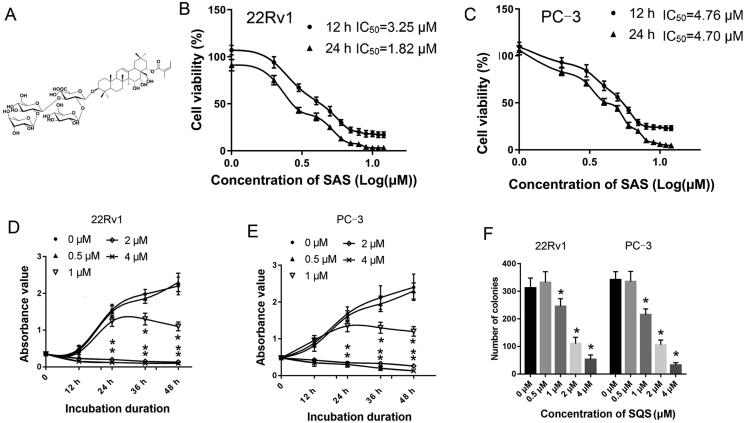
Materials and methods: PC cell lines (22Rv1 and PC-3) were treated with SQS (0, 0.5, 1, 2, and 4 μM) for 12 or 24 h. The viability of cells was evaluated, while the mRNA and protein levels of epithelial to mesenchymal transition (EMT)-related genes in PC cell lines were measured (Groups: Control, TGF-β1, TNF-α, TGF-β1 + TNF-α, and TGF-β1 + TNF-α + SQS). The migration and invasion abilities of PC cell lines were evaluated (Groups: Control, SQS). Finally, the antitumour effect of SQS (25, 50,100, and 200 mg/kg) in BALB/c nude mice (6 weeks, 18-20 g) was evaluated (Groups: Control, Vehicle, 25, 50,100, and 200 mg/kg SQS). The study duration was 1 month.
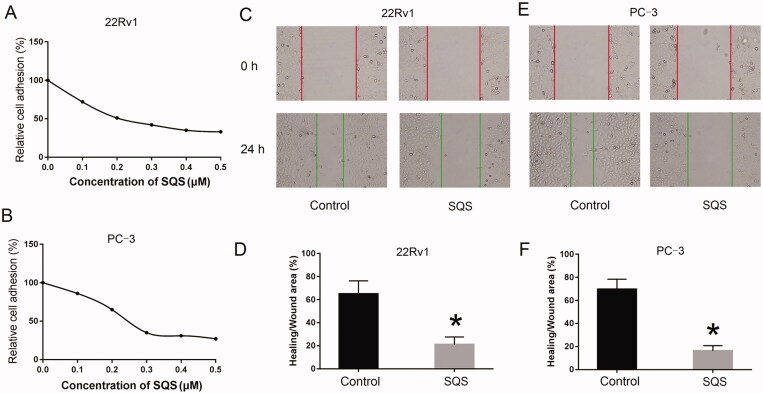
Results: SQS inhibited the viability and the number of colonies of 22Rv1 or PC-3 cells. The IC50 of SQS of 12 and 24 h in these two cells was 3.25, 1.82, 4.76, and 4.70 μM, respectively. SQS inhibited the adhesion, migration, and invasion of PC cells. It also inhibited the expression of EMT-related markers of PC cells. The PI3K/Akt/mTOR and Smad2/3 signalling pathways were activated in the process of EMT, and SQS could significantly reduce the activation of the PI3K/Akt/mTOR and Smad2/3 pathways. Finally, SQS inhibited the growth of xenograft tumours in vivo.
Conclusions: SQS inhibited EMT in PC by regulating the PI3K/Akt/mTOR and Smad pathways.
期刊介绍:
Pharmaceutical Biology will publish manuscripts describing the discovery, methods for discovery, description, analysis characterization, and production/isolation (including sources and surveys) of biologically-active chemicals or other substances, drugs, pharmaceutical products, or preparations utilized in systems of traditional medicine.
Topics may generally encompass any facet of natural product research related to pharmaceutical biology. Papers dealing with agents or topics related to natural product drugs are also appropriate (e.g., semi-synthetic derivatives). Manuscripts will be published as reviews, perspectives, regular research articles, and short communications. The primary criteria for acceptance and publication are scientific rigor and potential to advance the field.



 京公网安备 11010802042870号
京ICP备2023020795号-1
京公网安备 11010802042870号
京ICP备2023020795号-1

 分享
分享
 求助内容:
求助内容: 应助结果提醒方式:
 扫码关注我们
