Bacopa monnieri Phytochemicals Mediated Synthesis of Platinum Nanoparticles and Its Neurorescue Effect on 1-Methyl 4-Phenyl 1,2,3,6 Tetrahydropyridine-Induced Experimental Parkinsonism in Zebrafish.
{"title":"Bacopa monnieri Phytochemicals Mediated Synthesis of Platinum Nanoparticles and Its Neurorescue Effect on 1-Methyl 4-Phenyl 1,2,3,6 Tetrahydropyridine-Induced Experimental Parkinsonism in Zebrafish.","authors":"Jayshree Nellore, Cynthia Pauline, Kanchana Amarnath","doi":"10.1155/2013/972391","DOIUrl":null,"url":null,"abstract":"<p><p>Current discovery demonstrates the rapid formation of platinum nanoparticles using leaf extract of a neurobeneficial plant, Bacopa monnieri (BmE). The nanoparticles (BmE-PtNPs) were stabilized and then coated with varied phytochemicals present within the leaf extract. These nanoparticles demonstrated the same activity of Complex I, as that of oxidizing NADH to NAD(+) using a spectrophotometric method. This suggests that BmE-PtNPs are a potential medicinal substance for oxidative stress mediated disease with suppressed mitochondrial complex I, namely, Parkinson's disease (PD). Hence, the neuroprotective potentials of the phytochemical coated nanoparticle were explored in 1-methyl 4-phenyl 1,2,3,6 tetrahydropyridine- (MPTP-)induced experimental Parkinsonism in zebrafish model. BmE-PtNPs pretreatment significantly reversed toxic effects of MPTP by increasing the levels of dopamine, its metabolites, GSH and activities of GPx, catalase, SOD and complex I, and reducing levels of MDA along with enhanced locomotor activity. Taken together, these findings suggest that BmE-PtNPs have protective effect in MPTP-induced neurotoxicity in this model of Parkinson's disease via their dual functions as mitochondrial complex I and antioxidant activity. </p>","PeriodicalId":16405,"journal":{"name":"Journal of Neurodegenerative Diseases","volume":"2013 ","pages":"972391"},"PeriodicalIF":0.0000,"publicationDate":"2013-01-01","publicationTypes":"Journal Article","fieldsOfStudy":null,"isOpenAccess":false,"openAccessPdf":"https://sci-hub-pdf.com/10.1155/2013/972391","citationCount":"72","resultStr":null,"platform":"Semanticscholar","paperid":null,"PeriodicalName":"Journal of Neurodegenerative Diseases","FirstCategoryId":"1085","ListUrlMain":"https://doi.org/10.1155/2013/972391","RegionNum":0,"RegionCategory":null,"ArticlePicture":[],"TitleCN":null,"AbstractTextCN":null,"PMCID":null,"EPubDate":"2013/3/4 0:00:00","PubModel":"Epub","JCR":"","JCRName":"","Score":null,"Total":0}
引用次数: 72
Abstract
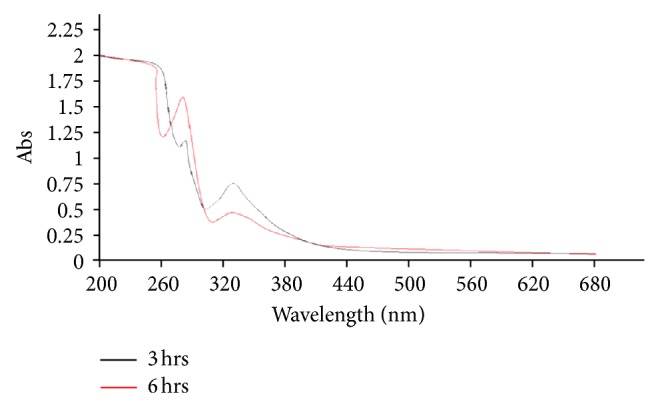
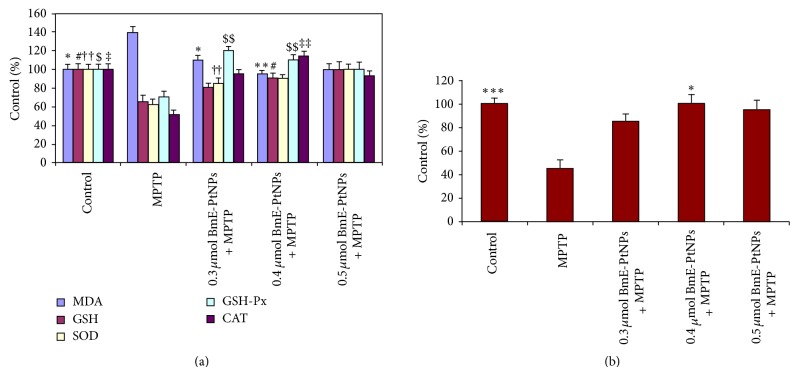
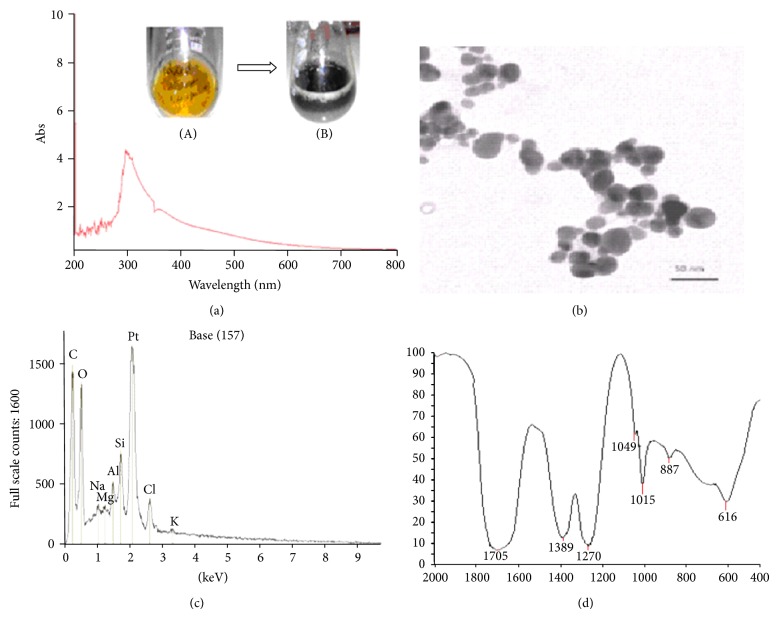
Current discovery demonstrates the rapid formation of platinum nanoparticles using leaf extract of a neurobeneficial plant, Bacopa monnieri (BmE). The nanoparticles (BmE-PtNPs) were stabilized and then coated with varied phytochemicals present within the leaf extract. These nanoparticles demonstrated the same activity of Complex I, as that of oxidizing NADH to NAD(+) using a spectrophotometric method. This suggests that BmE-PtNPs are a potential medicinal substance for oxidative stress mediated disease with suppressed mitochondrial complex I, namely, Parkinson's disease (PD). Hence, the neuroprotective potentials of the phytochemical coated nanoparticle were explored in 1-methyl 4-phenyl 1,2,3,6 tetrahydropyridine- (MPTP-)induced experimental Parkinsonism in zebrafish model. BmE-PtNPs pretreatment significantly reversed toxic effects of MPTP by increasing the levels of dopamine, its metabolites, GSH and activities of GPx, catalase, SOD and complex I, and reducing levels of MDA along with enhanced locomotor activity. Taken together, these findings suggest that BmE-PtNPs have protective effect in MPTP-induced neurotoxicity in this model of Parkinson's disease via their dual functions as mitochondrial complex I and antioxidant activity.



 京公网安备 11010802042870号
京ICP备2023020795号-1
京公网安备 11010802042870号
京ICP备2023020795号-1

 分享
分享

 求助内容:
求助内容: 应助结果提醒方式:
 扫码关注我们
