Andra D. Lewis , Lauryn C. Alexander , Oriana Ovide , Olivia Duffett , James Curran , Patrick Buzzini , Tatiana Trejos
{"title":"A study on the occurrence of glass and paint across various cities in the United States—Part I: Background presence of glass in the general population","authors":"Andra D. Lewis , Lauryn C. Alexander , Oriana Ovide , Olivia Duffett , James Curran , Patrick Buzzini , Tatiana Trejos","doi":"10.1016/j.forc.2023.100497","DOIUrl":null,"url":null,"abstract":"<div><p>The plausibility of finding glass fragments by chance in the general population becomes a relevant question when assessing glass recovered from someone suspected of being involved in an illegal activity implicating glass breaking. This research addresses this question in United States regions by searching the apparel of individuals assumed to be unconnected with crimes involving glass breaking. A large-scale study was conducted in the two metropolitan areas of Houston, TX, and Pittsburgh, PA, and the two suburban areas of Huntsville, TX, and Morgantown, WV. A total of 1,883 items of clothing and footwear were searched from 410 subjects, using tape liftings for garment areas and scrapings from the footwear soles. A total of eight glass fragments were recovered, five from the Houston set and one from each of the three other locations. No more than one glass fragment was recovered on a given item. The findings confirm that it is highly unlikely to observe glass fragments on the garments of individuals from the general population, and it is even less likely to find many fragments. Examination of glass by refractive index and micro-x-ray fluorescence spectrometry enabled their differentiation and classification by end-use. A zeta distribution and the R package <em>fitPS</em> developed for this study were used to estimate two parameters typically used for activity level likelihood ratio formulas: the probabilities of observing a given number of groups of fragments on target garments (<em>P</em>) and a particular number of fragments within an observed group (<em>S</em>).</p></div>","PeriodicalId":324,"journal":{"name":"Forensic Chemistry","volume":"34 ","pages":"Article 100497"},"PeriodicalIF":2.2000,"publicationDate":"2023-07-01","publicationTypes":"Journal Article","fieldsOfStudy":null,"isOpenAccess":false,"openAccessPdf":"","citationCount":"0","resultStr":null,"platform":"Semanticscholar","paperid":null,"PeriodicalName":"Forensic Chemistry","FirstCategoryId":"3","ListUrlMain":"https://www.sciencedirect.com/science/article/pii/S2468170923000334","RegionNum":3,"RegionCategory":"医学","ArticlePicture":[],"TitleCN":null,"AbstractTextCN":null,"PMCID":null,"EPubDate":"","PubModel":"","JCR":"Q2","JCRName":"CHEMISTRY, ANALYTICAL","Score":null,"Total":0}
引用次数: 0
Abstract
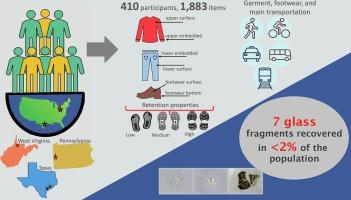
The plausibility of finding glass fragments by chance in the general population becomes a relevant question when assessing glass recovered from someone suspected of being involved in an illegal activity implicating glass breaking. This research addresses this question in United States regions by searching the apparel of individuals assumed to be unconnected with crimes involving glass breaking. A large-scale study was conducted in the two metropolitan areas of Houston, TX, and Pittsburgh, PA, and the two suburban areas of Huntsville, TX, and Morgantown, WV. A total of 1,883 items of clothing and footwear were searched from 410 subjects, using tape liftings for garment areas and scrapings from the footwear soles. A total of eight glass fragments were recovered, five from the Houston set and one from each of the three other locations. No more than one glass fragment was recovered on a given item. The findings confirm that it is highly unlikely to observe glass fragments on the garments of individuals from the general population, and it is even less likely to find many fragments. Examination of glass by refractive index and micro-x-ray fluorescence spectrometry enabled their differentiation and classification by end-use. A zeta distribution and the R package fitPS developed for this study were used to estimate two parameters typically used for activity level likelihood ratio formulas: the probabilities of observing a given number of groups of fragments on target garments (P) and a particular number of fragments within an observed group (S).
期刊介绍:
Forensic Chemistry publishes high quality manuscripts focusing on the theory, research and application of any chemical science to forensic analysis. The scope of the journal includes fundamental advancements that result in a better understanding of the evidentiary significance derived from the physical and chemical analysis of materials. The scope of Forensic Chemistry will also include the application and or development of any molecular and atomic spectrochemical technique, electrochemical techniques, sensors, surface characterization techniques, mass spectrometry, nuclear magnetic resonance, chemometrics and statistics, and separation sciences (e.g. chromatography) that provide insight into the forensic analysis of materials. Evidential topics of interest to the journal include, but are not limited to, fingerprint analysis, drug analysis, ignitable liquid residue analysis, explosives detection and analysis, the characterization and comparison of trace evidence (glass, fibers, paints and polymers, tapes, soils and other materials), ink and paper analysis, gunshot residue analysis, synthetic pathways for drugs, toxicology and the analysis and chemistry associated with the components of fingermarks. The journal is particularly interested in receiving manuscripts that report advances in the forensic interpretation of chemical evidence. Technology Readiness Level: When submitting an article to Forensic Chemistry, all authors will be asked to self-assign a Technology Readiness Level (TRL) to their article. The purpose of the TRL system is to help readers understand the level of maturity of an idea or method, to help track the evolution of readiness of a given technique or method, and to help filter published articles by the expected ease of implementation in an operation setting within a crime lab.



 京公网安备 11010802042870号
京ICP备2023020795号-1
京公网安备 11010802042870号
京ICP备2023020795号-1

 分享
分享
 求助内容:
求助内容: 应助结果提醒方式:
 扫码关注我们
