{"title":"Effects of dietary marigold extract supplementation on growth performance, pigmentation, antioxidant capacity and meat quality in broiler chickens.","authors":"Shuhao Wang, Lin Zhang, Jiaolong Li, Jiahui Cong, Feng Gao, Guanghong Zhou","doi":"10.5713/ajas.16.0075","DOIUrl":null,"url":null,"abstract":"<p><strong>Objective: </strong>This experiment was conducted to investigate the effects of dietary supplementation with marigold extract on growth performance, pigmentation, antioxidant capacity and meat quality in broiler chickens.</p><p><strong>Methods: </strong>A total of 320 one-day-old Arbor Acres chickens were randomly divided into 5 groups with 8 replicates of 8 chickens each. The chickens of control group were fed with basal diet and other experimental groups were fed with basal diet supplemented with 0.075%, 0.15%, 0.30%, and 0.60% marigold extract respectively (the corresponding concentrations of lutein were 15, 30, 60, and 120 mg/kg).</p><p><strong>Results: </strong>The results showed that marigold extract supplementation increased the yellowness values of shank, beak, skin and muscle and the redness (a*) value of thigh muscle (linear, p<0.01). Marigold extract supplementation significantly increased the total antioxidant capacity, and the activities of superoxide dismutase in liver and thigh muscle (linear, p<0.01) and significantly decreased the malondialdehyde contents of liver and thigh muscle (linear, p<0.01). Marigold extract supplementation significantly decreased the drip loss and shear force of thigh muscles (linear, p<0.01). There was no significant effect on growth performance with marigold extract supplementation.</p><p><strong>Conclusion: </strong>In conclusion, dietary supplementation of marigold extract significantly increased the yellowness values of carcass, antioxidant capacity and meat quality in broiler chickens.</p>","PeriodicalId":8558,"journal":{"name":"Asian-Australasian Journal of Animal Sciences","volume":"30 1","pages":"71-77"},"PeriodicalIF":2.2000,"publicationDate":"2017-01-01","publicationTypes":"Journal Article","fieldsOfStudy":null,"isOpenAccess":false,"openAccessPdf":"https://sci-hub-pdf.com/10.5713/ajas.16.0075","citationCount":"45","resultStr":null,"platform":"Semanticscholar","paperid":null,"PeriodicalName":"Asian-Australasian Journal of Animal Sciences","FirstCategoryId":"1085","ListUrlMain":"https://doi.org/10.5713/ajas.16.0075","RegionNum":2,"RegionCategory":"农林科学","ArticlePicture":[],"TitleCN":null,"AbstractTextCN":null,"PMCID":null,"EPubDate":"2016/6/9 0:00:00","PubModel":"Epub","JCR":"","JCRName":"","Score":null,"Total":0}
引用次数: 45
Abstract
Objective: This experiment was conducted to investigate the effects of dietary supplementation with marigold extract on growth performance, pigmentation, antioxidant capacity and meat quality in broiler chickens.
Methods: A total of 320 one-day-old Arbor Acres chickens were randomly divided into 5 groups with 8 replicates of 8 chickens each. The chickens of control group were fed with basal diet and other experimental groups were fed with basal diet supplemented with 0.075%, 0.15%, 0.30%, and 0.60% marigold extract respectively (the corresponding concentrations of lutein were 15, 30, 60, and 120 mg/kg).
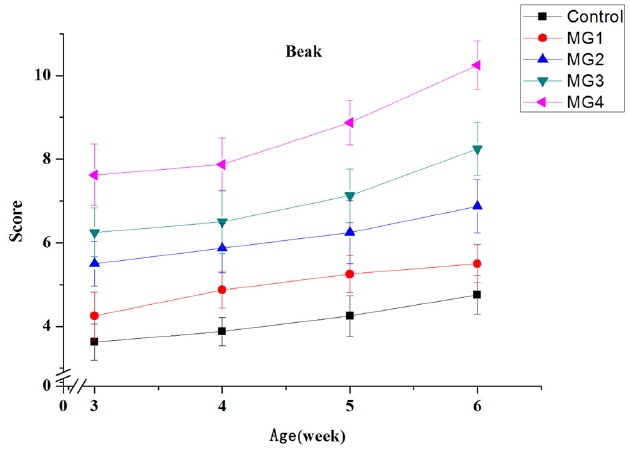
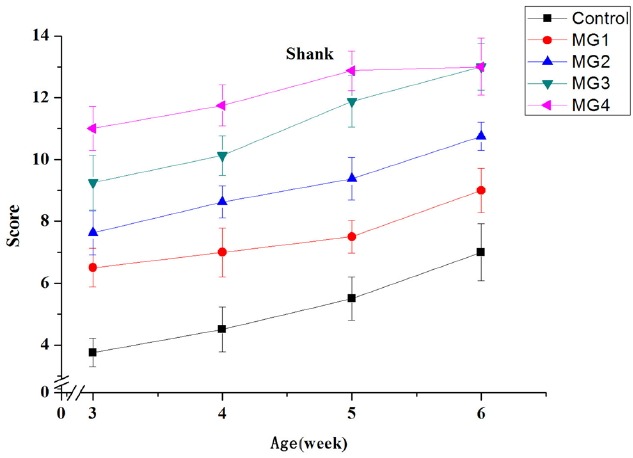
Results: The results showed that marigold extract supplementation increased the yellowness values of shank, beak, skin and muscle and the redness (a*) value of thigh muscle (linear, p<0.01). Marigold extract supplementation significantly increased the total antioxidant capacity, and the activities of superoxide dismutase in liver and thigh muscle (linear, p<0.01) and significantly decreased the malondialdehyde contents of liver and thigh muscle (linear, p<0.01). Marigold extract supplementation significantly decreased the drip loss and shear force of thigh muscles (linear, p<0.01). There was no significant effect on growth performance with marigold extract supplementation.
Conclusion: In conclusion, dietary supplementation of marigold extract significantly increased the yellowness values of carcass, antioxidant capacity and meat quality in broiler chickens.
期刊介绍:
Asian-Australasian Journal of Animal Sciences (AJAS) aims to publish original and cutting-edge research results and reviews on animal-related aspects of the life sciences. Emphasis will be placed on studies involving farm animals such as cattle, buffaloes, sheep, goats, pigs, horses, and poultry. Studies for the improvement of human health using animal models may also be publishable.
AJAS will encompass all areas of animal production and fundamental aspects of animal sciences: breeding and genetics, reproduction and physiology, nutrition, meat and milk science, biotechnology, behavior, welfare, health, and livestock farming systems.



 京公网安备 11010802042870号
京ICP备2023020795号-1
京公网安备 11010802042870号
京ICP备2023020795号-1

 分享
分享
 求助内容:
求助内容: 应助结果提醒方式:
 扫码关注我们
