Waleed Amjad Khan, Hu Chun-Mei, Nadeem Khan, Amjad Iqbal, Shan-Wu Lyu, Farooq Shah
{"title":"Bioengineered Plants Can Be a Useful Source of Omega-3 Fatty Acids.","authors":"Waleed Amjad Khan, Hu Chun-Mei, Nadeem Khan, Amjad Iqbal, Shan-Wu Lyu, Farooq Shah","doi":"10.1155/2017/7348919","DOIUrl":null,"url":null,"abstract":"<p><p>Omega-3 fatty acids have proven to be very essential for human health due to their multiple health benefits. These essential fatty acids (EFAs) need to be uptaken through diet because they are unable to be produced by the human body. These are important for skin and hair growth as well as for proper visual, neural, and reproductive functions of the body. These fatty acids are proven to be extremely vital for normal tissue development during pregnancy and infancy. Omega-3 fatty acids can be obtained mainly from two dietary sources: marine and plant oils. Eicosapentaenoic acid (EPA; C20:5 n-3) and docosahexaenoic acid (DHA; C22:6 n-3) are the primary marine-derived omega-3 fatty acids. Marine fishes are high in omega-3 fatty acids, yet high consumption of those fishes will cause a shortage of fish stocks existing naturally in the oceans. An alternative source to achieve the recommended daily intake of EFAs is the demand of today. In this review article, an attempt has, therefore, been made to discuss the importance of omega-3 fatty acids and the recent developments in order to produce these fatty acids by the genetic modifications of the plants.</p>","PeriodicalId":2,"journal":{"name":"ACS Applied Bio Materials","volume":" ","pages":"7348919"},"PeriodicalIF":4.7000,"publicationDate":"2017-01-01","publicationTypes":"Journal Article","fieldsOfStudy":null,"isOpenAccess":false,"openAccessPdf":"https://www.ncbi.nlm.nih.gov/pmc/articles/PMC5339522/pdf/","citationCount":"0","resultStr":null,"platform":"Semanticscholar","paperid":null,"PeriodicalName":"ACS Applied Bio Materials","FirstCategoryId":"99","ListUrlMain":"https://doi.org/10.1155/2017/7348919","RegionNum":0,"RegionCategory":null,"ArticlePicture":[],"TitleCN":null,"AbstractTextCN":null,"PMCID":null,"EPubDate":"2017/2/21 0:00:00","PubModel":"Epub","JCR":"Q2","JCRName":"MATERIALS SCIENCE, BIOMATERIALS","Score":null,"Total":0}
引用次数: 0
Abstract
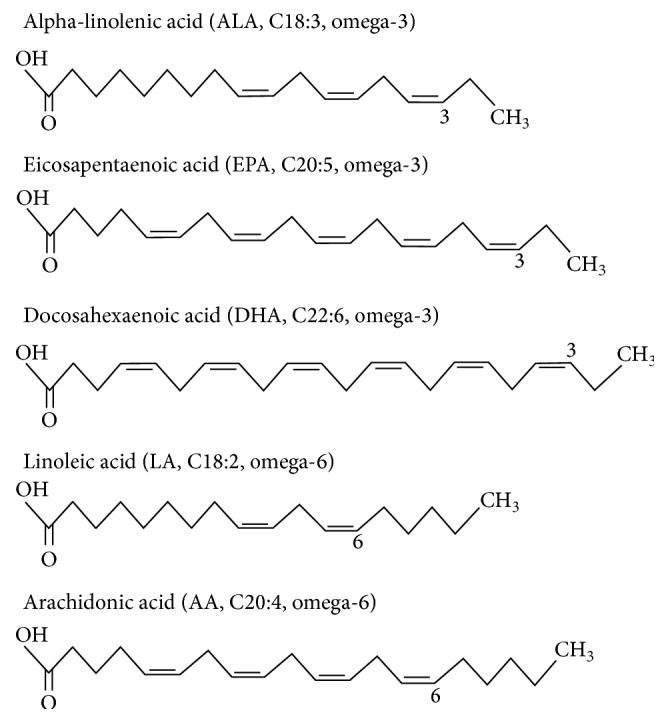
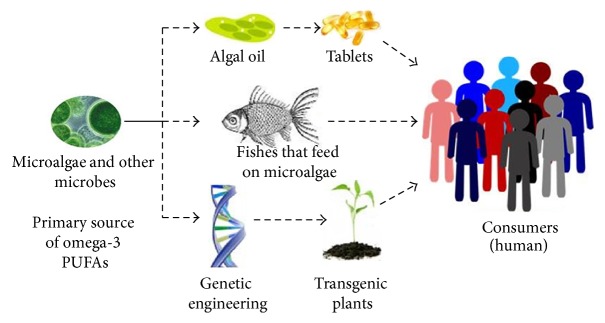
Omega-3 fatty acids have proven to be very essential for human health due to their multiple health benefits. These essential fatty acids (EFAs) need to be uptaken through diet because they are unable to be produced by the human body. These are important for skin and hair growth as well as for proper visual, neural, and reproductive functions of the body. These fatty acids are proven to be extremely vital for normal tissue development during pregnancy and infancy. Omega-3 fatty acids can be obtained mainly from two dietary sources: marine and plant oils. Eicosapentaenoic acid (EPA; C20:5 n-3) and docosahexaenoic acid (DHA; C22:6 n-3) are the primary marine-derived omega-3 fatty acids. Marine fishes are high in omega-3 fatty acids, yet high consumption of those fishes will cause a shortage of fish stocks existing naturally in the oceans. An alternative source to achieve the recommended daily intake of EFAs is the demand of today. In this review article, an attempt has, therefore, been made to discuss the importance of omega-3 fatty acids and the recent developments in order to produce these fatty acids by the genetic modifications of the plants.
期刊介绍:
ACS Applied Bio Materials is an interdisciplinary journal publishing original research covering all aspects of biomaterials and biointerfaces including and beyond the traditional biosensing, biomedical and therapeutic applications.
The journal is devoted to reports of new and original experimental and theoretical research of an applied nature that integrates knowledge in the areas of materials, engineering, physics, bioscience, and chemistry into important bio applications. The journal is specifically interested in work that addresses the relationship between structure and function and assesses the stability and degradation of materials under relevant environmental and biological conditions.




 京公网安备 11010802042870号
京ICP备2023020795号-1
京公网安备 11010802042870号
京ICP备2023020795号-1

 分享
分享
 求助内容:
求助内容: 应助结果提醒方式:
 扫码关注我们
