Gregory A. Roth MD, MPH , Catherine Johnson PhD , Amanuel Abajobir MPH , Foad Abd-Allah MD , Semaw Ferede Abera MSc , Gebre Abyu MS , Muktar Ahmed MPH, MBA , Baran Aksut MD , Tahiya Alam MPH , Khurshid Alam PhD , François Alla PhD , Nelson Alvis-Guzman PhD , Stephen Amrock MD , Hossein Ansari PhD , Johan Ärnlöv PhD , Hamid Asayesh PhD , Tesfay Mehari Atey MSc , Leticia Avila-Burgos PhD , Ashish Awasthi MSc , Amitava Banerjee DPhil , Christopher Murray DPhil
{"title":"Global, Regional, and National Burden of Cardiovascular Diseases for 10 Causes, 1990 to 2015","authors":"Gregory A. Roth MD, MPH , Catherine Johnson PhD , Amanuel Abajobir MPH , Foad Abd-Allah MD , Semaw Ferede Abera MSc , Gebre Abyu MS , Muktar Ahmed MPH, MBA , Baran Aksut MD , Tahiya Alam MPH , Khurshid Alam PhD , François Alla PhD , Nelson Alvis-Guzman PhD , Stephen Amrock MD , Hossein Ansari PhD , Johan Ärnlöv PhD , Hamid Asayesh PhD , Tesfay Mehari Atey MSc , Leticia Avila-Burgos PhD , Ashish Awasthi MSc , Amitava Banerjee DPhil , Christopher Murray DPhil","doi":"10.1016/j.jacc.2017.04.052","DOIUrl":null,"url":null,"abstract":"<div><h3>Background</h3><p>The burden of cardiovascular diseases (CVDs) remains unclear in many regions of the world.</p></div><div><h3>Objectives</h3><p>The GBD (Global Burden of Disease) 2015 study integrated data on disease incidence, prevalence, and mortality to produce consistent, up-to-date estimates for cardiovascular burden.</p></div><div><h3>Methods</h3><p>CVD mortality was estimated from vital registration and verbal autopsy data. CVD prevalence was estimated using modeling software and data from health surveys, prospective cohorts, health system administrative data, and registries. Years lived with disability (YLD) were estimated by multiplying prevalence by disability weights. Years of life lost (YLL) were estimated by multiplying age-specific CVD deaths by a reference life expectancy. A sociodemographic index (SDI) was created for each location based on income per capita, educational attainment, and fertility.</p></div><div><h3>Results</h3><p>In 2015, there were an estimated 422.7 million cases of CVD (95% uncertainty interval: 415.53 to 427.87 million cases) and 17.92 million CVD deaths (95% uncertainty interval: 17.59 to 18.28 million CVD deaths). Declines in the age-standardized CVD death rate occurred between 1990 and 2015 in all high-income and some middle-income countries. Ischemic heart disease was the leading cause of CVD health lost globally, as well as in each world region, followed by stroke. As SDI increased beyond 0.25, the highest CVD mortality shifted from women to men. CVD mortality decreased sharply for both sexes in countries with an SDI >0.75.</p></div><div><h3>Conclusions</h3><p>CVDs remain a major cause of health loss for all regions of the world. Sociodemographic change over the past 25 years has been associated with dramatic declines in CVD in regions with very high SDI, but only a gradual decrease or no change in most regions. Future updates of the GBD study can be used to guide policymakers who are focused on reducing the overall burden of noncommunicable disease and achieving specific global health targets for CVD.</p></div>","PeriodicalId":17187,"journal":{"name":"Journal of the American College of Cardiology","volume":"70 1","pages":"Pages 1-25"},"PeriodicalIF":22.3000,"publicationDate":"2017-07-04","publicationTypes":"Journal Article","fieldsOfStudy":null,"isOpenAccess":false,"openAccessPdf":"https://sci-hub-pdf.com/10.1016/j.jacc.2017.04.052","citationCount":"2537","resultStr":null,"platform":"Semanticscholar","paperid":null,"PeriodicalName":"Journal of the American College of Cardiology","FirstCategoryId":"3","ListUrlMain":"https://www.sciencedirect.com/science/article/pii/S0735109717372443","RegionNum":1,"RegionCategory":"医学","ArticlePicture":[],"TitleCN":null,"AbstractTextCN":null,"PMCID":null,"EPubDate":"","PubModel":"","JCR":"Q1","JCRName":"CARDIAC & CARDIOVASCULAR SYSTEMS","Score":null,"Total":0}
引用次数: 2537
Abstract
Background
The burden of cardiovascular diseases (CVDs) remains unclear in many regions of the world.
Objectives
The GBD (Global Burden of Disease) 2015 study integrated data on disease incidence, prevalence, and mortality to produce consistent, up-to-date estimates for cardiovascular burden.
Methods
CVD mortality was estimated from vital registration and verbal autopsy data. CVD prevalence was estimated using modeling software and data from health surveys, prospective cohorts, health system administrative data, and registries. Years lived with disability (YLD) were estimated by multiplying prevalence by disability weights. Years of life lost (YLL) were estimated by multiplying age-specific CVD deaths by a reference life expectancy. A sociodemographic index (SDI) was created for each location based on income per capita, educational attainment, and fertility.
Results
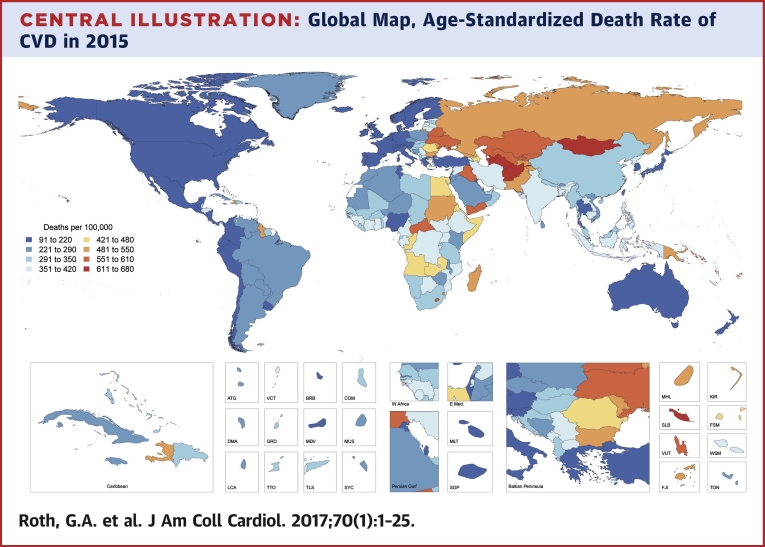
In 2015, there were an estimated 422.7 million cases of CVD (95% uncertainty interval: 415.53 to 427.87 million cases) and 17.92 million CVD deaths (95% uncertainty interval: 17.59 to 18.28 million CVD deaths). Declines in the age-standardized CVD death rate occurred between 1990 and 2015 in all high-income and some middle-income countries. Ischemic heart disease was the leading cause of CVD health lost globally, as well as in each world region, followed by stroke. As SDI increased beyond 0.25, the highest CVD mortality shifted from women to men. CVD mortality decreased sharply for both sexes in countries with an SDI >0.75.
Conclusions
CVDs remain a major cause of health loss for all regions of the world. Sociodemographic change over the past 25 years has been associated with dramatic declines in CVD in regions with very high SDI, but only a gradual decrease or no change in most regions. Future updates of the GBD study can be used to guide policymakers who are focused on reducing the overall burden of noncommunicable disease and achieving specific global health targets for CVD.
期刊介绍:
The Journal of the American College of Cardiology (JACC) publishes peer-reviewed articles highlighting all aspects of cardiovascular disease, including original clinical studies, experimental investigations with clear clinical relevance, state-of-the-art papers and viewpoints.
Content Profile:
-Original Investigations
-JACC State-of-the-Art Reviews
-JACC Review Topics of the Week
-Guidelines & Clinical Documents
-JACC Guideline Comparisons
-JACC Scientific Expert Panels
-Cardiovascular Medicine & Society
-Editorial Comments (accompanying every Original Investigation)
-Research Letters
-Fellows-in-Training/Early Career Professional Pages
-Editor’s Pages from the Editor-in-Chief or other invited thought leaders





 京公网安备 11010802042870号
京ICP备2023020795号-1
京公网安备 11010802042870号
京ICP备2023020795号-1

 分享
分享
 求助内容:
求助内容: 应助结果提醒方式:
 扫码关注我们
