Félice Lê-Scherban , Allison B. Brenner , Robert F. Schoeni
{"title":"Childhood family wealth and mental health in a national cohort of young adults","authors":"Félice Lê-Scherban , Allison B. Brenner , Robert F. Schoeni","doi":"10.1016/j.ssmph.2016.10.008","DOIUrl":null,"url":null,"abstract":"<div><h3>Purpose</h3><p>Mental health is critical to young adult health, as the onset of 75% of psychiatric disorders occurs by age 24 and psychiatric disorders early in life predict later behavioral health problems. Wealth may serve as a buffer against economic stressors. Family wealth may be particularly relevant for young adults by providing them with economic resources as they make educational decisions and move towards financial and social independence.</p></div><div><h3>Methods</h3><p>We used prospectively collected data from 2060 young adults aged 18–27 in 2005–2011 from the Panel Study of Income Dynamics, a national cohort of US families. We examined associations between nonspecific psychological distress (measured with the K-6 scale) and childhood average household wealth during ages 0–18 years (net worth in 2010 dollars).</p></div><div><h3>Results</h3><p>In demographics-adjusted generalized estimating equation models, higher childhood wealth percentile was related to a lower prevalence of serious psychological distress: compared to lowest-quartile wealth, prevalence ratio (PR)=0.52 (0.32–0.85) for 3rd quartile and PR=0.41 (0.24–0.68) for 4th quartile. The associations were attenuated slightly by adjustment for parent education and more so by adjustment for childhood household income percentile.</p></div><div><h3>Conclusions</h3><p>Understanding the lifelong processes through which distinct aspects of socioeconomic status affect mental health can help us identify high-risk populations and take steps to minimize future disparities in mental illness.</p></div>","PeriodicalId":47780,"journal":{"name":"Ssm-Population Health","volume":"2 ","pages":"Pages 798-806"},"PeriodicalIF":3.7000,"publicationDate":"2016-12-01","publicationTypes":"Journal Article","fieldsOfStudy":null,"isOpenAccess":false,"openAccessPdf":"https://sci-hub-pdf.com/10.1016/j.ssmph.2016.10.008","citationCount":"36","resultStr":null,"platform":"Semanticscholar","paperid":null,"PeriodicalName":"Ssm-Population Health","FirstCategoryId":"3","ListUrlMain":"https://www.sciencedirect.com/science/article/pii/S2352827316301161","RegionNum":2,"RegionCategory":"医学","ArticlePicture":[],"TitleCN":null,"AbstractTextCN":null,"PMCID":null,"EPubDate":"2016/10/18 0:00:00","PubModel":"Epub","JCR":"Q1","JCRName":"PUBLIC, ENVIRONMENTAL & OCCUPATIONAL HEALTH","Score":null,"Total":0}
引用次数: 36
Abstract
Purpose
Mental health is critical to young adult health, as the onset of 75% of psychiatric disorders occurs by age 24 and psychiatric disorders early in life predict later behavioral health problems. Wealth may serve as a buffer against economic stressors. Family wealth may be particularly relevant for young adults by providing them with economic resources as they make educational decisions and move towards financial and social independence.
Methods
We used prospectively collected data from 2060 young adults aged 18–27 in 2005–2011 from the Panel Study of Income Dynamics, a national cohort of US families. We examined associations between nonspecific psychological distress (measured with the K-6 scale) and childhood average household wealth during ages 0–18 years (net worth in 2010 dollars).
Results
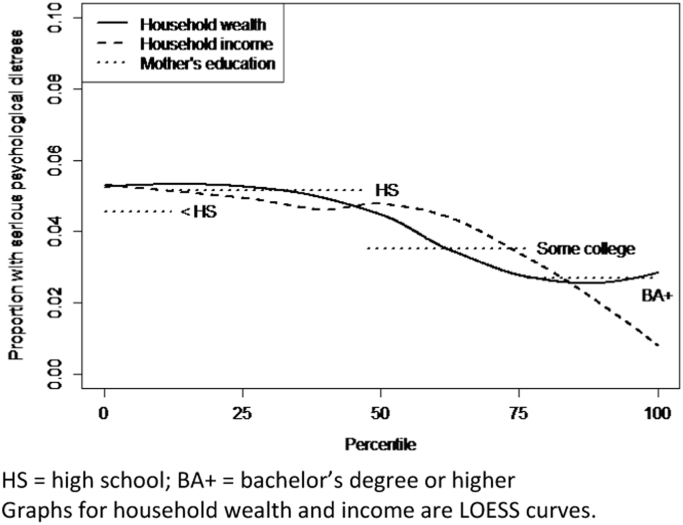
In demographics-adjusted generalized estimating equation models, higher childhood wealth percentile was related to a lower prevalence of serious psychological distress: compared to lowest-quartile wealth, prevalence ratio (PR)=0.52 (0.32–0.85) for 3rd quartile and PR=0.41 (0.24–0.68) for 4th quartile. The associations were attenuated slightly by adjustment for parent education and more so by adjustment for childhood household income percentile.
Conclusions
Understanding the lifelong processes through which distinct aspects of socioeconomic status affect mental health can help us identify high-risk populations and take steps to minimize future disparities in mental illness.
期刊介绍:
SSM - Population Health. The new online only, open access, peer reviewed journal in all areas relating Social Science research to population health. SSM - Population Health shares the same Editors-in Chief and general approach to manuscripts as its sister journal, Social Science & Medicine. The journal takes a broad approach to the field especially welcoming interdisciplinary papers from across the Social Sciences and allied areas. SSM - Population Health offers an alternative outlet for work which might not be considered, or is classed as ''out of scope'' elsewhere, and prioritizes fast peer review and publication to the benefit of authors and readers. The journal welcomes all types of paper from traditional primary research articles, replication studies, short communications, methodological studies, instrument validation, opinion pieces, literature reviews, etc. SSM - Population Health also offers the opportunity to publish special issues or sections to reflect current interest and research in topical or developing areas. The journal fully supports authors wanting to present their research in an innovative fashion though the use of multimedia formats.





 京公网安备 11010802042870号
京ICP备2023020795号-1
京公网安备 11010802042870号
京ICP备2023020795号-1

 分享
分享
 求助内容:
求助内容: 应助结果提醒方式:
 扫码关注我们
