Ralf Everaers, Alexander Y. Grosberg, Michael Rubinstein and Angelo Rosa
{"title":"Flory theory of randomly branched polymers","authors":"Ralf Everaers, Alexander Y. Grosberg, Michael Rubinstein and Angelo Rosa","doi":"10.1039/C6SM02756C","DOIUrl":null,"url":null,"abstract":"<p >Randomly branched polymer chains (or trees) are a classical subject of polymer physics with connections to the theory of magnetic systems, percolation and critical phenomena. More recently, the model has been reconsidered for RNA, supercoiled DNA and the crumpling of topologically-constrained polymers. While solvable in the ideal case, little is known exactly about randomly branched polymers with volume interactions. Flory theory provides a simple, unifying description for a wide range of branched systems, including isolated trees in good and θ-solvent, and tree melts. In particular, the approach provides a common framework for the description of randomly branched polymers with quenched connectivity and for randomly branching polymers with annealed connectivity. Here we review the Flory theory for interacting trees in the asymptotic limit of very large polymerization degree for good solvent, θ-solutions and melts, and report its predictions for annealed connectivity in θ-solvents. We compare the predictions of Flory theory for randomly branched polymers to a wide range of available analytical and numerical results and conclude that they are qualitatively excellent and quantitatively good in most cases.</p>","PeriodicalId":103,"journal":{"name":"Soft Matter","volume":" 6","pages":" 1223-1234"},"PeriodicalIF":2.8000,"publicationDate":"2017-01-11","publicationTypes":"Journal Article","fieldsOfStudy":null,"isOpenAccess":false,"openAccessPdf":"https://sci-hub-pdf.com/10.1039/C6SM02756C","citationCount":"46","resultStr":null,"platform":"Semanticscholar","paperid":null,"PeriodicalName":"Soft Matter","FirstCategoryId":"92","ListUrlMain":"https://pubs.rsc.org/en/content/articlelanding/2017/sm/c6sm02756c","RegionNum":3,"RegionCategory":"化学","ArticlePicture":[],"TitleCN":null,"AbstractTextCN":null,"PMCID":null,"EPubDate":"","PubModel":"","JCR":"Q3","JCRName":"CHEMISTRY, PHYSICAL","Score":null,"Total":0}
引用次数: 46
Abstract
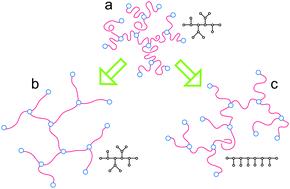
Randomly branched polymer chains (or trees) are a classical subject of polymer physics with connections to the theory of magnetic systems, percolation and critical phenomena. More recently, the model has been reconsidered for RNA, supercoiled DNA and the crumpling of topologically-constrained polymers. While solvable in the ideal case, little is known exactly about randomly branched polymers with volume interactions. Flory theory provides a simple, unifying description for a wide range of branched systems, including isolated trees in good and θ-solvent, and tree melts. In particular, the approach provides a common framework for the description of randomly branched polymers with quenched connectivity and for randomly branching polymers with annealed connectivity. Here we review the Flory theory for interacting trees in the asymptotic limit of very large polymerization degree for good solvent, θ-solutions and melts, and report its predictions for annealed connectivity in θ-solvents. We compare the predictions of Flory theory for randomly branched polymers to a wide range of available analytical and numerical results and conclude that they are qualitatively excellent and quantitatively good in most cases.
期刊介绍:
Soft Matter is an international journal published by the Royal Society of Chemistry using Engineering-Materials Science: A Synthesis as its research focus. It publishes original research articles, review articles, and synthesis articles related to this field, reporting the latest discoveries in the relevant theoretical, practical, and applied disciplines in a timely manner, and aims to promote the rapid exchange of scientific information in this subject area. The journal is an open access journal. The journal is an open access journal and has not been placed on the alert list in the last three years.



 京公网安备 11010802042870号
京ICP备2023020795号-1
京公网安备 11010802042870号
京ICP备2023020795号-1

 分享
分享
 求助内容:
求助内容: 应助结果提醒方式:
 扫码关注我们
