Ramanaskanda Braveenth, Hyuna Lee, Sohyeon Kim, Kanthasamy Raagulan, Sunghoon Kim, Jang Hyuk Kwon and Kyu Yun Chai
{"title":"High efficiency green TADF emitters of acridine donor and triazine acceptor D–A–D structures†","authors":"Ramanaskanda Braveenth, Hyuna Lee, Sohyeon Kim, Kanthasamy Raagulan, Sunghoon Kim, Jang Hyuk Kwon and Kyu Yun Chai","doi":"10.1039/C9TC02491C","DOIUrl":null,"url":null,"abstract":"<p >Two thermally activated delayed fluorescence (TADF) emitters with high synthetic yields were designed and synthesized. Both emitters, 10,10′-(5-(4,6-diphenyl-1,3,5-triazin-2-yl)-1,3-phenylene)bis(9,9-dimethyl-9,10-dihydroacridine) (<strong>TRZ-DDMAc</strong>) and 10,10′-(5-(4,6-diphenyl-1,3,5-triazin-2-yl)-1,3-phenylene)bis(9,9-diphenyl-9,10-dihydroacridine) (<strong>TRZ-DDPAc</strong>), showed excellent photophysical properties. Interestingly, both of the materials had a small energy difference between singlet and triplet levels, which confirmed that donor–acceptor based molecular design brought effective reverse intersystem crossing (RISC) to enable the TADF mechanism. The TADF characteristic was confirmed by a delay time of 10.32 and 10.37 μs for <strong>TRZ-DDMAc</strong> and <strong>TRZ-DDPAc</strong>, respectively. <strong>TRZ-DDPAc</strong> revealed a photoluminescence quantum yield of 79.7% in a doped film state. Moreover, several green OLED devices were fabricated by using different host materials along with various doping concentrations to ensure the optimal performance of each TADF material. The device with <strong>TRZ-DDPAc</strong> as an emitter (30%: DBFPO) exhibited excellent current and maximum external quantum efficiencies of 62.8 cd A<small><sup>?1</sup></small> and 27.3%, respectively. Green colour emission was observed from all devices, which originated through the TADF mechanism.</p>","PeriodicalId":84,"journal":{"name":"Journal of Materials Chemistry C","volume":" 25","pages":" 7672-7680"},"PeriodicalIF":5.1000,"publicationDate":"2019-05-22","publicationTypes":"Journal Article","fieldsOfStudy":null,"isOpenAccess":false,"openAccessPdf":"https://sci-hub-pdf.com/10.1039/C9TC02491C","citationCount":"22","resultStr":null,"platform":"Semanticscholar","paperid":null,"PeriodicalName":"Journal of Materials Chemistry C","FirstCategoryId":"1","ListUrlMain":"https://pubs.rsc.org/en/content/articlelanding/2019/tc/c9tc02491c","RegionNum":2,"RegionCategory":"材料科学","ArticlePicture":[],"TitleCN":null,"AbstractTextCN":null,"PMCID":null,"EPubDate":"","PubModel":"","JCR":"Q2","JCRName":"MATERIALS SCIENCE, MULTIDISCIPLINARY","Score":null,"Total":0}
引用次数: 22
Abstract
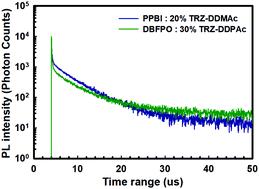
Two thermally activated delayed fluorescence (TADF) emitters with high synthetic yields were designed and synthesized. Both emitters, 10,10′-(5-(4,6-diphenyl-1,3,5-triazin-2-yl)-1,3-phenylene)bis(9,9-dimethyl-9,10-dihydroacridine) (TRZ-DDMAc) and 10,10′-(5-(4,6-diphenyl-1,3,5-triazin-2-yl)-1,3-phenylene)bis(9,9-diphenyl-9,10-dihydroacridine) (TRZ-DDPAc), showed excellent photophysical properties. Interestingly, both of the materials had a small energy difference between singlet and triplet levels, which confirmed that donor–acceptor based molecular design brought effective reverse intersystem crossing (RISC) to enable the TADF mechanism. The TADF characteristic was confirmed by a delay time of 10.32 and 10.37 μs for TRZ-DDMAc and TRZ-DDPAc, respectively. TRZ-DDPAc revealed a photoluminescence quantum yield of 79.7% in a doped film state. Moreover, several green OLED devices were fabricated by using different host materials along with various doping concentrations to ensure the optimal performance of each TADF material. The device with TRZ-DDPAc as an emitter (30%: DBFPO) exhibited excellent current and maximum external quantum efficiencies of 62.8 cd A?1 and 27.3%, respectively. Green colour emission was observed from all devices, which originated through the TADF mechanism.
设计并合成了两种高合成率的热激活延迟荧光(TADF)发射器。两种发射体10,10′-(5-(4,6-二苯基-1,3,5-三嗪-2-基)-1,3-苯)双(9,9-二甲基-9,10-二氢吖啶)(TRZ-DDMAc)和10,10′-(5-(4,6-二苯基-1,3,5-三嗪-2-基)-1,3-苯)双(9,9-二苯基-9,10-二氢吖啶)(TRZ-DDPAc)均表现出优异的光物理性质。有趣的是,这两种材料在单线态和三重态水平之间的能量差异很小,这证实了基于供体-受体的分子设计带来了有效的反向系统间交叉(RISC),从而实现了TADF机制。TRZ-DDMAc和TRZ-DDPAc的延迟时间分别为10.32和10.37 μs,证实了其TADF特性。在掺杂薄膜状态下,TRZ-DDPAc的光致发光量子产率为79.7%。此外,采用不同的主体材料和不同的掺杂浓度制备了几种绿色OLED器件,以确保每种TADF材料的最佳性能。以TRZ-DDPAc作为发射极(30%:DBFPO)的器件表现出优异的电流和最大的外量子效率为62.8 cd A?分别为1%和27.3%。所有器件都有绿色发光,这是由TADF机制产生的。
期刊介绍:
The Journal of Materials Chemistry is divided into three distinct sections, A, B, and C, each catering to specific applications of the materials under study:
Journal of Materials Chemistry A focuses primarily on materials intended for applications in energy and sustainability.
Journal of Materials Chemistry B specializes in materials designed for applications in biology and medicine.
Journal of Materials Chemistry C is dedicated to materials suitable for applications in optical, magnetic, and electronic devices.
Example topic areas within the scope of Journal of Materials Chemistry C are listed below. This list is neither exhaustive nor exclusive.
Bioelectronics
Conductors
Detectors
Dielectrics
Displays
Ferroelectrics
Lasers
LEDs
Lighting
Liquid crystals
Memory
Metamaterials
Multiferroics
Photonics
Photovoltaics
Semiconductors
Sensors
Single molecule conductors
Spintronics
Superconductors
Thermoelectrics
Topological insulators
Transistors



 京公网安备 11010802042870号
京ICP备2023020795号-1
京公网安备 11010802042870号
京ICP备2023020795号-1

 分享
分享
 求助内容:
求助内容: 应助结果提醒方式:
 扫码关注我们
