Yongrui Huang, Jianhao Yang, Pengkai Liao, Jiahui Pan
{"title":"Fusion of Facial Expressions and EEG for Multimodal Emotion Recognition.","authors":"Yongrui Huang, Jianhao Yang, Pengkai Liao, Jiahui Pan","doi":"10.1155/2017/2107451","DOIUrl":null,"url":null,"abstract":"<p><p>This paper proposes two multimodal fusion methods between brain and peripheral signals for emotion recognition. The input signals are electroencephalogram and facial expression. The stimuli are based on a subset of movie clips that correspond to four specific areas of valance-arousal emotional space (happiness, neutral, sadness, and fear). For facial expression detection, four basic emotion states (happiness, neutral, sadness, and fear) are detected by a neural network classifier. For EEG detection, four basic emotion states and three emotion intensity levels (strong, ordinary, and weak) are detected by two support vector machines (SVM) classifiers, respectively. Emotion recognition is based on two decision-level fusion methods of both EEG and facial expression detections by using a sum rule or a production rule. Twenty healthy subjects attended two experiments. The results show that the accuracies of two multimodal fusion detections are 81.25% and 82.75%, respectively, which are both higher than that of facial expression (74.38%) or EEG detection (66.88%). The combination of facial expressions and EEG information for emotion recognition compensates for their defects as single information sources.</p>","PeriodicalId":10634,"journal":{"name":"Computational Intelligence and Neuroscience","volume":" ","pages":"2107451"},"PeriodicalIF":0.0000,"publicationDate":"2017-01-01","publicationTypes":"Journal Article","fieldsOfStudy":null,"isOpenAccess":false,"openAccessPdf":"https://sci-hub-pdf.com/10.1155/2017/2107451","citationCount":"82","resultStr":null,"platform":"Semanticscholar","paperid":null,"PeriodicalName":"Computational Intelligence and Neuroscience","FirstCategoryId":"5","ListUrlMain":"https://doi.org/10.1155/2017/2107451","RegionNum":3,"RegionCategory":"工程技术","ArticlePicture":[],"TitleCN":null,"AbstractTextCN":null,"PMCID":null,"EPubDate":"2017/9/19 0:00:00","PubModel":"Epub","JCR":"Q1","JCRName":"Mathematics","Score":null,"Total":0}
引用次数: 82
Abstract
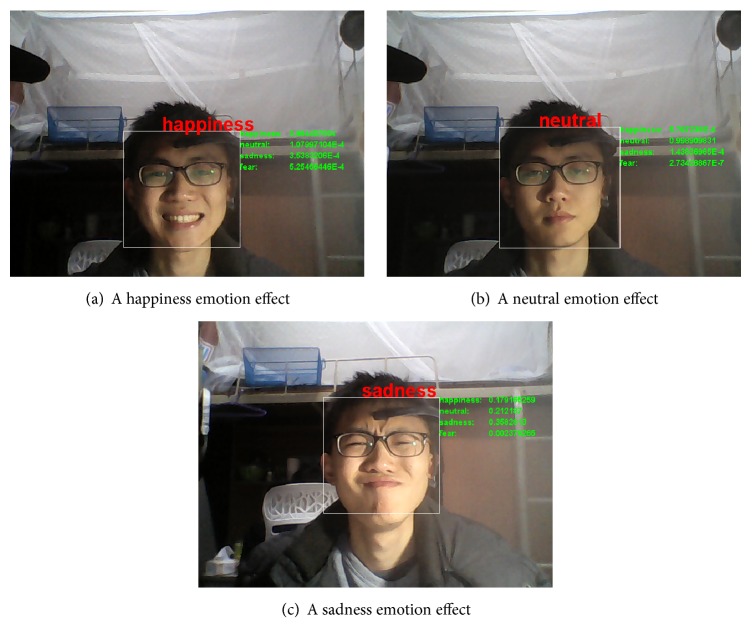
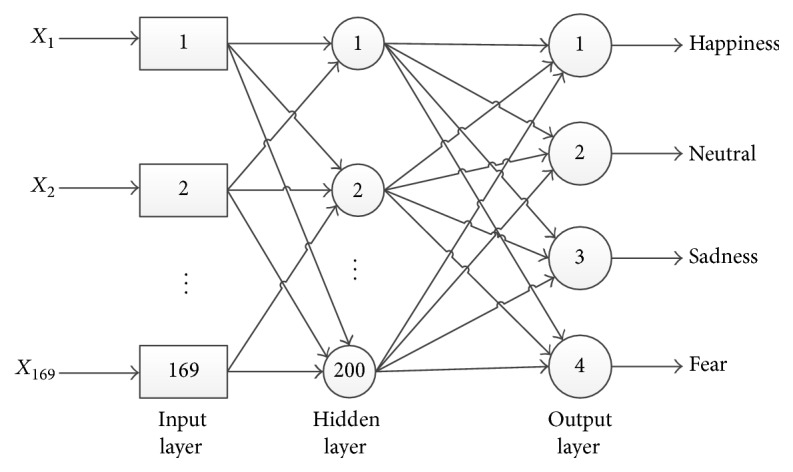
This paper proposes two multimodal fusion methods between brain and peripheral signals for emotion recognition. The input signals are electroencephalogram and facial expression. The stimuli are based on a subset of movie clips that correspond to four specific areas of valance-arousal emotional space (happiness, neutral, sadness, and fear). For facial expression detection, four basic emotion states (happiness, neutral, sadness, and fear) are detected by a neural network classifier. For EEG detection, four basic emotion states and three emotion intensity levels (strong, ordinary, and weak) are detected by two support vector machines (SVM) classifiers, respectively. Emotion recognition is based on two decision-level fusion methods of both EEG and facial expression detections by using a sum rule or a production rule. Twenty healthy subjects attended two experiments. The results show that the accuracies of two multimodal fusion detections are 81.25% and 82.75%, respectively, which are both higher than that of facial expression (74.38%) or EEG detection (66.88%). The combination of facial expressions and EEG information for emotion recognition compensates for their defects as single information sources.
期刊介绍:
The journal provides research and review papers at an interdisciplinary level, with the field of intelligent systems for computational neuroscience as its focus. This field includes areas like artificial intelligence, models and computational theories of human cognition, perception and motivation; brain models, artificial neural nets and neural computing. All items relevant to building theoretical and practical systems are within its scope, including contributions in the area of applicable neural networks theory, supervised and unsupervised learning methods, algorithms, architectures, performance measures, applied statistics, software simulations, hardware implementations, benchmarks, system engineering and integration and innovative applications.




 京公网安备 11010802042870号
京ICP备2023020795号-1
京公网安备 11010802042870号
京ICP备2023020795号-1

 分享
分享
 求助内容:
求助内容: 应助结果提醒方式:
 扫码关注我们
