Stephanie R Partridge, Anne C Grunseit, Patrick Gallagher, Becky Freeman, Blythe J O'Hara, Lis Neubeck, Sarah Due, Glenn Paull, Ding Ding, Adrian Bauman, Philayrath Phongsavan, Kellie Roach, Leonie Sadler, Helen Glinatsis, Robyn Gallagher
{"title":"Cardiac Patients' Experiences and Perceptions of Social Media: Mixed-Methods Study.","authors":"Stephanie R Partridge, Anne C Grunseit, Patrick Gallagher, Becky Freeman, Blythe J O'Hara, Lis Neubeck, Sarah Due, Glenn Paull, Ding Ding, Adrian Bauman, Philayrath Phongsavan, Kellie Roach, Leonie Sadler, Helen Glinatsis, Robyn Gallagher","doi":"10.2196/jmir.8081","DOIUrl":null,"url":null,"abstract":"<p><strong>Background: </strong>Traditional in-person cardiac rehabilitation has substantial benefits for cardiac patients, which are offset by poor attendance. The rapid increase in social media use in older adults provides an opportunity to reach patients who are eligible for cardiac rehabilitation but unable to attend traditional face-to-face groups. However, there is a paucity of research on cardiac patients' experiences and perspectives on using social media to support their health.</p><p><strong>Objective: </strong>The aim of this study was to describe cardiac rehabilitation patients' experiences in using social media in general and their perspective on using social media, particularly Facebook, to support their cardiac health and secondary prevention efforts.</p><p><strong>Methods: </strong>A mixed-methods study was undertaken among cardiac rehabilitation patients in both urban and rural areas. First, this study included a survey (n=284) on social media use and capability. Second, six focus group interviews were conducted with current Facebook users (n=18) to elucidate Facebook experience and perspectives.</p><p><strong>Results: </strong>Social media use was low (28.0%, 79/282) but more common in participants who were under 70 years of age, employed, and had completed high school. Social media users accessed Web-based information on general health issues (65%, 51/79), medications (56%, 44/79), and heart health (43%, 34/79). Participants were motivated to invest time in using Facebook for \"keeping in touch\" with family and friends and to be informed by expert cardiac health professionals and fellow cardiac participants if given the opportunity. It appeared that participants who had a higher level of Facebook capability (understanding of features and the consequences of their use and efficiency in use) spent more time on Facebook and reported higher levels of \"liking,\" commenting, or sharing posts. Furthermore, higher Facebook capability appeared to increase a participants' willingness to participate in a cardiac Facebook support group. More capable users were more receptive to the use of Facebook for cardiac rehabilitation and more likely to express interest in providing peer support. Recommended features for a cardiac rehabilitation Facebook group included a closed group, expert cardiac professional involvement, provision of cardiac health information, and ensuring trustworthiness of the group.</p><p><strong>Conclusions: </strong>Cardiac health professionals have an opportunity to capitalize on cardiac patients' motivations and social media, mostly Facebook, as well as the capability for supporting cardiac rehabilitation and secondary prevention. Participants' favored purposeful time spent on Facebook and their cardiac health provides such a purpose for a Facebook intervention. The study results will inform the development of a Facebook intervention for secondary prevention of cardiovascular disease.</p>","PeriodicalId":16337,"journal":{"name":"Journal of Medical Internet Research","volume":"19 9","pages":"e323"},"PeriodicalIF":6.0000,"publicationDate":"2017-09-15","publicationTypes":"Journal Article","fieldsOfStudy":null,"isOpenAccess":false,"openAccessPdf":"https://www.ncbi.nlm.nih.gov/pmc/articles/PMC5622287/pdf/","citationCount":"16","resultStr":null,"platform":"Semanticscholar","paperid":null,"PeriodicalName":"Journal of Medical Internet Research","FirstCategoryId":"3","ListUrlMain":"https://doi.org/10.2196/jmir.8081","RegionNum":2,"RegionCategory":"医学","ArticlePicture":[],"TitleCN":null,"AbstractTextCN":null,"PMCID":null,"EPubDate":"","PubModel":"","JCR":"Q1","JCRName":"HEALTH CARE SCIENCES & SERVICES","Score":null,"Total":0}
引用次数: 16
Abstract
Background: Traditional in-person cardiac rehabilitation has substantial benefits for cardiac patients, which are offset by poor attendance. The rapid increase in social media use in older adults provides an opportunity to reach patients who are eligible for cardiac rehabilitation but unable to attend traditional face-to-face groups. However, there is a paucity of research on cardiac patients' experiences and perspectives on using social media to support their health.
Objective: The aim of this study was to describe cardiac rehabilitation patients' experiences in using social media in general and their perspective on using social media, particularly Facebook, to support their cardiac health and secondary prevention efforts.
Methods: A mixed-methods study was undertaken among cardiac rehabilitation patients in both urban and rural areas. First, this study included a survey (n=284) on social media use and capability. Second, six focus group interviews were conducted with current Facebook users (n=18) to elucidate Facebook experience and perspectives.
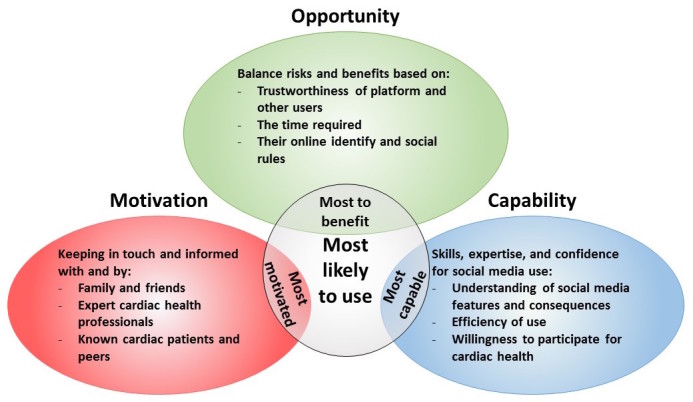
Results: Social media use was low (28.0%, 79/282) but more common in participants who were under 70 years of age, employed, and had completed high school. Social media users accessed Web-based information on general health issues (65%, 51/79), medications (56%, 44/79), and heart health (43%, 34/79). Participants were motivated to invest time in using Facebook for "keeping in touch" with family and friends and to be informed by expert cardiac health professionals and fellow cardiac participants if given the opportunity. It appeared that participants who had a higher level of Facebook capability (understanding of features and the consequences of their use and efficiency in use) spent more time on Facebook and reported higher levels of "liking," commenting, or sharing posts. Furthermore, higher Facebook capability appeared to increase a participants' willingness to participate in a cardiac Facebook support group. More capable users were more receptive to the use of Facebook for cardiac rehabilitation and more likely to express interest in providing peer support. Recommended features for a cardiac rehabilitation Facebook group included a closed group, expert cardiac professional involvement, provision of cardiac health information, and ensuring trustworthiness of the group.
Conclusions: Cardiac health professionals have an opportunity to capitalize on cardiac patients' motivations and social media, mostly Facebook, as well as the capability for supporting cardiac rehabilitation and secondary prevention. Participants' favored purposeful time spent on Facebook and their cardiac health provides such a purpose for a Facebook intervention. The study results will inform the development of a Facebook intervention for secondary prevention of cardiovascular disease.
期刊介绍:
The Journal of Medical Internet Research (JMIR) is a highly respected publication in the field of health informatics and health services. With a founding date in 1999, JMIR has been a pioneer in the field for over two decades.
As a leader in the industry, the journal focuses on digital health, data science, health informatics, and emerging technologies for health, medicine, and biomedical research. It is recognized as a top publication in these disciplines, ranking in the first quartile (Q1) by Impact Factor.
Notably, JMIR holds the prestigious position of being ranked #1 on Google Scholar within the "Medical Informatics" discipline.



 京公网安备 11010802042870号
京ICP备2023020795号-1
京公网安备 11010802042870号
京ICP备2023020795号-1

 分享
分享
 求助内容:
求助内容: 应助结果提醒方式:
 扫码关注我们
