Liane John, Michael Küper, Thomas Hulst, Dagmar Timmann, Joachim Hermsdörfer
{"title":"Effects of transcranial direct current stimulation on grip force control in patients with cerebellar degeneration.","authors":"Liane John, Michael Küper, Thomas Hulst, Dagmar Timmann, Joachim Hermsdörfer","doi":"10.1186/s40673-017-0072-8","DOIUrl":null,"url":null,"abstract":"<p><strong>Background: </strong>The control of grip forces when moving a hand held object is impaired in patients with cerebellar degeneration. We asked the question whether after-effects of anodal transcranial direct current stimulation (tDCS) applied to the lateral cerebellum or M1 improved grip force control in cerebellar patients.</p><p><strong>Methods: </strong>Grip force control while holding an object during cyclic arm movements was assessed in patients with pure cerebellar degeneration (<i>n</i> = 14, mean age 50.2 years ± SD 8.8 years) and age- and sex-matched control participants (n = 14, mean age 50.7 years ± SD 9.8 years). All subjects were tested before and after application of tDCS (2 mA, 22 min) in a within-subject design. Each subject received anodal tDCS applied to the cerebellum, anodal tDCS applied to M1 or sham-stimulation with a break of 1 week between the three experimental sessions.</p><p><strong>Results: </strong>There were no clear after-effects of tDCS on grip force control neither in control participants nor in cerebellar patients. Cerebellar patients showed typical impairments with higher grip forces, a higher variability of movements.</p><p><strong>Conclusion: </strong>In the present study, deficits in grip force control were neither improved by tDCS applied over the cerebellum nor M1 in cerebellar degeneration.</p>","PeriodicalId":36752,"journal":{"name":"Cerebellum and Ataxias","volume":"4 ","pages":"15"},"PeriodicalIF":0.0000,"publicationDate":"2017-09-15","publicationTypes":"Journal Article","fieldsOfStudy":null,"isOpenAccess":false,"openAccessPdf":"https://sci-hub-pdf.com/10.1186/s40673-017-0072-8","citationCount":"17","resultStr":null,"platform":"Semanticscholar","paperid":null,"PeriodicalName":"Cerebellum and Ataxias","FirstCategoryId":"1085","ListUrlMain":"https://doi.org/10.1186/s40673-017-0072-8","RegionNum":0,"RegionCategory":null,"ArticlePicture":[],"TitleCN":null,"AbstractTextCN":null,"PMCID":null,"EPubDate":"2017/1/1 0:00:00","PubModel":"eCollection","JCR":"Q3","JCRName":"Medicine","Score":null,"Total":0}
引用次数: 17
Abstract
Background: The control of grip forces when moving a hand held object is impaired in patients with cerebellar degeneration. We asked the question whether after-effects of anodal transcranial direct current stimulation (tDCS) applied to the lateral cerebellum or M1 improved grip force control in cerebellar patients.
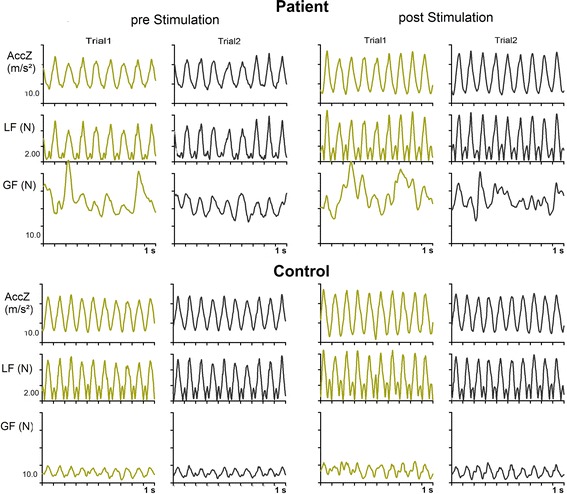
Methods: Grip force control while holding an object during cyclic arm movements was assessed in patients with pure cerebellar degeneration (n = 14, mean age 50.2 years ± SD 8.8 years) and age- and sex-matched control participants (n = 14, mean age 50.7 years ± SD 9.8 years). All subjects were tested before and after application of tDCS (2 mA, 22 min) in a within-subject design. Each subject received anodal tDCS applied to the cerebellum, anodal tDCS applied to M1 or sham-stimulation with a break of 1 week between the three experimental sessions.
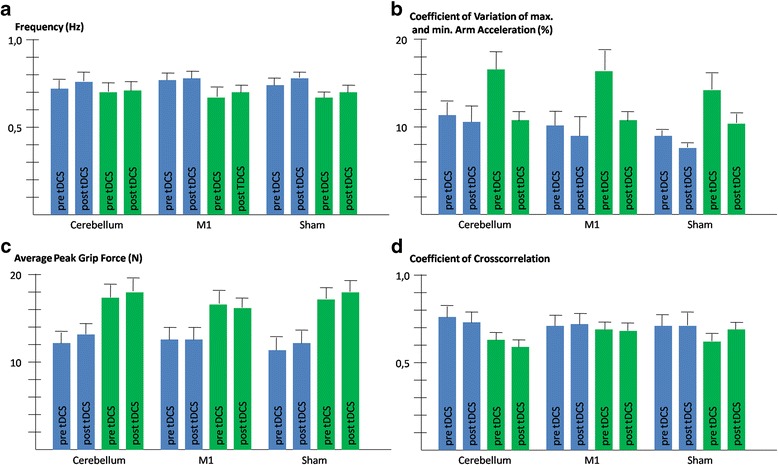
Results: There were no clear after-effects of tDCS on grip force control neither in control participants nor in cerebellar patients. Cerebellar patients showed typical impairments with higher grip forces, a higher variability of movements.
Conclusion: In the present study, deficits in grip force control were neither improved by tDCS applied over the cerebellum nor M1 in cerebellar degeneration.




 京公网安备 11010802042870号
京ICP备2023020795号-1
京公网安备 11010802042870号
京ICP备2023020795号-1

 分享
分享
 求助内容:
求助内容: 应助结果提醒方式:
 扫码关注我们
