{"title":"The mechanosensitive Piezo1 channel: structural features and molecular bases underlying its ion permeation and mechanotransduction","authors":"Yubo Wang, Bailong Xiao","doi":"10.1113/JP274404","DOIUrl":null,"url":null,"abstract":"The evolutionarily conserved Piezo family of proteins, including Piezo1 and Piezo2, encodes the long‐sought‐after mammalian mechanosensitive cation channels that play critical roles in various mechanotransduction processes such as touch, pain, proprioception, vascular development and blood pressure regulation. Mammalian Piezo proteins contain over 2500 amino acids with numerous predicted transmembrane segments, and do not bear sequence homology with any known class of ion channels. Thus, it is imperative, but challenging, to understand how they serve as effective mechanotransducers for converting mechanical force into electrochemical signals. Here, we review the recent major breakthroughs in determining the three‐bladed, propeller‐shaped structure of mouse Piezo1 using the state‐of‐the‐art cryo‐electron microscopy (cryo‐EM) and functionally dissecting out the molecular bases that define its ion permeation and mechanotransduction properties, which provide key insights into clarifying its oligomeric status and pore‐forming region. We also discuss the hypothesis that the complex Piezo proteins can be deduced into discrete mechanotransduction and ion‐conducting pore modules, which coordinate to fulfil their specialized function in mechanical sensing and transduction, ion permeation and selection.","PeriodicalId":50088,"journal":{"name":"Journal of Physiology-London","volume":"596 6","pages":"969-978"},"PeriodicalIF":4.4000,"publicationDate":"2017-11-24","publicationTypes":"Journal Article","fieldsOfStudy":null,"isOpenAccess":false,"openAccessPdf":"https://sci-hub-pdf.com/10.1113/JP274404","citationCount":"46","resultStr":null,"platform":"Semanticscholar","paperid":null,"PeriodicalName":"Journal of Physiology-London","FirstCategoryId":"3","ListUrlMain":"https://onlinelibrary.wiley.com/doi/10.1113/JP274404","RegionNum":2,"RegionCategory":"医学","ArticlePicture":[],"TitleCN":null,"AbstractTextCN":null,"PMCID":null,"EPubDate":"","PubModel":"","JCR":"Q1","JCRName":"NEUROSCIENCES","Score":null,"Total":0}
引用次数: 46
Abstract
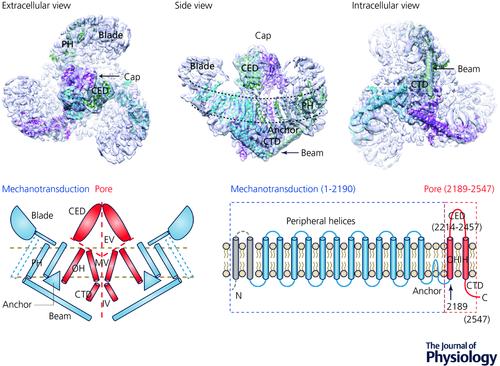
The evolutionarily conserved Piezo family of proteins, including Piezo1 and Piezo2, encodes the long‐sought‐after mammalian mechanosensitive cation channels that play critical roles in various mechanotransduction processes such as touch, pain, proprioception, vascular development and blood pressure regulation. Mammalian Piezo proteins contain over 2500 amino acids with numerous predicted transmembrane segments, and do not bear sequence homology with any known class of ion channels. Thus, it is imperative, but challenging, to understand how they serve as effective mechanotransducers for converting mechanical force into electrochemical signals. Here, we review the recent major breakthroughs in determining the three‐bladed, propeller‐shaped structure of mouse Piezo1 using the state‐of‐the‐art cryo‐electron microscopy (cryo‐EM) and functionally dissecting out the molecular bases that define its ion permeation and mechanotransduction properties, which provide key insights into clarifying its oligomeric status and pore‐forming region. We also discuss the hypothesis that the complex Piezo proteins can be deduced into discrete mechanotransduction and ion‐conducting pore modules, which coordinate to fulfil their specialized function in mechanical sensing and transduction, ion permeation and selection.
期刊介绍:
The Journal of Physiology publishes full-length original Research Papers and Techniques for Physiology, which are short papers aimed at disseminating new techniques for physiological research. Articles solicited by the Editorial Board include Perspectives, Symposium Reports and Topical Reviews, which highlight areas of special physiological interest. CrossTalk articles are short editorial-style invited articles framing a debate between experts in the field on controversial topics. Letters to the Editor and Journal Club articles are also published. All categories of papers are subjected to peer reivew.
The Journal of Physiology welcomes submitted research papers in all areas of physiology. Authors should present original work that illustrates new physiological principles or mechanisms. Papers on work at the molecular level, at the level of the cell membrane, single cells, tissues or organs and on systems physiology are all acceptable. Theoretical papers and papers that use computational models to further our understanding of physiological processes will be considered if based on experimentally derived data and if the hypothesis advanced is directly amenable to experimental testing. While emphasis is on human and mammalian physiology, work on lower vertebrate or invertebrate preparations may be suitable if it furthers the understanding of the functioning of other organisms including mammals.



 京公网安备 11010802042870号
京ICP备2023020795号-1
京公网安备 11010802042870号
京ICP备2023020795号-1

 分享
分享
 求助内容:
求助内容: 应助结果提醒方式:
 扫码关注我们
