Amanda L Hannan, Wayne Hing, Vini Simas, Mike Climstein, Jeff S Coombes, Rohan Jayasinghe, Joshua Byrnes, James Furness
{"title":"High-intensity interval training versus moderate-intensity continuous training within cardiac rehabilitation: a systematic review and meta-analysis.","authors":"Amanda L Hannan, Wayne Hing, Vini Simas, Mike Climstein, Jeff S Coombes, Rohan Jayasinghe, Joshua Byrnes, James Furness","doi":"10.2147/OAJSM.S150596","DOIUrl":null,"url":null,"abstract":"<p><strong>Background: </strong>Aerobic capacity has been shown to be inversely proportionate to cardiovascular mortality and morbidity and there is growing evidence that high-intensity interval training (HIIT) appears to be more effective than moderate-intensity continuous training (MICT) in improving cardiorespiratory fitness within the cardiac population. Previously published systematic reviews in cardiovascular disease have neither investigated the effect that the number of weeks of intervention has on cardiorespiratory fitness changes, nor have adverse events been collated.</p><p><strong>Objective: </strong>We aimed to undertake a systematic review and meta-analysis of randomized controlled trials (RCTs) within the cardiac population that investigated cardiorespiratory fitness changes resulting from HIIT versus MICT and to collate adverse events.</p><p><strong>Methods: </strong>A critical narrative synthesis and meta-analysis was conducted after systematically searching relevant databases up to July 2017. We searched for RCTs that compared cardiorespiratory fitness changes resulting from HIIT versus MICT interventions within the cardiac population.</p><p><strong>Results: </strong>Seventeen studies, involving 953 participants (465 for HIIT and 488 for MICT) were included in the analysis. HIIT was significantly superior to MICT in improving cardiorespiratory fitness overall (SMD 0.34 mL/kg/min; 95% confidence interval [CI; 0.2-0.48]; <i>p</i><0.00001; <i>I</i><sup>2</sup>=28%). There were no deaths or cardiac events requiring hospitalization reported in any study during training. Overall, there were more adverse events reported as a result of the MICT (n=14) intervention than the HIIT intervention (n=9). However, some adverse events (n=5) were not classified by intervention group.</p><p><strong>Conclusion: </strong>HIIT is superior to MICT in improving cardiorespiratory fitness in participants of cardiac rehabilitation (CR). Improvements in cardiorespiratory fitness are significant for CR programs of >6-week duration. Programs of 7-12 weeks' duration resulted in the largest improvements in cardiorespiratory fitness for patients with coronary artery disease. HIIT appears to be as safe as MICT for CR participants.</p>","PeriodicalId":51644,"journal":{"name":"Open Access Journal of Sports Medicine","volume":"9 ","pages":"1-17"},"PeriodicalIF":1.6000,"publicationDate":"2018-01-26","publicationTypes":"Journal Article","fieldsOfStudy":null,"isOpenAccess":false,"openAccessPdf":"https://ftp.ncbi.nlm.nih.gov/pub/pmc/oa_pdf/e4/ec/oajsm-9-001.PMC5790162.pdf","citationCount":"0","resultStr":null,"platform":"Semanticscholar","paperid":null,"PeriodicalName":"Open Access Journal of Sports Medicine","FirstCategoryId":"1085","ListUrlMain":"https://doi.org/10.2147/OAJSM.S150596","RegionNum":0,"RegionCategory":null,"ArticlePicture":[],"TitleCN":null,"AbstractTextCN":null,"PMCID":null,"EPubDate":"2018/1/1 0:00:00","PubModel":"eCollection","JCR":"Q3","JCRName":"SPORT SCIENCES","Score":null,"Total":0}
引用次数: 0
Abstract
Background: Aerobic capacity has been shown to be inversely proportionate to cardiovascular mortality and morbidity and there is growing evidence that high-intensity interval training (HIIT) appears to be more effective than moderate-intensity continuous training (MICT) in improving cardiorespiratory fitness within the cardiac population. Previously published systematic reviews in cardiovascular disease have neither investigated the effect that the number of weeks of intervention has on cardiorespiratory fitness changes, nor have adverse events been collated.
Objective: We aimed to undertake a systematic review and meta-analysis of randomized controlled trials (RCTs) within the cardiac population that investigated cardiorespiratory fitness changes resulting from HIIT versus MICT and to collate adverse events.
Methods: A critical narrative synthesis and meta-analysis was conducted after systematically searching relevant databases up to July 2017. We searched for RCTs that compared cardiorespiratory fitness changes resulting from HIIT versus MICT interventions within the cardiac population.
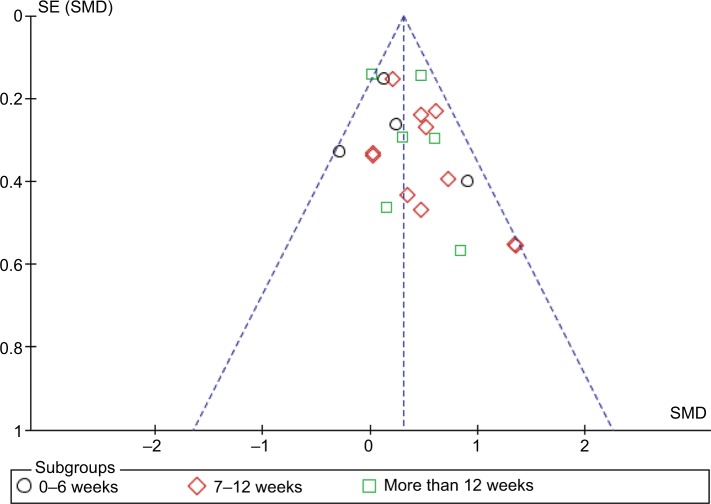
Results: Seventeen studies, involving 953 participants (465 for HIIT and 488 for MICT) were included in the analysis. HIIT was significantly superior to MICT in improving cardiorespiratory fitness overall (SMD 0.34 mL/kg/min; 95% confidence interval [CI; 0.2-0.48]; p<0.00001; I2=28%). There were no deaths or cardiac events requiring hospitalization reported in any study during training. Overall, there were more adverse events reported as a result of the MICT (n=14) intervention than the HIIT intervention (n=9). However, some adverse events (n=5) were not classified by intervention group.
Conclusion: HIIT is superior to MICT in improving cardiorespiratory fitness in participants of cardiac rehabilitation (CR). Improvements in cardiorespiratory fitness are significant for CR programs of >6-week duration. Programs of 7-12 weeks' duration resulted in the largest improvements in cardiorespiratory fitness for patients with coronary artery disease. HIIT appears to be as safe as MICT for CR participants.






 京公网安备 11010802042870号
京ICP备2023020795号-1
京公网安备 11010802042870号
京ICP备2023020795号-1

 分享
分享
 求助内容:
求助内容: 应助结果提醒方式:
 扫码关注我们
