Kwame Yeboah, Jennifer A Agyekum, Eric Kyei Baafour, Daniel A Antwi, Afua B Adjei, Vincent Boima, Ben Gyan
{"title":"Circulating Angiogenic Growth Factors in Diabetes Patients with Peripheral Arterial Disease and Exertional Leg Pain in Ghana.","authors":"Kwame Yeboah, Jennifer A Agyekum, Eric Kyei Baafour, Daniel A Antwi, Afua B Adjei, Vincent Boima, Ben Gyan","doi":"10.1155/2017/2390174","DOIUrl":null,"url":null,"abstract":"<p><strong>Objective: </strong>Peripheral arterial disease (PAD) is a common complication of diabetes, associated with impairment in angiogenesis. Angiogenesis is regulated by angiogenic growth factors such as angiopoietin 1 (Ang-1), Ang-2, and vascular endothelial growth factor (VEGF). We studied the association between angiogenic growth factors versus PAD and exertional leg symptoms in diabetes patients in Ghana.</p><p><strong>Method: </strong>In this cross-sectional study, ankle-brachial index was measured with oscillometrically and exertional leg symptoms were screened with Edinburgh claudication questionnaire in 140 diabetes patients and 110 nondiabetes individuals. Circulating levels of Ang-1, Ang-2, and VEGF were measured with immunosorbent assay.</p><p><strong>Results: </strong>The prevalence of PAD and exertional leg pain was 16.8% and 24.8%, respectively. Compared to non-PAD participants, PAD patients had higher VEGF levels [85.8 (37.5-154.5) versus 57.7 (16.6-161.1) <i>p</i> = 0.032] and lower Ang-1 levels [31.3 (24.8-42.6) versus 40.9 (28.2-62.1), <i>p</i> = 0.017]. In multivariable logistic regression, patients with exertional leg pain had increased the odds of plasma Ang-2 levels [OR (95% CI): 2.08 (1.08-6.41), <i>p</i> = 0.036].</p><p><strong>Conclusion: </strong>Diabetes patients with PAD and exertional leg pain have imbalance in angiogenic growth factors, indicating impaired angiogenesis. In patients with exertional leg pains, Ang-2 may be an important biomarker.</p>","PeriodicalId":14448,"journal":{"name":"International Journal of Vascular Medicine","volume":"2017 ","pages":"2390174"},"PeriodicalIF":1.1000,"publicationDate":"2017-01-01","publicationTypes":"Journal Article","fieldsOfStudy":null,"isOpenAccess":false,"openAccessPdf":"https://sci-hub-pdf.com/10.1155/2017/2390174","citationCount":"4","resultStr":null,"platform":"Semanticscholar","paperid":null,"PeriodicalName":"International Journal of Vascular Medicine","FirstCategoryId":"1085","ListUrlMain":"https://doi.org/10.1155/2017/2390174","RegionNum":0,"RegionCategory":null,"ArticlePicture":[],"TitleCN":null,"AbstractTextCN":null,"PMCID":null,"EPubDate":"2017/12/27 0:00:00","PubModel":"Epub","JCR":"Q2","JCRName":"PERIPHERAL VASCULAR DISEASE","Score":null,"Total":0}
引用次数: 4
Abstract
Objective: Peripheral arterial disease (PAD) is a common complication of diabetes, associated with impairment in angiogenesis. Angiogenesis is regulated by angiogenic growth factors such as angiopoietin 1 (Ang-1), Ang-2, and vascular endothelial growth factor (VEGF). We studied the association between angiogenic growth factors versus PAD and exertional leg symptoms in diabetes patients in Ghana.
Method: In this cross-sectional study, ankle-brachial index was measured with oscillometrically and exertional leg symptoms were screened with Edinburgh claudication questionnaire in 140 diabetes patients and 110 nondiabetes individuals. Circulating levels of Ang-1, Ang-2, and VEGF were measured with immunosorbent assay.
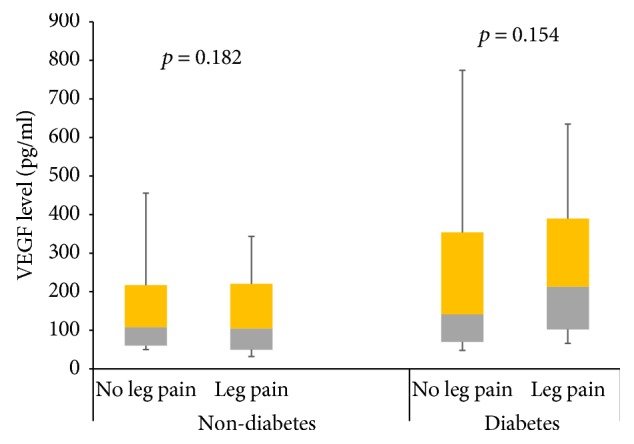
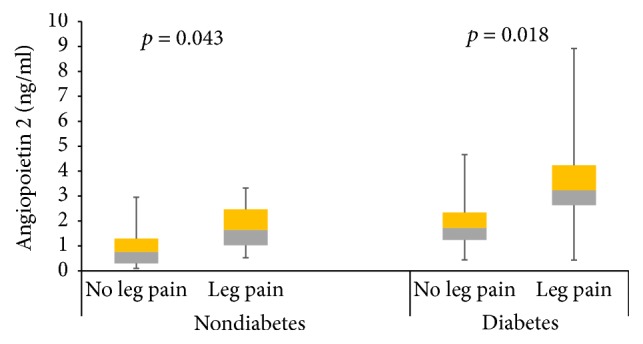
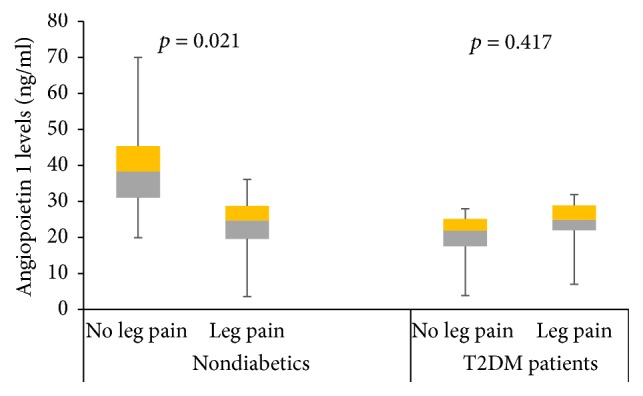
Results: The prevalence of PAD and exertional leg pain was 16.8% and 24.8%, respectively. Compared to non-PAD participants, PAD patients had higher VEGF levels [85.8 (37.5-154.5) versus 57.7 (16.6-161.1) p = 0.032] and lower Ang-1 levels [31.3 (24.8-42.6) versus 40.9 (28.2-62.1), p = 0.017]. In multivariable logistic regression, patients with exertional leg pain had increased the odds of plasma Ang-2 levels [OR (95% CI): 2.08 (1.08-6.41), p = 0.036].
Conclusion: Diabetes patients with PAD and exertional leg pain have imbalance in angiogenic growth factors, indicating impaired angiogenesis. In patients with exertional leg pains, Ang-2 may be an important biomarker.




 京公网安备 11010802042870号
京ICP备2023020795号-1
京公网安备 11010802042870号
京ICP备2023020795号-1

 分享
分享
 求助内容:
求助内容: 应助结果提醒方式:
 扫码关注我们
