{"title":"Luminescent lanthanide barcodes based on postsynthetic modified nanoscale metal–organic frameworks†","authors":"Ye Lu and Bing Yan","doi":"10.1039/C4TC01077A","DOIUrl":null,"url":null,"abstract":"<p >A new method for luminescent barcode based on nanoscale MOFs (MOF-253) is displayed, which the barcoding is realized by postsynthetic method (PSM) to introduce lanthanide ion (Eu<small><sup>3+</sup></small>, Tb<small><sup>3+</sup></small> and Sm<small><sup>3+</sup></small>). The framework does not preferentially include either lanthanide ion, and then any desired lanthanide composition in the result product can be achieved by controlling the stoichiometry of the reactant. The emission intensity of each of lanthanide ion is proportional to its amount in the MOF, resulting in unique luminescent barcodes that depend on the lanthanide ion ratios and compositions. The synthesized barcoded material is successfully applied in marking functional ionic liquid and preparing luminescent thin film.</p>","PeriodicalId":84,"journal":{"name":"Journal of Materials Chemistry C","volume":" 35","pages":" 7411-7416"},"PeriodicalIF":5.1000,"publicationDate":"2014-07-16","publicationTypes":"Journal Article","fieldsOfStudy":null,"isOpenAccess":false,"openAccessPdf":"https://sci-hub-pdf.com/10.1039/C4TC01077A","citationCount":"68","resultStr":null,"platform":"Semanticscholar","paperid":null,"PeriodicalName":"Journal of Materials Chemistry C","FirstCategoryId":"1","ListUrlMain":"https://pubs.rsc.org/en/content/articlelanding/2014/tc/c4tc01077a","RegionNum":2,"RegionCategory":"材料科学","ArticlePicture":[],"TitleCN":null,"AbstractTextCN":null,"PMCID":null,"EPubDate":"","PubModel":"","JCR":"Q2","JCRName":"MATERIALS SCIENCE, MULTIDISCIPLINARY","Score":null,"Total":0}
引用次数: 68
Abstract
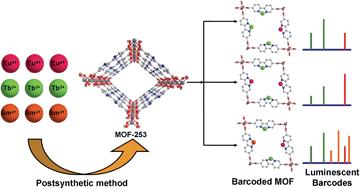
A new method for luminescent barcode based on nanoscale MOFs (MOF-253) is displayed, which the barcoding is realized by postsynthetic method (PSM) to introduce lanthanide ion (Eu3+, Tb3+ and Sm3+). The framework does not preferentially include either lanthanide ion, and then any desired lanthanide composition in the result product can be achieved by controlling the stoichiometry of the reactant. The emission intensity of each of lanthanide ion is proportional to its amount in the MOF, resulting in unique luminescent barcodes that depend on the lanthanide ion ratios and compositions. The synthesized barcoded material is successfully applied in marking functional ionic liquid and preparing luminescent thin film.
期刊介绍:
The Journal of Materials Chemistry is divided into three distinct sections, A, B, and C, each catering to specific applications of the materials under study:
Journal of Materials Chemistry A focuses primarily on materials intended for applications in energy and sustainability.
Journal of Materials Chemistry B specializes in materials designed for applications in biology and medicine.
Journal of Materials Chemistry C is dedicated to materials suitable for applications in optical, magnetic, and electronic devices.
Example topic areas within the scope of Journal of Materials Chemistry C are listed below. This list is neither exhaustive nor exclusive.
Bioelectronics
Conductors
Detectors
Dielectrics
Displays
Ferroelectrics
Lasers
LEDs
Lighting
Liquid crystals
Memory
Metamaterials
Multiferroics
Photonics
Photovoltaics
Semiconductors
Sensors
Single molecule conductors
Spintronics
Superconductors
Thermoelectrics
Topological insulators
Transistors



 京公网安备 11010802042870号
京ICP备2023020795号-1
京公网安备 11010802042870号
京ICP备2023020795号-1

 分享
分享
 求助内容:
求助内容: 应助结果提醒方式:
 扫码关注我们
