{"title":"Association of spring-summer hydrology and meteorology with human West Nile virus infection in West Texas, USA, 2002-2016.","authors":"Israel Ukawuba, Jeffrey Shaman","doi":"10.1186/s13071-018-2781-0","DOIUrl":null,"url":null,"abstract":"<p><strong>Background: </strong>The emergence of West Nile virus (WNV) in the Western Hemisphere has motivated research into the processes contributing to the incidence and persistence of the disease in the region. Meteorology and hydrology are fundamental determinants of vector-borne disease transmission dynamics of a region. The availability of water influences the population dynamics of vector and host, while temperature impacts vector growth rates, feeding habits, and disease transmission potential. Characterization of the temporal pattern of environmental factors influencing WNV risk is crucial to broaden our understanding of local transmission dynamics and to inform efforts of control and surveillance.</p><p><strong>Methods: </strong>We used hydrologic, meteorological and WNV data from west Texas (2002-2016) to analyze the relationship between environmental conditions and annual human WNV infection. A Bayesian model averaging framework was used to evaluate the association of monthly environmental conditions with WNV infection.</p><p><strong>Results: </strong>Findings indicate that wet conditions in the spring combined with dry and cool conditions in the summer are associated with increased annual WNV cases. Bayesian multi-model inference reveals monthly means of soil moisture, specific humidity and temperature to be the most important variables among predictors tested. Environmental conditions in March, June, July and August were the leading predictors in the best-fitting models.</p><p><strong>Conclusions: </strong>The results significantly link soil moisture and temperature in the spring and summer to WNV transmission risk. Wet spring in association with dry and cool summer was the temporal pattern best-describing WNV, regardless of year. Our findings also highlight that soil moisture may be a stronger predictor of annual WNV transmission than rainfall.</p>","PeriodicalId":19793,"journal":{"name":"Parasites & Vectors","volume":" ","pages":"224"},"PeriodicalIF":3.5000,"publicationDate":"2018-04-04","publicationTypes":"Journal Article","fieldsOfStudy":null,"isOpenAccess":false,"openAccessPdf":"https://sci-hub-pdf.com/10.1186/s13071-018-2781-0","citationCount":"10","resultStr":null,"platform":"Semanticscholar","paperid":null,"PeriodicalName":"Parasites & Vectors","FirstCategoryId":"3","ListUrlMain":"https://doi.org/10.1186/s13071-018-2781-0","RegionNum":2,"RegionCategory":"医学","ArticlePicture":[],"TitleCN":null,"AbstractTextCN":null,"PMCID":null,"EPubDate":"","PubModel":"","JCR":"Q1","JCRName":"PARASITOLOGY","Score":null,"Total":0}
引用次数: 10
Abstract
Background: The emergence of West Nile virus (WNV) in the Western Hemisphere has motivated research into the processes contributing to the incidence and persistence of the disease in the region. Meteorology and hydrology are fundamental determinants of vector-borne disease transmission dynamics of a region. The availability of water influences the population dynamics of vector and host, while temperature impacts vector growth rates, feeding habits, and disease transmission potential. Characterization of the temporal pattern of environmental factors influencing WNV risk is crucial to broaden our understanding of local transmission dynamics and to inform efforts of control and surveillance.
Methods: We used hydrologic, meteorological and WNV data from west Texas (2002-2016) to analyze the relationship between environmental conditions and annual human WNV infection. A Bayesian model averaging framework was used to evaluate the association of monthly environmental conditions with WNV infection.
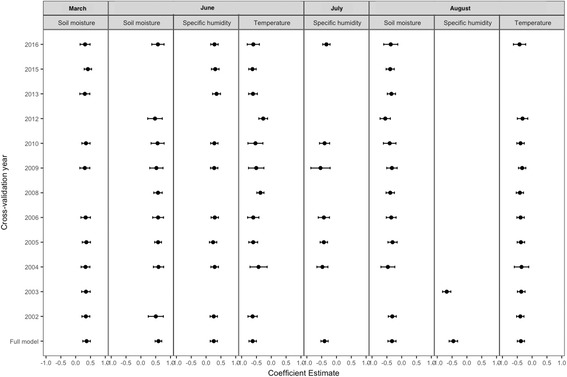
Results: Findings indicate that wet conditions in the spring combined with dry and cool conditions in the summer are associated with increased annual WNV cases. Bayesian multi-model inference reveals monthly means of soil moisture, specific humidity and temperature to be the most important variables among predictors tested. Environmental conditions in March, June, July and August were the leading predictors in the best-fitting models.
Conclusions: The results significantly link soil moisture and temperature in the spring and summer to WNV transmission risk. Wet spring in association with dry and cool summer was the temporal pattern best-describing WNV, regardless of year. Our findings also highlight that soil moisture may be a stronger predictor of annual WNV transmission than rainfall.
期刊介绍:
Parasites & Vectors is an open access, peer-reviewed online journal dealing with the biology of parasites, parasitic diseases, intermediate hosts, vectors and vector-borne pathogens. Manuscripts published in this journal will be available to all worldwide, with no barriers to access, immediately following acceptance. However, authors retain the copyright of their material and may use it, or distribute it, as they wish.
Manuscripts on all aspects of the basic and applied biology of parasites, intermediate hosts, vectors and vector-borne pathogens will be considered. In addition to the traditional and well-established areas of science in these fields, we also aim to provide a vehicle for publication of the rapidly developing resources and technology in parasite, intermediate host and vector genomics and their impacts on biological research. We are able to publish large datasets and extensive results, frequently associated with genomic and post-genomic technologies, which are not readily accommodated in traditional journals. Manuscripts addressing broader issues, for example economics, social sciences and global climate change in relation to parasites, vectors and disease control, are also welcomed.




 京公网安备 11010802042870号
京ICP备2023020795号-1
京公网安备 11010802042870号
京ICP备2023020795号-1

 分享
分享
 求助内容:
求助内容: 应助结果提醒方式:
 扫码关注我们
