Yingbo Li, Qingwei Li, Guimei Guo, Ting He, Runhong Gao, Muhammad Faheem, Jianhua Huang, Ruiju Lu, Chenghong Liu
{"title":"Transient Overexpression of <i>HvSERK2</i> Improves Barley Resistance to Powdery Mildew.","authors":"Yingbo Li, Qingwei Li, Guimei Guo, Ting He, Runhong Gao, Muhammad Faheem, Jianhua Huang, Ruiju Lu, Chenghong Liu","doi":"10.3390/ijms19041226","DOIUrl":null,"url":null,"abstract":"<p><p>Somatic embryogenesis receptor-like kinases (SERKs) play an essential role in plant response to pathogen infection. Here we identified three <i>SERK</i> genes (<i>HvSERK1/2/3</i>) from barley, and aimed to determine their implication in defense responses to barley powdery mildew (<i>Bgh</i>). Although <i>HvSERK1/2/3</i> share the characteristic domains of the SERK family, only <i>HvSERK2</i> was significantly induced in barley leaves during <i>Bgh</i> infection. The expression of <i>HvSERK2</i> was rapidly induced by hydrogen peroxide (H₂O₂) treatment, but not by treatment with salicylic acid (SA), methyl jasmonate (MeJA), ethephon (ETH), or abscisic acid (ABA). Bioinformatics analysis of the cloned <i>HvSERK2</i> promoter revealed that it contains several elements responsible for defense responses against pathogens. Promoter functional analysis showed that the <i>HvSERK2</i> promoter was induced by <i>Bgh</i> and H₂O₂. Subcellular localization analysis of <i>HvSERK2</i> indicated that it is mainly located on the plasma membrane. Transient overexpression of <i>HvSERK2</i> in epidermal cells of the susceptible barley cultivar Hua 30 reduced the <i>Bgh</i> haustorium index from 58.6% to 43.2%. This study suggests that the <i>HvSERK2</i> gene plays a positive role in the improvement of barley resistance to powdery mildew, and provides new insight into the function of <i>SERK</i> genes in the biotic stress response of plants.</p>","PeriodicalId":14156,"journal":{"name":"International Journal of Molecular Sciences","volume":" ","pages":""},"PeriodicalIF":4.9000,"publicationDate":"2018-04-18","publicationTypes":"Journal Article","fieldsOfStudy":null,"isOpenAccess":false,"openAccessPdf":"https://sci-hub-pdf.com/10.3390/ijms19041226","citationCount":"10","resultStr":null,"platform":"Semanticscholar","paperid":null,"PeriodicalName":"International Journal of Molecular Sciences","FirstCategoryId":"99","ListUrlMain":"https://doi.org/10.3390/ijms19041226","RegionNum":2,"RegionCategory":"生物学","ArticlePicture":[],"TitleCN":null,"AbstractTextCN":null,"PMCID":null,"EPubDate":"","PubModel":"","JCR":"","JCRName":"","Score":null,"Total":0}
引用次数: 10
Abstract
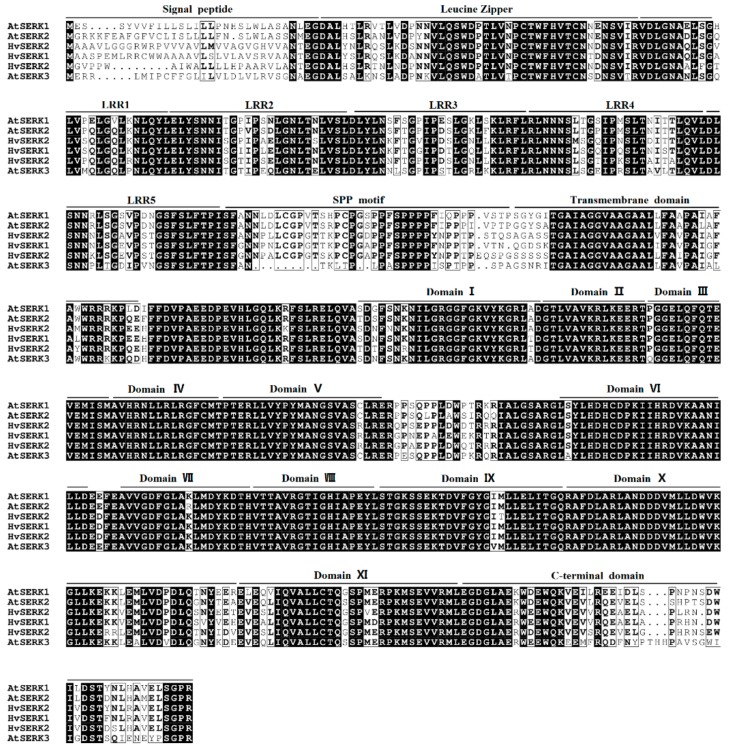
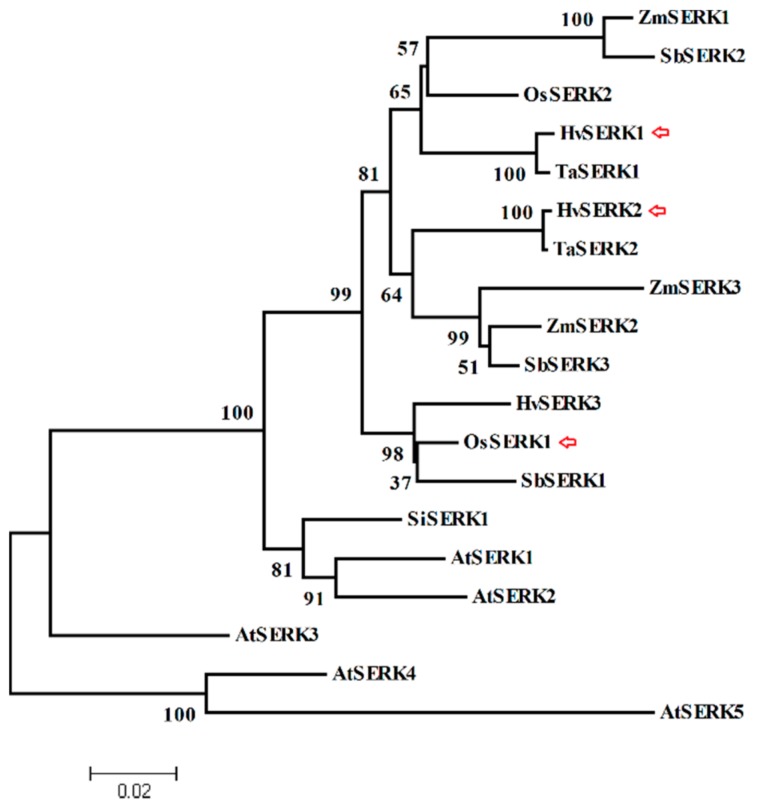
Somatic embryogenesis receptor-like kinases (SERKs) play an essential role in plant response to pathogen infection. Here we identified three SERK genes (HvSERK1/2/3) from barley, and aimed to determine their implication in defense responses to barley powdery mildew (Bgh). Although HvSERK1/2/3 share the characteristic domains of the SERK family, only HvSERK2 was significantly induced in barley leaves during Bgh infection. The expression of HvSERK2 was rapidly induced by hydrogen peroxide (H₂O₂) treatment, but not by treatment with salicylic acid (SA), methyl jasmonate (MeJA), ethephon (ETH), or abscisic acid (ABA). Bioinformatics analysis of the cloned HvSERK2 promoter revealed that it contains several elements responsible for defense responses against pathogens. Promoter functional analysis showed that the HvSERK2 promoter was induced by Bgh and H₂O₂. Subcellular localization analysis of HvSERK2 indicated that it is mainly located on the plasma membrane. Transient overexpression of HvSERK2 in epidermal cells of the susceptible barley cultivar Hua 30 reduced the Bgh haustorium index from 58.6% to 43.2%. This study suggests that the HvSERK2 gene plays a positive role in the improvement of barley resistance to powdery mildew, and provides new insight into the function of SERK genes in the biotic stress response of plants.
期刊介绍:
The International Journal of Molecular Sciences (ISSN 1422-0067) provides an advanced forum for chemistry, molecular physics (chemical physics and physical chemistry) and molecular biology. It publishes research articles, reviews, communications and short notes. Our aim is to encourage scientists to publish their theoretical and experimental results in as much detail as possible. Therefore, there is no restriction on the length of the papers or the number of electronics supplementary files. For articles with computational results, the full experimental details must be provided so that the results can be reproduced. Electronic files regarding the full details of the calculation and experimental procedure, if unable to be published in a normal way, can be deposited as supplementary material (including animated pictures, videos, interactive Excel sheets, software executables and others).




 京公网安备 11010802042870号
京ICP备2023020795号-1
京公网安备 11010802042870号
京ICP备2023020795号-1

 分享
分享
 求助内容:
求助内容: 应助结果提醒方式:
 扫码关注我们
