John Mair-Jenkins, Tracey Lamming, Andy Dziadosz, Daniel Flecknoe, Thomas Stubington, Massimo Mentasti, Peter Muir, Philip Monk
{"title":"A Psittacosis Outbreak among English Office Workers with Little or No Contact with Birds, August 2015.","authors":"John Mair-Jenkins, Tracey Lamming, Andy Dziadosz, Daniel Flecknoe, Thomas Stubington, Massimo Mentasti, Peter Muir, Philip Monk","doi":"10.1371/currents.outbreaks.b646c3bb2b4f0e3397183f31823bbca6","DOIUrl":null,"url":null,"abstract":"<p><strong>Introduction: </strong>On 14th August 2015 an office manager informed Public Health England of five employees known to have been diagnosed with pneumonia over the previous three weeks. We investigated to establish whether an outbreak occurred and to identify and control the source of infection.</p><p><strong>Methods: </strong>We undertook case finding for self-reported pneumonia cases at local businesses (July-August 2015). Clinical samples from a hospitalised case were tested for common respiratory pathogens, but returned negative results. Further testing confirmed <i>Chlamydia psittaci</i> infection in this case (serology and PCR). We subsequently undertook <i>C. psittaci</i> testing for all cases, redefining them as confirmed (<i>C. psittaci</i> PCR or high antibody titre via serology) or probable (inconclusive <i>C. psittaci</i> serology). Twenty-eight day exposure histories informed descriptive epidemiological analysis. We conducted an environmental investigation at the office to identify potential sources of exposure.</p><p><strong>Results: </strong>We identified six office workers with pneumonia; four met case definitions (three confirmed, one probable) with symptom onset between 29th July and 4th August 2015. Workplace was the only epidemiological link and only one case reported limited, indirect bird contact. Environmental investigations identified pigeons roosting near the office which were being fed by workers (none cases).</p><p><strong>Discussion: </strong>This was a probable outbreak of psittacosis with no direct bird-to-human contact reported. Cases recovered after receiving appropriate antibiotics. Feeding of pigeons was stopped. A deep clean of office ventilation systems was conducted and workers were advised to avoid bird contact. We hypothesised that indirect environmental exposure to infected pigeons was to the source of this outbreak. This work provides evidence that health professionals should consider psittacosis in the differential diagnosis of cases of severe or atypical respiratory illness even without overt bird contact.</p>","PeriodicalId":74464,"journal":{"name":"PLoS currents","volume":"10 ","pages":""},"PeriodicalIF":0.0000,"publicationDate":"2018-04-27","publicationTypes":"Journal Article","fieldsOfStudy":null,"isOpenAccess":false,"openAccessPdf":"https://www.ncbi.nlm.nih.gov/pmc/articles/PMC5951689/pdf/","citationCount":"15","resultStr":null,"platform":"Semanticscholar","paperid":null,"PeriodicalName":"PLoS currents","FirstCategoryId":"1085","ListUrlMain":"https://doi.org/10.1371/currents.outbreaks.b646c3bb2b4f0e3397183f31823bbca6","RegionNum":0,"RegionCategory":null,"ArticlePicture":[],"TitleCN":null,"AbstractTextCN":null,"PMCID":null,"EPubDate":"","PubModel":"","JCR":"","JCRName":"","Score":null,"Total":0}
引用次数: 15
Abstract
Introduction: On 14th August 2015 an office manager informed Public Health England of five employees known to have been diagnosed with pneumonia over the previous three weeks. We investigated to establish whether an outbreak occurred and to identify and control the source of infection.
Methods: We undertook case finding for self-reported pneumonia cases at local businesses (July-August 2015). Clinical samples from a hospitalised case were tested for common respiratory pathogens, but returned negative results. Further testing confirmed Chlamydia psittaci infection in this case (serology and PCR). We subsequently undertook C. psittaci testing for all cases, redefining them as confirmed (C. psittaci PCR or high antibody titre via serology) or probable (inconclusive C. psittaci serology). Twenty-eight day exposure histories informed descriptive epidemiological analysis. We conducted an environmental investigation at the office to identify potential sources of exposure.
Results: We identified six office workers with pneumonia; four met case definitions (three confirmed, one probable) with symptom onset between 29th July and 4th August 2015. Workplace was the only epidemiological link and only one case reported limited, indirect bird contact. Environmental investigations identified pigeons roosting near the office which were being fed by workers (none cases).
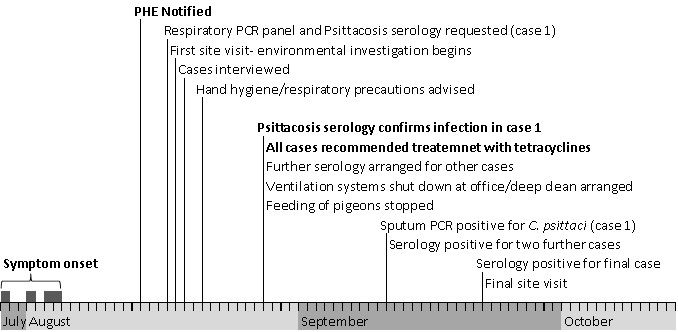
Discussion: This was a probable outbreak of psittacosis with no direct bird-to-human contact reported. Cases recovered after receiving appropriate antibiotics. Feeding of pigeons was stopped. A deep clean of office ventilation systems was conducted and workers were advised to avoid bird contact. We hypothesised that indirect environmental exposure to infected pigeons was to the source of this outbreak. This work provides evidence that health professionals should consider psittacosis in the differential diagnosis of cases of severe or atypical respiratory illness even without overt bird contact.



 京公网安备 11010802042870号
京ICP备2023020795号-1
京公网安备 11010802042870号
京ICP备2023020795号-1

 分享
分享

 求助内容:
求助内容: 应助结果提醒方式:
 扫码关注我们
