Arthroscopic Treatment of Acetabular Retroversion With Acetabuloplasty and Subspine Decompression: A Matched Comparison With Patients Undergoing Arthroscopic Treatment for Focal Pincer-Type Femoroacetabular Impingement.
Sergio E Flores, Caitlin C Chambers, Kristina R Borak, Alan L Zhang
{"title":"Arthroscopic Treatment of Acetabular Retroversion With Acetabuloplasty and Subspine Decompression: A Matched Comparison With Patients Undergoing Arthroscopic Treatment for Focal Pincer-Type Femoroacetabular Impingement.","authors":"Sergio E Flores, Caitlin C Chambers, Kristina R Borak, Alan L Zhang","doi":"10.1177/2325967118783741","DOIUrl":null,"url":null,"abstract":"<p><strong>Background: </strong>Global acetabular retroversion is classically treated with open reverse periacetabular osteotomy. Given the low morbidity and recent success associated with the arthroscopic treatment of femoroacetabular impingement (FAI), there may also be a role for arthroscopic treatment of acetabular retroversion. However, the safety and outcomes after hip arthroscopic surgery for retroversion need further study, and the effect of impingement from the anterior inferior iliac spine (subspine) in patients with retroversion is currently unknown.</p><p><strong>Hypothesis: </strong>Arthroscopic treatment for global acetabular retroversion will be safe, and patients will have similar outcomes compared with a matched group undergoing arthroscopic treatment for focal pincer-type FAI.</p><p><strong>Study design: </strong>Cohort study; Level of evidence, 2.</p><p><strong>Methods: </strong>Patients undergoing hip arthroscopic surgery for symptomatic global acetabular retroversion were prospectively enrolled and compared with a matched group of patients undergoing arthroscopic surgery for focal pincer-type FAI. Both groups underwent the same arthroscopic treatment protocol. All patients were administered patient-reported outcome (PRO) measures, including the 12-item Short-Form Health Survey (SF-12) Physical Component Summary (PCS) and a Mental Component Summary (MCS), modified Harris Hip Score (mHHS), Hip disability and Osteoarthritis Outcome Score (HOOS), and visual analog scale (VAS) for pain preoperatively and at 1 year postoperatively.</p><p><strong>Results: </strong>There were no differences in age, sex, or body mass index between 39 hips treated for global acetabular retroversion and 39 hips treated for focal pincer-type FAI. There were no major or minor complications in either group. Patients who underwent arthroscopic treatment for global acetabular retroversion demonstrated similar significant improvements in postoperative PRO scores (scores increased by 17 to 43 points) as patients who underwent arthroscopic treatment for focal pincer-type FAI. Patients treated for retroversion who also underwent subspine decompression had greater improvement than patients who did not undergo subspine decompression for the HOOS-Pain (33.7 ± 15.3 vs 22.5 ± 17.6, respectively; <i>P</i> = .046) and HOOS-Quality of Life (49.7 ± 18.8 vs 34.6 ± 22.0, respectively; <i>P</i> = .030) scores.</p><p><strong>Conclusion: </strong>Arthroscopic treatment for acetabular retroversion is safe and provides significant clinical improvement similar to arthroscopic treatment for pincer-type FAI. Patients with acetabular retroversion who also underwent arthroscopic subspine decompression demonstrated greater improvements in pain and quality of life outcomes than those who underwent arthroscopic treatment without subspine decompression.</p>","PeriodicalId":19646,"journal":{"name":"Orthopaedic Journal of Sports Medicine","volume":" ","pages":"2325967118783741"},"PeriodicalIF":2.5000,"publicationDate":"2018-07-11","publicationTypes":"Journal Article","fieldsOfStudy":null,"isOpenAccess":false,"openAccessPdf":"https://sci-hub-pdf.com/10.1177/2325967118783741","citationCount":"18","resultStr":null,"platform":"Semanticscholar","paperid":null,"PeriodicalName":"Orthopaedic Journal of Sports Medicine","FirstCategoryId":"3","ListUrlMain":"https://doi.org/10.1177/2325967118783741","RegionNum":3,"RegionCategory":"医学","ArticlePicture":[],"TitleCN":null,"AbstractTextCN":null,"PMCID":null,"EPubDate":"2018/7/1 0:00:00","PubModel":"eCollection","JCR":"Q2","JCRName":"ORTHOPEDICS","Score":null,"Total":0}
引用次数: 18
Abstract
Background: Global acetabular retroversion is classically treated with open reverse periacetabular osteotomy. Given the low morbidity and recent success associated with the arthroscopic treatment of femoroacetabular impingement (FAI), there may also be a role for arthroscopic treatment of acetabular retroversion. However, the safety and outcomes after hip arthroscopic surgery for retroversion need further study, and the effect of impingement from the anterior inferior iliac spine (subspine) in patients with retroversion is currently unknown.
Hypothesis: Arthroscopic treatment for global acetabular retroversion will be safe, and patients will have similar outcomes compared with a matched group undergoing arthroscopic treatment for focal pincer-type FAI.
Study design: Cohort study; Level of evidence, 2.
Methods: Patients undergoing hip arthroscopic surgery for symptomatic global acetabular retroversion were prospectively enrolled and compared with a matched group of patients undergoing arthroscopic surgery for focal pincer-type FAI. Both groups underwent the same arthroscopic treatment protocol. All patients were administered patient-reported outcome (PRO) measures, including the 12-item Short-Form Health Survey (SF-12) Physical Component Summary (PCS) and a Mental Component Summary (MCS), modified Harris Hip Score (mHHS), Hip disability and Osteoarthritis Outcome Score (HOOS), and visual analog scale (VAS) for pain preoperatively and at 1 year postoperatively.
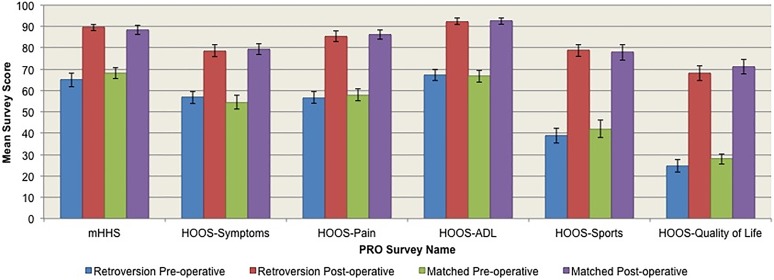
Results: There were no differences in age, sex, or body mass index between 39 hips treated for global acetabular retroversion and 39 hips treated for focal pincer-type FAI. There were no major or minor complications in either group. Patients who underwent arthroscopic treatment for global acetabular retroversion demonstrated similar significant improvements in postoperative PRO scores (scores increased by 17 to 43 points) as patients who underwent arthroscopic treatment for focal pincer-type FAI. Patients treated for retroversion who also underwent subspine decompression had greater improvement than patients who did not undergo subspine decompression for the HOOS-Pain (33.7 ± 15.3 vs 22.5 ± 17.6, respectively; P = .046) and HOOS-Quality of Life (49.7 ± 18.8 vs 34.6 ± 22.0, respectively; P = .030) scores.
Conclusion: Arthroscopic treatment for acetabular retroversion is safe and provides significant clinical improvement similar to arthroscopic treatment for pincer-type FAI. Patients with acetabular retroversion who also underwent arthroscopic subspine decompression demonstrated greater improvements in pain and quality of life outcomes than those who underwent arthroscopic treatment without subspine decompression.
背景:髋臼后倾的典型治疗方法是开放性髋臼周围反向截骨术。鉴于关节镜治疗股髋臼撞击(FAI)的低发病率和近期的成功,关节镜治疗髋臼后翻也可能有一定的作用。然而,髋关节镜手术治疗后的安全性和结果需要进一步研究,髂前下棘(棘下)撞击对后翻患者的影响目前尚不清楚。假设:关节镜治疗整体髋臼后翻是安全的,与接受关节镜治疗局灶性钳型FAI的匹配组相比,患者的结果相似。研究设计:队列研究;证据等级2。方法:前瞻性纳入接受髋关节镜手术治疗症状性全髋臼后翻的患者,并与接受关节镜手术治疗局灶性钳型FAI的匹配组患者进行比较。两组均采用相同的关节镜治疗方案。所有患者均接受患者报告结果(PRO)测量,包括12项简短健康调查(SF-12)身体成分总结(PCS)和精神成分总结(MCS)、改良Harris髋关节评分(mHHS)、髋关节残疾和骨关节炎结局评分(HOOS)以及术前和术后1年疼痛的视觉模拟量表(VAS)。结果:39例髋臼整体后翻和39例局灶性钳型FAI患者的年龄、性别和体重指数均无差异。两组均无重大或轻微并发症。接受关节镜治疗整体髋臼后翻的患者与接受关节镜治疗局灶钳型FAI的患者在术后PRO评分方面表现出类似的显著改善(评分增加17至43分)。同时接受脊柱下减压的后退患者比未接受脊柱下减压的患者改善更大(分别为33.7±15.3 vs 22.5±17.6);P = 0.046)和hos -生活质量(分别为49.7±18.8 vs 34.6±22.0);P = .030)得分。结论:关节镜下治疗髋臼后翻是安全的,与关节镜下治疗钳型FAI有明显的临床改善。髋臼后翻患者同时接受关节镜下脊柱下减压,与不接受关节镜下脊柱下减压的患者相比,在疼痛和生活质量方面有更大的改善。
期刊介绍:
The Orthopaedic Journal of Sports Medicine (OJSM), developed by the American Orthopaedic Society for Sports Medicine (AOSSM), is a global, peer-reviewed, open access journal that combines the interests of researchers and clinical practitioners across orthopaedic sports medicine, arthroscopy, and knee arthroplasty.
Topics include original research in the areas of:
-Orthopaedic Sports Medicine, including surgical and nonsurgical treatment of orthopaedic sports injuries
-Arthroscopic Surgery (Shoulder/Elbow/Wrist/Hip/Knee/Ankle/Foot)
-Relevant translational research
-Sports traumatology/epidemiology
-Knee and shoulder arthroplasty
The OJSM also publishes relevant systematic reviews and meta-analyses.
This journal is a member of the Committee on Publication Ethics (COPE).




 京公网安备 11010802042870号
京ICP备2023020795号-1
京公网安备 11010802042870号
京ICP备2023020795号-1

 分享
分享
 求助内容:
求助内容: 应助结果提醒方式:
 扫码关注我们
