Abhinaba Chatterjee, Samprit Banerjee, Cheryl Stein, Min-Hyung Kim, Joseph DeFerio, Jyotishman Pathak
{"title":"Risk Factors for Depression Among Civilians After the 9/11 World Trade Center Terrorist Attacks: A Systematic Review and Meta-Analysis.","authors":"Abhinaba Chatterjee, Samprit Banerjee, Cheryl Stein, Min-Hyung Kim, Joseph DeFerio, Jyotishman Pathak","doi":"10.1371/currents.dis.6a00b40c8ace0a6a0017361d7577c50a","DOIUrl":null,"url":null,"abstract":"<p><strong>Introduction: </strong>The development of depressive symptoms among the population of civilians who were not directly involved in recovery or rescue efforts following the 9/11 World Trade Center (WTC) terrorist attacks is not comprehensively understood. We performed a meta-analysis that examined the associations between multiple risk factors and depressive symptoms after the 9/11 WTC terrorist attacks in New York City among civilians including survivors, residents, and passersby.</p><p><strong>Methods: </strong>PubMed, Google Scholar, and the Cochrane Library were searched from September, 2001 through July, 2016. Reviewers identified eligible studies and synthesized odds ratios (ORs) using a random-effects model.</p><p><strong>Results: </strong>The meta-analysis included findings from 7 studies (29,930 total subjects). After adjusting for multiple comparisons, depressive symptoms were significantly associated with minority race/ethnicity (OR, 1.40; 99.5% Confidence Interval [CI], 1.04 to 1.88), lower income level (OR, 1.25; 99.5% CI, 1.09 to 1.43), post-9/11 social isolation (OR, 1.68; 99.5% CI, 1.13 to 2.49), post-9/11 change in employment (OR, 2.06; 99.5% CI, 1.30 to 3.26), not being married post-9/11 (OR, 1.59; 99.5% CI, 1.18 to 2.15), and knowing someone injured or killed (OR, 2.02; 99.5% CI, 1.42 to 2.89). Depressive symptoms were not significantly associated with greater age (OR, 0.86; 99.5% CI, 0.70 to 1.05), no college degree (OR, 1.32; 99.5% CI, 0.96 to 1.83), female sex (OR, 1.24; 99.5% CI, 0.98 to 1.59), or direct exposure to WTC related traumatic events (OR, 1.26; 99.5% CI, 0.69 to 2.30).</p><p><strong>Discussion: </strong>Findings from this study suggest that lack of post-disaster social capital was most strongly associated with depressive symptoms among the civilian population after the 9/11 WTC terrorist attacks, followed by bereavement and lower socioeconomic status. These risk factors should be identified among civilians in future disaster response efforts.</p>","PeriodicalId":74464,"journal":{"name":"PLoS currents","volume":"10 ","pages":""},"PeriodicalIF":0.0000,"publicationDate":"2018-03-30","publicationTypes":"Journal Article","fieldsOfStudy":null,"isOpenAccess":false,"openAccessPdf":"https://www.ncbi.nlm.nih.gov/pmc/articles/PMC5898905/pdf/","citationCount":"0","resultStr":null,"platform":"Semanticscholar","paperid":null,"PeriodicalName":"PLoS currents","FirstCategoryId":"1085","ListUrlMain":"https://doi.org/10.1371/currents.dis.6a00b40c8ace0a6a0017361d7577c50a","RegionNum":0,"RegionCategory":null,"ArticlePicture":[],"TitleCN":null,"AbstractTextCN":null,"PMCID":null,"EPubDate":"","PubModel":"","JCR":"","JCRName":"","Score":null,"Total":0}
引用次数: 0
Abstract
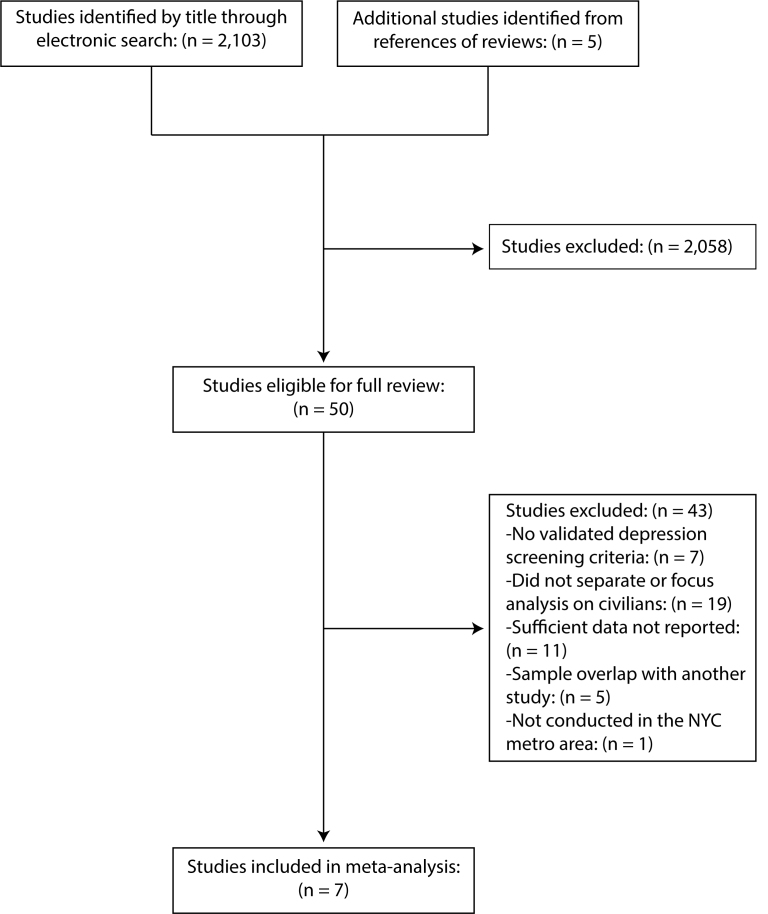
Introduction: The development of depressive symptoms among the population of civilians who were not directly involved in recovery or rescue efforts following the 9/11 World Trade Center (WTC) terrorist attacks is not comprehensively understood. We performed a meta-analysis that examined the associations between multiple risk factors and depressive symptoms after the 9/11 WTC terrorist attacks in New York City among civilians including survivors, residents, and passersby.
Methods: PubMed, Google Scholar, and the Cochrane Library were searched from September, 2001 through July, 2016. Reviewers identified eligible studies and synthesized odds ratios (ORs) using a random-effects model.
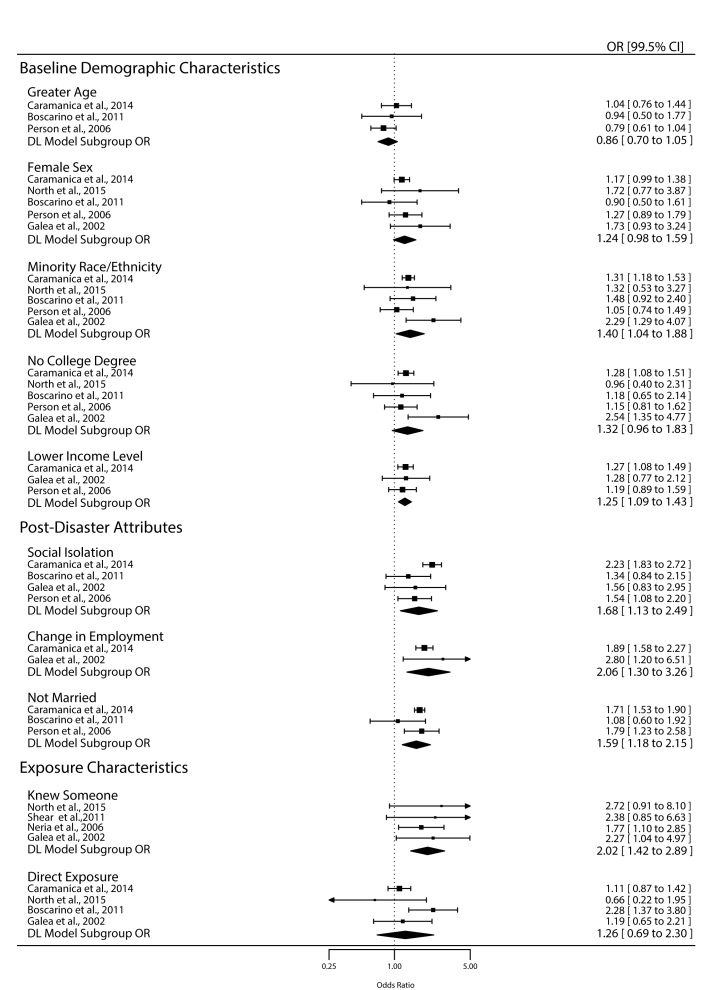
Results: The meta-analysis included findings from 7 studies (29,930 total subjects). After adjusting for multiple comparisons, depressive symptoms were significantly associated with minority race/ethnicity (OR, 1.40; 99.5% Confidence Interval [CI], 1.04 to 1.88), lower income level (OR, 1.25; 99.5% CI, 1.09 to 1.43), post-9/11 social isolation (OR, 1.68; 99.5% CI, 1.13 to 2.49), post-9/11 change in employment (OR, 2.06; 99.5% CI, 1.30 to 3.26), not being married post-9/11 (OR, 1.59; 99.5% CI, 1.18 to 2.15), and knowing someone injured or killed (OR, 2.02; 99.5% CI, 1.42 to 2.89). Depressive symptoms were not significantly associated with greater age (OR, 0.86; 99.5% CI, 0.70 to 1.05), no college degree (OR, 1.32; 99.5% CI, 0.96 to 1.83), female sex (OR, 1.24; 99.5% CI, 0.98 to 1.59), or direct exposure to WTC related traumatic events (OR, 1.26; 99.5% CI, 0.69 to 2.30).
Discussion: Findings from this study suggest that lack of post-disaster social capital was most strongly associated with depressive symptoms among the civilian population after the 9/11 WTC terrorist attacks, followed by bereavement and lower socioeconomic status. These risk factors should be identified among civilians in future disaster response efforts.



 京公网安备 11010802042870号
京ICP备2023020795号-1
京公网安备 11010802042870号
京ICP备2023020795号-1

 分享
分享

 求助内容:
求助内容: 应助结果提醒方式:
 扫码关注我们
