Protective efficacy of various carbonyl compounds and their metabolites, and nutrients against acute toxicity of some cyanogens in rats: biochemical and physiological studies.
Rahul Bhattacharya, Niranjan L Gujar, Deo Kumar, Jebin Jacob John
{"title":"Protective efficacy of various carbonyl compounds and their metabolites, and nutrients against acute toxicity of some cyanogens in rats: biochemical and physiological studies.","authors":"Rahul Bhattacharya, Niranjan L Gujar, Deo Kumar, Jebin Jacob John","doi":"10.1515/intox-2017-0001","DOIUrl":null,"url":null,"abstract":"<p><p>Cyanogens are widely used in industries and their toxicity is mainly due to cyanogenesis. The antidotes for cyanide are usually instituted for the management of cyanogen poisoning. The present study reports the protective efficacy of 14 carbonyl compounds and their metabolites, and nutrients (1.0 g/kg; oral; +5 min) against acute oral toxicity of acetonitrile (ATCN), acrylonitrile (ACN), malononitrile (MCN), propionitrile (PCN), sodium nitroprusside (SNP), succinonitrile (SCN), and potassium ferricyanide (PFCN) in rats. Maximum protection index was observed for alpha-ketoglutarate (A-KG) against MCN and PCN (5.60), followed by dihydroxyacetone (DHA) against MCN (2.79). Further, MCN (0.75 LD50) caused significant increase in cyanide concentration in brain, liver and kidney and inhibition of cytochrome c oxidase activity in brain and liver, which favorably responded to A-KG and DHA treatment. Up-regulation of inducible nitric oxide synthase by MCN, PCN and SNP, and uncoupling protein by PCN and SNP observed in the brain was abolished by A-KG administration. However, no DNA damage was detected in the brain. MCN and SNP significantly decreased the mean arterial pressure, heart rate, respiratory rate and neuromuscular transmission, which were resolved by A-KG. The study suggests a beneficial effect of A-KG in the treatment of acute cyanogen poisoning.</p>","PeriodicalId":13715,"journal":{"name":"Interdisciplinary Toxicology","volume":"10 1","pages":"1-10"},"PeriodicalIF":0.0000,"publicationDate":"2017-09-01","publicationTypes":"Journal Article","fieldsOfStudy":null,"isOpenAccess":false,"openAccessPdf":"https://ftp.ncbi.nlm.nih.gov/pub/pmc/oa_pdf/6b/8e/ITX-10-1.PMC6096866.pdf","citationCount":"2","resultStr":null,"platform":"Semanticscholar","paperid":null,"PeriodicalName":"Interdisciplinary Toxicology","FirstCategoryId":"1085","ListUrlMain":"https://doi.org/10.1515/intox-2017-0001","RegionNum":0,"RegionCategory":null,"ArticlePicture":[],"TitleCN":null,"AbstractTextCN":null,"PMCID":null,"EPubDate":"","PubModel":"","JCR":"Q3","JCRName":"Environmental Science","Score":null,"Total":0}
引用次数: 2
Abstract
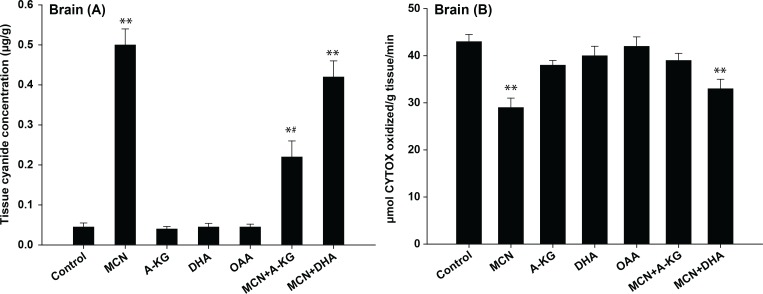
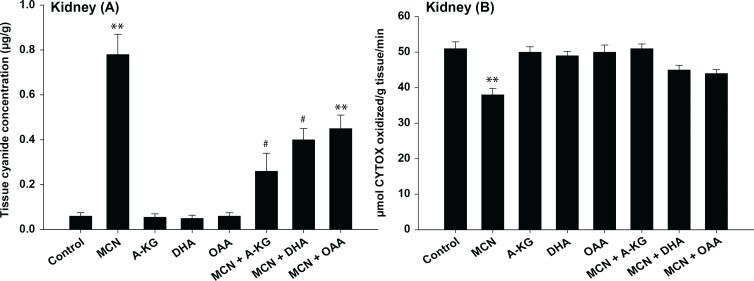
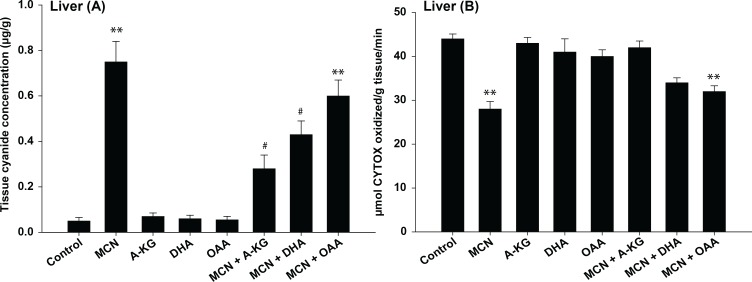
Cyanogens are widely used in industries and their toxicity is mainly due to cyanogenesis. The antidotes for cyanide are usually instituted for the management of cyanogen poisoning. The present study reports the protective efficacy of 14 carbonyl compounds and their metabolites, and nutrients (1.0 g/kg; oral; +5 min) against acute oral toxicity of acetonitrile (ATCN), acrylonitrile (ACN), malononitrile (MCN), propionitrile (PCN), sodium nitroprusside (SNP), succinonitrile (SCN), and potassium ferricyanide (PFCN) in rats. Maximum protection index was observed for alpha-ketoglutarate (A-KG) against MCN and PCN (5.60), followed by dihydroxyacetone (DHA) against MCN (2.79). Further, MCN (0.75 LD50) caused significant increase in cyanide concentration in brain, liver and kidney and inhibition of cytochrome c oxidase activity in brain and liver, which favorably responded to A-KG and DHA treatment. Up-regulation of inducible nitric oxide synthase by MCN, PCN and SNP, and uncoupling protein by PCN and SNP observed in the brain was abolished by A-KG administration. However, no DNA damage was detected in the brain. MCN and SNP significantly decreased the mean arterial pressure, heart rate, respiratory rate and neuromuscular transmission, which were resolved by A-KG. The study suggests a beneficial effect of A-KG in the treatment of acute cyanogen poisoning.




 京公网安备 11010802042870号
京ICP备2023020795号-1
京公网安备 11010802042870号
京ICP备2023020795号-1

 分享
分享
 求助内容:
求助内容: 应助结果提醒方式:
 扫码关注我们
