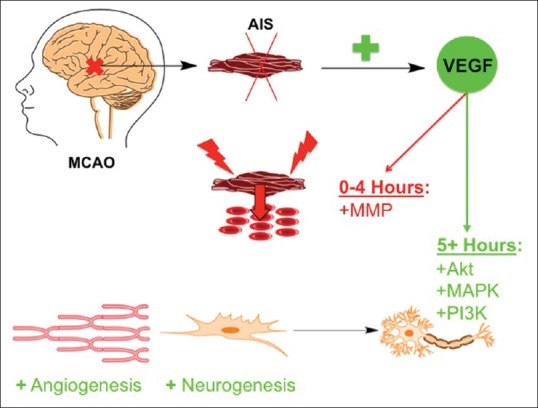
{"title":"The role of vascular endothelial growth factor in angiogenesis and brain circulation after stroke.","authors":"Eric Eugene Paul Cosky, Yuchuan Ding","doi":"10.4103/bc.bc_8_18","DOIUrl":null,"url":null,"abstract":"The process of angiogenesis is paramount in blood vessel recovery and regeneration after a cerebrovascular accident. The reparative role of angiogenesis in the maintenance of brain circulation after an acute ischemic stroke (AIS) episode is mediated by cellular signaling cascades orchestrated through many molecules including an essential protein regulator of angiogenesis known as vascular endothelial growth factor (VEGF).[1] The use of VEGF as a molecular target for therapeutic treatment of AIS events is complex, and its application involves an intricate timeline to minimize nervous system tissue damage and maximize blood vessel restoration. There are numerous ongoing investigations aimed at better understanding the cellular and molecular mechanisms of VEGF in the setting of AIS. These clinical and scientific studies have similar long-term goals, such as the development of rational drug therapies, including monoclonal antibodies and stem cells, and the improvement of patients’ functional outcomes and rehabilitative times.","PeriodicalId":9288,"journal":{"name":"Brain Circulation","volume":"4 2","pages":"73-75"},"PeriodicalIF":4.8000,"publicationDate":"2018-04-01","publicationTypes":"Journal Article","fieldsOfStudy":null,"isOpenAccess":false,"openAccessPdf":"https://ftp.ncbi.nlm.nih.gov/pub/pmc/oa_pdf/16/ea/BC-4-73.PMC6126238.pdf","citationCount":"16","resultStr":null,"platform":"Semanticscholar","paperid":null,"PeriodicalName":"Brain Circulation","FirstCategoryId":"3","ListUrlMain":"https://doi.org/10.4103/bc.bc_8_18","RegionNum":4,"RegionCategory":"医学","ArticlePicture":[],"TitleCN":null,"AbstractTextCN":null,"PMCID":null,"EPubDate":"2018/6/29 0:00:00","PubModel":"Epub","JCR":"Q3","JCRName":"CLINICAL NEUROLOGY","Score":null,"Total":0}
引用次数: 16
Abstract
The process of angiogenesis is paramount in blood vessel recovery and regeneration after a cerebrovascular accident. The reparative role of angiogenesis in the maintenance of brain circulation after an acute ischemic stroke (AIS) episode is mediated by cellular signaling cascades orchestrated through many molecules including an essential protein regulator of angiogenesis known as vascular endothelial growth factor (VEGF).[1] The use of VEGF as a molecular target for therapeutic treatment of AIS events is complex, and its application involves an intricate timeline to minimize nervous system tissue damage and maximize blood vessel restoration. There are numerous ongoing investigations aimed at better understanding the cellular and molecular mechanisms of VEGF in the setting of AIS. These clinical and scientific studies have similar long-term goals, such as the development of rational drug therapies, including monoclonal antibodies and stem cells, and the improvement of patients’ functional outcomes and rehabilitative times.




 京公网安备 11010802042870号
京ICP备2023020795号-1
京公网安备 11010802042870号
京ICP备2023020795号-1

 分享
分享
 求助内容:
求助内容: 应助结果提醒方式:
 扫码关注我们
