Rana El Hajj, Hanady Bou Youness, Laurence Lachaud, Patrick Bastien, Carine Masquefa, Pierre-Antoine Bonnet, Hiba El Hajj, Ibrahim Khalifeh
{"title":"EAPB0503: An Imiquimod analog with potent in vitro activity against cutaneous leishmaniasis caused by Leishmania major and Leishmania tropica.","authors":"Rana El Hajj, Hanady Bou Youness, Laurence Lachaud, Patrick Bastien, Carine Masquefa, Pierre-Antoine Bonnet, Hiba El Hajj, Ibrahim Khalifeh","doi":"10.1371/journal.pntd.0006854","DOIUrl":null,"url":null,"abstract":"<p><p>Cutaneous Leishmaniasis (CL) is a parasitic infection classified by the WHO as one of the most uncontrolled spreading neglected diseases. Syria is endemic for Leishmania tropica and Leishmania major, causing CL in the Eastern Mediterranean. The large-scale displacement of Syrian refugees exacerbated the spread of CL into neighboring countries. Therapeutic interventions against CL include local, systemic and physical treatments. The high risk for drug-resistance to current treatments stresses the need for new therapies. Imiquimod is an immunomodulatory drug with a tested efficacy against L. major species. Yet, Imiquimod efficacy against L. tropica and the molecular mechanisms dictating its potency are still underexplored. In this study, we characterized the effect of Imiquimod against L. tropica and L. major, and characterized the molecular mechanisms dictating its anti-leishmanial efficacy against both strains. We also investigated the potency and molecular mechanisms of an Imiquimod analog, EAPB0503, against these two strains. We have tested the effect of Imiquimod and EAPB0503 on macrophages infected with either L. major, L. tropica strains, or patient-derived freshly isolated L. tropica parasites. The anti-amastigote activity of either drugs was assessed by quantitative real time PCR (RT-PCR) using kinetoplast specific primers, confocal microscopy using the Glycoprotein 63 (Gp63) Leishmania amastigote antibody or by histology staining. The mechanism of action of either drugs on the canonical nuclear factor kappa- B (NF-κB) pathway was determined by western blot, and confocal microscopy. The immune production of cytokines upon treatment of infected macrophages with either drugs was assessed by ELISA. Both drugs reduced amastigote replication. EAPB0503 proved more potent, particularly on the wild type L. tropica amastigotes. Toll-Like Receptor-7 was upregulated, mainly by Imiquimod, and to a lesser extent by EAPB0503. Both drugs activated the NF-κB canonical pathway triggering an immune response and i-NOS upregulation in infected macrophages. Our findings establish Imiquimod as a strong candidate for treating L. tropica and show the higher potency of its analog EAPB0503 against CL.</p>","PeriodicalId":20260,"journal":{"name":"PLoS Neglected Tropical Diseases","volume":"12 11","pages":"e0006854"},"PeriodicalIF":3.4000,"publicationDate":"2018-11-21","publicationTypes":"Journal Article","fieldsOfStudy":null,"isOpenAccess":false,"openAccessPdf":"https://sci-hub-pdf.com/10.1371/journal.pntd.0006854","citationCount":"24","resultStr":null,"platform":"Semanticscholar","paperid":null,"PeriodicalName":"PLoS Neglected Tropical Diseases","FirstCategoryId":"3","ListUrlMain":"https://doi.org/10.1371/journal.pntd.0006854","RegionNum":2,"RegionCategory":"医学","ArticlePicture":[],"TitleCN":null,"AbstractTextCN":null,"PMCID":null,"EPubDate":"2018/11/1 0:00:00","PubModel":"eCollection","JCR":"Q1","JCRName":"Medicine","Score":null,"Total":0}
引用次数: 24
Abstract
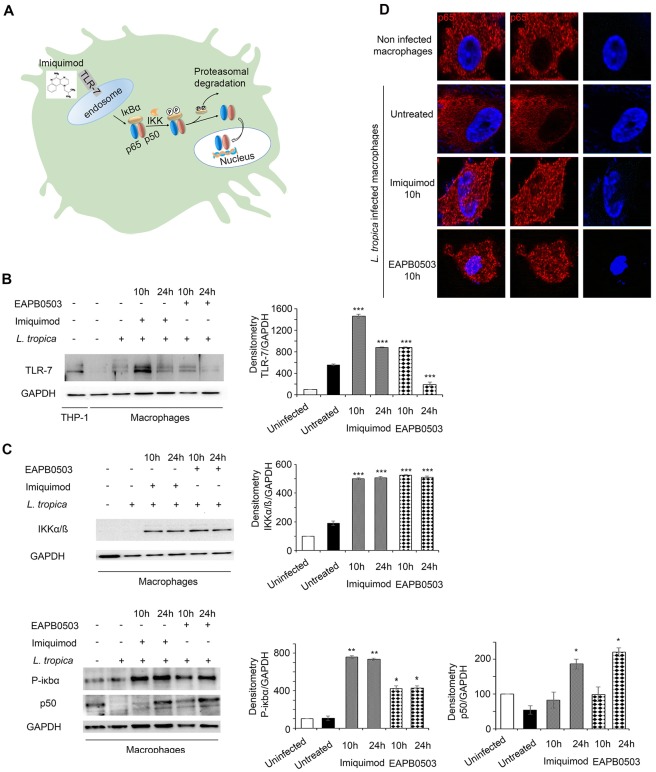
Cutaneous Leishmaniasis (CL) is a parasitic infection classified by the WHO as one of the most uncontrolled spreading neglected diseases. Syria is endemic for Leishmania tropica and Leishmania major, causing CL in the Eastern Mediterranean. The large-scale displacement of Syrian refugees exacerbated the spread of CL into neighboring countries. Therapeutic interventions against CL include local, systemic and physical treatments. The high risk for drug-resistance to current treatments stresses the need for new therapies. Imiquimod is an immunomodulatory drug with a tested efficacy against L. major species. Yet, Imiquimod efficacy against L. tropica and the molecular mechanisms dictating its potency are still underexplored. In this study, we characterized the effect of Imiquimod against L. tropica and L. major, and characterized the molecular mechanisms dictating its anti-leishmanial efficacy against both strains. We also investigated the potency and molecular mechanisms of an Imiquimod analog, EAPB0503, against these two strains. We have tested the effect of Imiquimod and EAPB0503 on macrophages infected with either L. major, L. tropica strains, or patient-derived freshly isolated L. tropica parasites. The anti-amastigote activity of either drugs was assessed by quantitative real time PCR (RT-PCR) using kinetoplast specific primers, confocal microscopy using the Glycoprotein 63 (Gp63) Leishmania amastigote antibody or by histology staining. The mechanism of action of either drugs on the canonical nuclear factor kappa- B (NF-κB) pathway was determined by western blot, and confocal microscopy. The immune production of cytokines upon treatment of infected macrophages with either drugs was assessed by ELISA. Both drugs reduced amastigote replication. EAPB0503 proved more potent, particularly on the wild type L. tropica amastigotes. Toll-Like Receptor-7 was upregulated, mainly by Imiquimod, and to a lesser extent by EAPB0503. Both drugs activated the NF-κB canonical pathway triggering an immune response and i-NOS upregulation in infected macrophages. Our findings establish Imiquimod as a strong candidate for treating L. tropica and show the higher potency of its analog EAPB0503 against CL.
期刊介绍:
PLOS Neglected Tropical Diseases publishes research devoted to the pathology, epidemiology, prevention, treatment and control of the neglected tropical diseases (NTDs), as well as relevant public policy.
The NTDs are defined as a group of poverty-promoting chronic infectious diseases, which primarily occur in rural areas and poor urban areas of low-income and middle-income countries. Their impact on child health and development, pregnancy, and worker productivity, as well as their stigmatizing features limit economic stability.
All aspects of these diseases are considered, including:
Pathogenesis
Clinical features
Pharmacology and treatment
Diagnosis
Epidemiology
Vector biology
Vaccinology and prevention
Demographic, ecological and social determinants
Public health and policy aspects (including cost-effectiveness analyses).





 京公网安备 11010802042870号
京ICP备2023020795号-1
京公网安备 11010802042870号
京ICP备2023020795号-1

 分享
分享
 求助内容:
求助内容: 应助结果提醒方式:
 扫码关注我们
