V Mazzarello, M G Donadu, M Ferrari, G Piga, D Usai, S Zanetti, M A Sotgiu
{"title":"Treatment of acne with a combination of propolis, tea tree oil, and <i>Aloe vera</i> compared to erythromycin cream: two double-blind investigations.","authors":"V Mazzarello, M G Donadu, M Ferrari, G Piga, D Usai, S Zanetti, M A Sotgiu","doi":"10.2147/CPAA.S180474","DOIUrl":null,"url":null,"abstract":"Introduction\nAntibiotics that suppress Propionibacterium acnes are the standard treatment for acne but are becoming less effective, due to the appearance of antibiotic-resistant strains. Many plants are known to have innate antimicrobial action and can be used as alternatives to antibiotics; thus, it is necessary to prove their effectiveness in vivo. This study aimed to evaluate the anti-acne efficacy of a new cream based on three natural extracts, comparing it to erythromycin cream and placebo.\n\n\nPatients and methods\nSixty patients with mild to moderate acne vulgaris were randomly divided into three groups: treated with cream containing 20% propolis, 3% \"tea tree oil\", and 10% \"Aloe vera\" (PTAC) (n=20); or with 3 % erythromycin cream (ERC) (n=20); or with placebo (n=20). At baseline, after 15 and 30 days, investigators evaluated response to treatment by counting acne lesions through noninvasive measurements and macrophotography.\n\n\nResults\nAll the clinical and instrumental values studied were statistically different from placebo except for sebometry, pHmetry, and erythema index values, measured on healthy skin. Unlike in the placebo group, papular and scar lesions showed high erythema reduction after 15 and 30 days of PTAC and ERC application.\n\n\nConclusion\nThe PTAC formulation was better than ERC in reducing erythema scars, acne severity index, and total lesion count.","PeriodicalId":10406,"journal":{"name":"Clinical Pharmacology : Advances and Applications","volume":"10 ","pages":"175-181"},"PeriodicalIF":2.5000,"publicationDate":"2018-12-13","publicationTypes":"Journal Article","fieldsOfStudy":null,"isOpenAccess":false,"openAccessPdf":"https://sci-hub-pdf.com/10.2147/CPAA.S180474","citationCount":"44","resultStr":null,"platform":"Semanticscholar","paperid":null,"PeriodicalName":"Clinical Pharmacology : Advances and Applications","FirstCategoryId":"1085","ListUrlMain":"https://doi.org/10.2147/CPAA.S180474","RegionNum":0,"RegionCategory":null,"ArticlePicture":[],"TitleCN":null,"AbstractTextCN":null,"PMCID":null,"EPubDate":"2018/1/1 0:00:00","PubModel":"eCollection","JCR":"Q2","JCRName":"PHARMACOLOGY & PHARMACY","Score":null,"Total":0}
引用次数: 44
Abstract
Introduction
Antibiotics that suppress Propionibacterium acnes are the standard treatment for acne but are becoming less effective, due to the appearance of antibiotic-resistant strains. Many plants are known to have innate antimicrobial action and can be used as alternatives to antibiotics; thus, it is necessary to prove their effectiveness in vivo. This study aimed to evaluate the anti-acne efficacy of a new cream based on three natural extracts, comparing it to erythromycin cream and placebo.
Patients and methods
Sixty patients with mild to moderate acne vulgaris were randomly divided into three groups: treated with cream containing 20% propolis, 3% "tea tree oil", and 10% "Aloe vera" (PTAC) (n=20); or with 3 % erythromycin cream (ERC) (n=20); or with placebo (n=20). At baseline, after 15 and 30 days, investigators evaluated response to treatment by counting acne lesions through noninvasive measurements and macrophotography.
Results
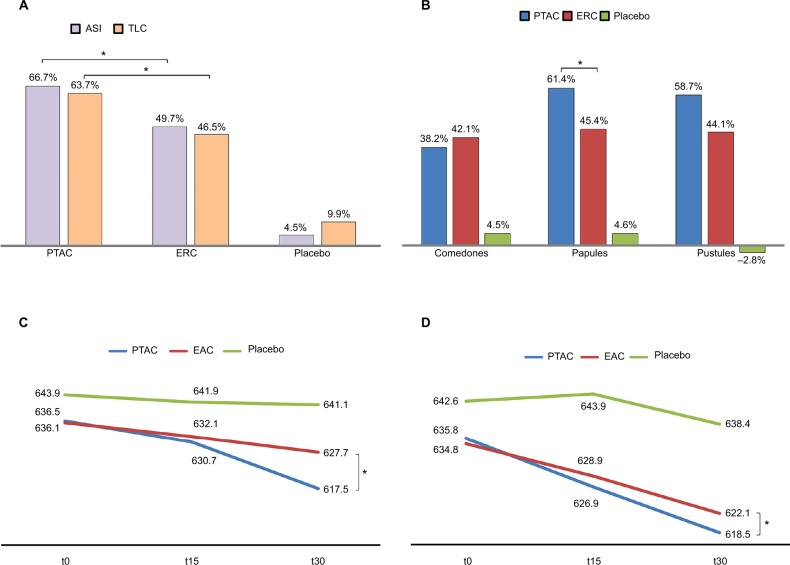
All the clinical and instrumental values studied were statistically different from placebo except for sebometry, pHmetry, and erythema index values, measured on healthy skin. Unlike in the placebo group, papular and scar lesions showed high erythema reduction after 15 and 30 days of PTAC and ERC application.
Conclusion
The PTAC formulation was better than ERC in reducing erythema scars, acne severity index, and total lesion count.




 京公网安备 11010802042870号
京ICP备2023020795号-1
京公网安备 11010802042870号
京ICP备2023020795号-1

 分享
分享
 求助内容:
求助内容: 应助结果提醒方式:
 扫码关注我们
