Reza Ebrahimzadeh-Vesal , Atieh Teymoori , Ali Mohammad Dourandish , Mohsen Azimi-Nezhad
{"title":"Identification of a novel nonsense mutation in kyphoscoliosis peptidase gene in an Iranian patient with myofibrillar myopathy","authors":"Reza Ebrahimzadeh-Vesal , Atieh Teymoori , Ali Mohammad Dourandish , Mohsen Azimi-Nezhad","doi":"10.1016/j.gendis.2018.09.004","DOIUrl":null,"url":null,"abstract":"<div><p>Myofibrillar myopathies (MFMs) are rare genetic and slowly progressive neuromuscular disorders. Several pathogenic mutations have been reported in MFM-related genes including <em>DES</em>, <em>CRYAB</em>, <em>MYOT</em>, <em>LDB3</em> or <em>ZASP</em>, <em>FLNC</em>, <em>BAG3</em>, <em>FHL1</em> and <em>DNAJB6</em>. Although MFMs is commonly inherited in an autosomal dominant manner, the inheritance pattern and novel mutated genes are not thoroughly elucidated in some cases. Here, we report discovery of a novel nonsense mutation in a 29-year-old Iranian male patient with motor disorders and deformity in his lower limbs. His parents are second cousins. Hereditary Motor Sensory Neuropathy as initial genetic diagnosis was ruled out. Whole exome sequencing using NGS on Illumina HiSeq4000 platform was performed to identify the disease and possible mutated gene(s). Our data analysis identified a homozygous nonsense unreported c.C415T (p.R139X) variant on kyphoscoliosis peptidase (<em>KY</em>) gene (NM_178554: exon4). Sanger sequencing of this mutation has been performed for his other related family members. Sequencing and segregation analysis was confirmed the NGS results and autosomal recessive inheritance pattern of the disease.</p></div>","PeriodicalId":12689,"journal":{"name":"Genes & Diseases","volume":"5 4","pages":"Pages 331-334"},"PeriodicalIF":9.4000,"publicationDate":"2018-12-01","publicationTypes":"Journal Article","fieldsOfStudy":null,"isOpenAccess":false,"openAccessPdf":"https://sci-hub-pdf.com/10.1016/j.gendis.2018.09.004","citationCount":"5","resultStr":null,"platform":"Semanticscholar","paperid":null,"PeriodicalName":"Genes & Diseases","FirstCategoryId":"3","ListUrlMain":"https://www.sciencedirect.com/science/article/pii/S2352304218301119","RegionNum":2,"RegionCategory":"医学","ArticlePicture":[],"TitleCN":null,"AbstractTextCN":null,"PMCID":null,"EPubDate":"","PubModel":"","JCR":"Q1","JCRName":"BIOCHEMISTRY & MOLECULAR BIOLOGY","Score":null,"Total":0}
引用次数: 5
Abstract
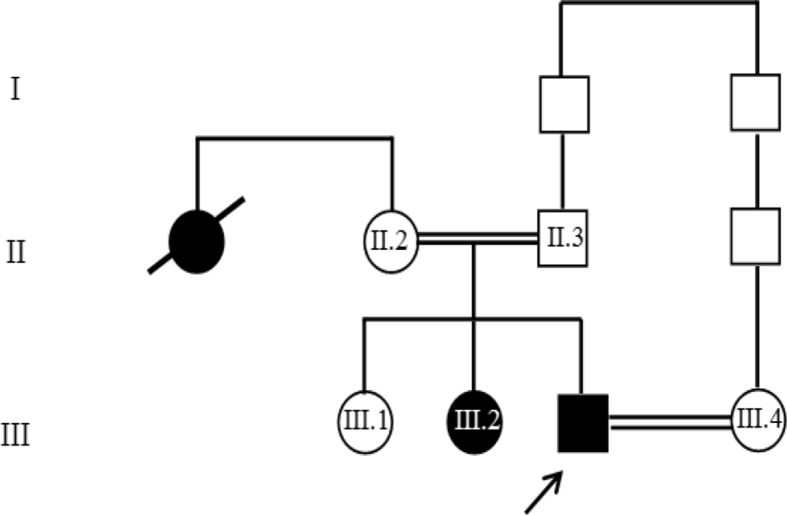
Myofibrillar myopathies (MFMs) are rare genetic and slowly progressive neuromuscular disorders. Several pathogenic mutations have been reported in MFM-related genes including DES, CRYAB, MYOT, LDB3 or ZASP, FLNC, BAG3, FHL1 and DNAJB6. Although MFMs is commonly inherited in an autosomal dominant manner, the inheritance pattern and novel mutated genes are not thoroughly elucidated in some cases. Here, we report discovery of a novel nonsense mutation in a 29-year-old Iranian male patient with motor disorders and deformity in his lower limbs. His parents are second cousins. Hereditary Motor Sensory Neuropathy as initial genetic diagnosis was ruled out. Whole exome sequencing using NGS on Illumina HiSeq4000 platform was performed to identify the disease and possible mutated gene(s). Our data analysis identified a homozygous nonsense unreported c.C415T (p.R139X) variant on kyphoscoliosis peptidase (KY) gene (NM_178554: exon4). Sanger sequencing of this mutation has been performed for his other related family members. Sequencing and segregation analysis was confirmed the NGS results and autosomal recessive inheritance pattern of the disease.
期刊介绍:
Genes & Diseases is an international journal for molecular and translational medicine. The journal primarily focuses on publishing investigations on the molecular bases and experimental therapeutics of human diseases. Publication formats include full length research article, review article, short communication, correspondence, perspectives, commentary, views on news, and research watch.
Aims and Scopes
Genes & Diseases publishes rigorously peer-reviewed and high quality original articles and authoritative reviews that focus on the molecular bases of human diseases. Emphasis will be placed on hypothesis-driven, mechanistic studies relevant to pathogenesis and/or experimental therapeutics of human diseases. The journal has worldwide authorship, and a broad scope in basic and translational biomedical research of molecular biology, molecular genetics, and cell biology, including but not limited to cell proliferation and apoptosis, signal transduction, stem cell biology, developmental biology, gene regulation and epigenetics, cancer biology, immunity and infection, neuroscience, disease-specific animal models, gene and cell-based therapies, and regenerative medicine.





 京公网安备 11010802042870号
京ICP备2023020795号-1
京公网安备 11010802042870号
京ICP备2023020795号-1

 分享
分享
 求助内容:
求助内容: 应助结果提醒方式:
 扫码关注我们
